A Kremlin shake-up of Russia's Defense Ministry comes at a key moment in the Ukraine war
May 13, 2024
Over the weekend, President Vladimir Putin replaced Defense Minister Sergei Shoigu — the longest serving member of his Cabinet at 11 1/2 years — in a rare Kremlin shake-up that came even as a Russian offensive in Ukraine is making gains
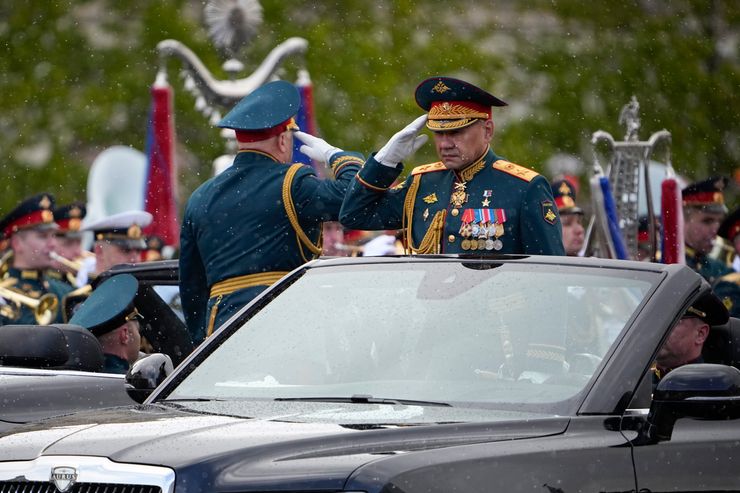
Standing in his dress uniform in the back of his Aurus convertible, Defense Minister Sergei Shoigu was driven around Red Square to review the troops during
last week's Victory Day
parade. It was to be his last inspection in that role.Over the weekend,
President Vladimir Putin replaced Shoigu
— the 68-year-old was the longest serving member of his Cabinet — in a rare Kremlin shake-up that took place even as a Russian offensive in northeastern Ukraine was making gains.Just as stunning was the choice to replace Shoigu — Andrei Belousov, a 65-year-old economics expert who has never dealt with the military or other law enforcement agencies.
Putting Belousov in charge of the Defense Ministry was seen as a way to tighten control over military spending and put the burgeoning defense sector in sync with the rest of the economy, hit hard by Western sanctions.
The reshuffle caught more than a few pundits by surprise, and some mysteries are yet to unfold.
SHOIGU’S WOES
Shoigu’s job seemed to be in jeopardy early in
the 2022 invasion
as Russia suffered battlefield setbacks that drew the ire of Russia's hawks. He and the chief of the military’s General Staff, Gen. Valery Gerasimov, were widely blamed for the failure to capture Kyiv as well as a hasty retreat by Russian troops from northeastern and southern Ukraine amid a stiff counteroffensive.Last year,
Russian mercenary chief Yevgeny Prigozhin
unleashed a blistering and profane verbal attack on Shoigu and Gerasimov, accusing them of incompetence and corruption. In June, Prigozhin launched a mutiny to demand their ouster, seizing the military headquarters in the southern city of Rostov-on-Don and sending his soldiers-for-hire on a march on Moscow that he called off hours later.Two months later, Prigozhin and his top lieutenants died in a suspicious plane crash widely seen as Kremlin payback, while Shoigu seemed to shore up his position. The Kremlin denied involvement.
Even though he has held the defense minister's job for 11 1/2 years, Shoigu's fortunes seemed to take a further downturn last month. His deputy, Timur Ivanov, was arrested on bribery charges and hauled into court still in his military uniform. Ivanov had been Shoigu’s top associate since before becoming defense minister, and Kremlin watchers saw it as a serious blow.
A SOFT LANDING
But Putin is known to abhor firings under pressure, and the staunchly loyal Shoigu — who has accompanied the president on vacations in the Siberian mountains over the years — was no exception. Shoigu got a soft landing, shifted to heading the presidential Security Council and
replacing Nikolai Patrushev
. The role is roughly similar to the U.S. national security adviser.Patrushev, a longtime hawkish and powerful member of Putin’s inner circle, will get a new appointment to be announced soon, the Kremlin said, leaving another unanswered question.
“Shoigu is moving into a respectable and powerful position because he is loyal, and he and Putin are friends,” Dara Massicot, senior fellow at the Carnegie Endowment’s Russia and Eurasia Program, said on the social media platform X.
AN ECONOMIST AS DEFENSE MINISTER
While Shoigu gets a dignified exit from the Defense Ministry, Belousov "will probably make organizational changes,” Massicot said.
Putting an economist in charge of the Defense Ministry was seen as a way of better managing what is an increasing drain on Russia's wealth as the war's third year drags on.
Kremlin spokesman Dmitry Peskov emphasized the need to integrate the military sector more closely with the economy to “put it in sync with the current dynamics.”
Belousov graduated from the economics faculty of Moscow State University and held a succession of senior government jobs before serving as Putin’s economic adviser in 2013-20. Since then, he was a deputy prime minister in charge of economic strategies, advocating stronger state controls.
Deeply religious, Belousov has talked repeatedly about needing to uphold “traditional family values” putting him in line with Putin’s conservative agenda.
When Moscow illegally annexed the Crimean Peninsula from Ukraine in 2014, Belousov reportedly was the only member of Putin’s economic team who immediately supported the move.
Belousov isn’t Russia’s first civilian defense minister. Although Shoigu loved wearing the uniform, he had no military background; before becoming the minister, he had led the Emergency Situations Ministry, responsible for civil defense and addressing natural disasters. Previous defense ministers were Anatoly Serdyukov, the head of tax police, and Sergei Ivanov, the former foreign intelligence chief.
But Belousov’s predecessors all got the job in peacetime while he takes over in what many military analysts see as a decisive moment in the war — when Russia is trying to take advantage of a slowdown in the West sending weapons to Ukraine.
EASING HAWKS' CONCERNS
The Kremlin sought to ease the widespread bewilderment over choosing Belousov as defense minister by emphasizing that Gerasimov — the chief of the General Staff — actually directs the fighting in Ukraine.
“The chief of the General Staff is in many ways the key person who reports directly to the commander-in-chief, Putin, and the minister is really just to ensure that the military have what they need,” said Mark Galeotti, head of the Mayak Intelligence consultancy.
“Having an economist, someone who has been speaking about the need to basically subordinate much of the economy to the needs of the defense sector, actually makes a certain amount of sense. It’s now essentially a financial administrator’s job,” he said in a commentary.
Galeotti said Putin could still replace Gerasimov, describing him as “unimaginative, prone to truly wasteful operations,” and “absolutely unwilling to actually tell the commander-in-chief, to tell Putin, some of the realities of war. The Ukrainians must be hoping that he stays.”
Belousov is widely expected to purge the ministry of Shoigu’s top associates -– a move that would hardly encourage stability at a key moment in the conflict.
Still, Massicot and other observers believe that some popular commanders whom Shoigu saw as rivals and tried to sideline — including Gen. Sergei Surovikin, known to have longtime links to Prigozhin and credited for building multilayered defenses that stymied Ukraine's botched counteroffensive last summer — could again get senior positions.
Sergei Markov, a pro-Kremlin political analyst, said Putin’s key motive was to rein in graft in the top brass, embodied by figures like Ivanov, who was arrested in April and accused of taking massive bribes.
“The situation with Timur Ivanov has shown that corruption has exceeded all limits,” Markov said. Another task for Belousov will be to work more closely with industries to modernize the military quickly, he added.
GIRDING FOR A LONG WAR
Putin likely expects Belousov to better integrate the Defense Ministry’s agenda with broader economic policies, according to the Institute for the Study of War, a Washington-based think-tank.
“This effort sets conditions for a fuller economic mobilization, suggesting that the Kremlin continues to prepare for a protracted war in Ukraine,” it said.
Alexandra Prokopenko of the Carnegie Russia Eurasia Center also sees Belousov’s appointment as a sign the Kremlin envisions a long war.
“Putin’s priority is war; war of attrition is won by economics,” she wrote. “Belousov is in favor of stimulating demand from the budget, which means that military spending will at least not decrease but rather increase.”