A Russian border city cancels Orthodox Epiphany events due to the threat of Ukrainian attacks
Jan 18, 2024
A Russian city near the Ukrainian border canceled its traditional Orthodox Epiphany festivities on Friday due to the threat of attacks as Kyiv’s forces pursue a new strategy with the war approaching its two-year milestone
A Russian city near the Ukrainian border canceled its traditional Orthodox Epiphany festivities on Friday due to the threat of attacks as Kyiv’s forces pursue a new strategy with
the war
approaching its two-year milestone.The city of Belgorod has scrapped events in which the faithful plunge into ponds and pools through holes in the ice on the feast of Epiphany every Jan. 19, the state news agency Tass reported, citing the regional emergencies ministry. The annual celebrations are widespread in Russia.
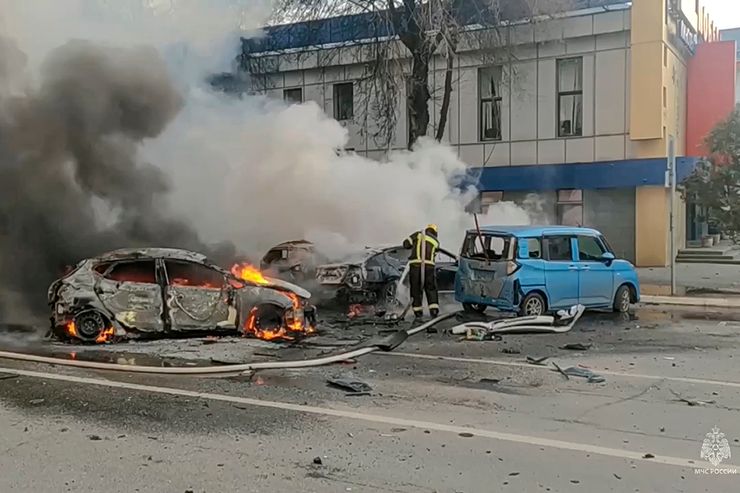
Cross-border attacks have become increasingly frequent in recent weeks in Belgorod, the largest Russian city near the border with about 340,000 people, and can be reached by relatively simple and movable weapons such as multiple rocket launchers. It is about 100 kilometers (60 miles) north of Kharkiv, Ukraine’s second-largest city.
On Dec. 30, shelling in the center of Belgorod killed 21 people and wounded 110, regional officials said, in what was
one of the deadliest attacks
on Russian soil since the start of Moscow’s full-scale invasion of its neighbor.Border villages have been
targeted sporadically during the war
by Ukrainian artillery fire, rockets, mortar shells and drones launched from dense forests, where they are hard to detect. But until Thursday, no major public events were known to have been called off.In Moscow, meanwhile, Foreign Minister Sergey Lavrov dismissed a U.S. proposal to resume a dialogue on nuclear arms control, saying it’s impossible while
Washington offers military support to Ukraine
.Speaking at an annual news conference, Lavrov accused the West of fueling global security risks by encouraging Ukraine to ramp up strikes on Russian territory and warned that Moscow will achieve its goals in the conflict despite Western assistance to Kyiv.
Ukrainian President Volodymyr Zelenskyy has pledged to hit more targets inside Russian border regions this year. The goal is to disrupt life and unsettle Russians, especially ahead of a March 17 election in Russia when President Vladimir Putin is seeking another six years in power.
Ten rockets fired from Ukraine were shot down, with one woman injured by falling wreckage, Belgorod regional Gov. Vyacheslav Gladkov said Thursday.
Long-range cross-border missile, drone and artillery strikes have been a feature of the war, especially when fighting on the front line eases off during winter.
Russian forces have repeatedly
blasted civilian areas
of Ukraine. On Thursday, a multistory building was hit in Kupiansk, in the eastern Kharkiv region, killing a 57-year-old woman and wounding two men, according to regional Gov. Oleh Syniehubov.Near Kupiansk, Russian troops also shelled the village of Maly Burluk, killing an elderly woman, Ukraine’s presidential office said. A 10-year-old boy and a 13-year-old girl were wounded, it said.
In the southern city of Kherson, shelling killed a driver in his car and a passerby on the street. Seven people were wounded in the region, including an 81-year-old woman, according to the presidential office.
It was not possible to independently verify either side’s battlefield claims.
Ukraine’s air force said it intercepted 22 out of 33 Shahed drones launched by Russia overnight. The Kremlin’s forces also fired two S-300 missiles at the Kharkiv region for the
second night in a row
, officials said.Ukraine has urged its Western allies to step up its weapon and ammunition supplies so it can keep up the battlefield pressure on Moscow.
France on Thursday announced more planned
deliveries of its Caesar artillery system
to Ukraine and said it is speeding up weapons manufacturing as it seeks to avoid depleting its own military stocks while continuing to support Kyiv.“The logic of ceding materiel taken from the armies’ stocks is reaching its end,” French Defense Minister Sébastien Lecornu told Le Parisien. “From now on, the solution is to directly connect French defense industries with the Ukrainian army.”
France also launched a drive to fund the delivery of 78 Caesar self-propelled 155 mm howitzers to Ukraine this year. Ukraine has already paid for six of the guns itself and France will provide 50 million euros ($54 million) to deliver 12 more, Lecornu said separately in a speech. France is also seeking 280 million euros ($305 million) from other allies of Ukraine to pay for the 60 other Caesars, he said.
Ukrainian Defense Minister Rustem Umerov said Russian forces are firing five times more artillery shells — 10 times more in some places — than Kyiv's forces along the front lines, and stronger artillery “is one of our key needs to win this war.”
Russian Defense Minister Sergei Shoigu, meanwhile, toured a plant near Moscow that designs and manufactures cruise missiles as part of an effort to bolster the Kremlin’s long-range arsenal.
Shoigu told factory managers who reported increasing the range of one type of missile to 250 kilometers (150 miles) that it should be increased even more, according to the Defense Ministry.
Boris Obnosov, the head of the state corporation overseeing the production of tactical missiles, said a new variant of the weapon has a range of 310 kilometers (190 miles).
“Now we need to make sure we have enough of such missiles,” Shoigu said, according to the ministry. “We spend them and score hits daily.”
___
Follow AP’s coverage of the war in Ukraine at
https://apnews.com/hub/russia-ukraine