A West Bank village feels helpless after Israeli settlers attack with fire and bullets
May 10, 2024
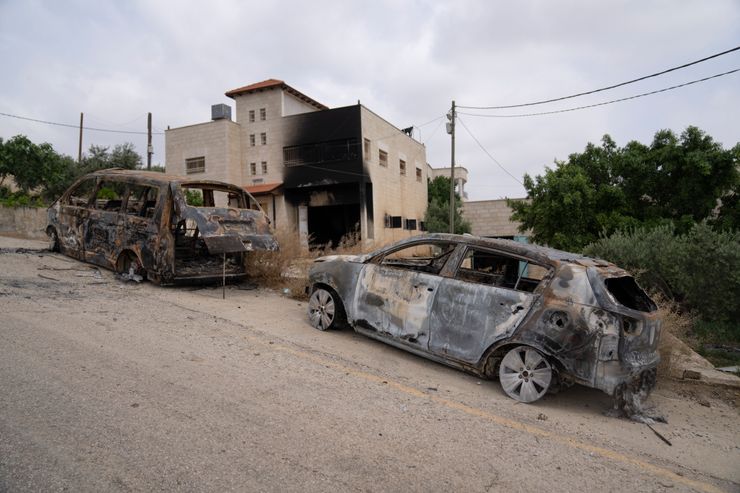
Charred homes and cars dot the hilltop West Bank village of Duma, a searing reminder of Palestinians' vulnerability to rising violence from Israeli settlers
DUMA, West Bank (AP) — Charred homes and cars dotting this hilltop village surrounded by olive groves are a searing reminder of Palestinians' vulnerability to rising violence from Israeli settlers.
The trail of wreckage along Duma's main road is the aftermath of a three-hour attack in mid-April that left 15 homes damaged by arson and six residents injured by bullets, the head of its village council said. It was one of nearly 800 settler attacks against Palestinians in the occupied West Bank since
Hamas attacked Israel
from the Gaza Strip on Oct. 7, according to the U.N.The burnt remains in Duma also highlight the village's limited resources to clean up and rebuild, let alone defend itself from future incursions, which seem inevitable as gun-toting settlers patrol the area roughly 20 miles (30 kilometers) north of Jerusalem.
“We as the village of Duma ... do not have the power to defend ourselves,” said Suleiman Dawabsha, chairman of the village council for this community of more than 2,000 people. He estimated the attack caused five million shekels ($1.3 million) in damage.
The rampage on April 13 echoed a similar event that took place
almost a decade ago
. In 2015, three Palestinians from Duma were killed, including an 18 month-old baby, after settlers fire-bombed a home there. An Israeli man was later convicted for murder.The latest attack against Duma was part of a wave of settler violence touched off by the death of a 14-year-old Israeli who went missing on the morning of April 12. Authorities found his body the next day and they have arrested a man from Duma who they say was connected to the boy's alleged murder.
On April 15, two days after the attack in Duma, two Palestinians were shot dead by settlers near the town of Aqraba, according to the Palestinian Health Ministry. And in a related spurt of violence, a man was killed by Israeli fire on April 12 in nearby al-Mughayyir, though it remains unclear whether the fatal bullet was fired by a soldier or settler.
There have been 794 settler attacks against Palestinians in the West Bank since Oct. 7 — from stones thrown at passing cars to bullets fired at residents, according to the United Nations Office for the Coordination of Humanitarian Affairs. At least 10 Palestinians have been killed by settlers in these attacks, it said.
Attacks by settlers
aren't the only form of violence
on the rise in the West Bank.Since the war in Gaza began, nearly 500 Palestinians have been killed by Israeli fire in the territory, according to the Health Ministry based in Ramallah, which says the overwhelming majority have been shot dead by soldiers. Palestinians in the West Bank have killed nine Israelis, including five soldiers, since Oct. 7, according to U.N. data.
The war has undoubtedly heightened tensions between settlers and Palestinians. But Israeli human rights groups blame the far-right government of Prime Minister Benjamin Netanyahu for fueling settler violence by promoting
an ideology of total Israeli supremacy in the West Bank
.These groups say the Israeli army doesn't do enough to stop the violence, and even facilitates it in some cases by offering the settlers protection. The Israeli army said in a statement it tries to protect everyone living in the West Bank and that complaints about soldiers are investigated.
No one was killed in the attack on Duma, but residents described narrow escapes.
Ibrahim Dawabsha, a truck driver and father of four, said most of his family hid in the kitchen as settlers launched firebombs and set part of their home ablaze.
“My daughter was at her uncle’s house, there was no one there,” he said. “What they (might) do to her I don’t know.”
The heads of Duma and al-Mughayyir said Israeli troops arrived shortly after the attacks on their communities began but did little to intervene. Instead, they fired at Palestinians attempting to confront the settlers, these officials said.
A prominent Israeli human rights group, Yesh Din, described it as an “umbrella of security” — a collaboration it says has become increasingly common since Israel's right-wing coalition government came to power in late 2022.
“As soon as the Palestinians try to protect themselves, they’re the ones who the army attacks,” said Ziv Stahl, Yesh Din’s director.
The United States has increased pressure on Israel to curb settler attacks in the West Bank,
sanctioning some leaders
, including a close ally of Israel's far-right national security minister, Itamar Ben-Gvir.Dawabsha, the chief of Duma, does not believe the pressure campaign will be effective. “I am not pinning my hopes on the American government,” he said.
Israel captured the West Bank, east Jerusalem and Gaza in the 1967 Mideast war, territories Palestinians want as part of a future state. Settlers claim the West Bank, home to some 3 million Palestinians, is their biblical birthright.
Around 500,000 Israeli settlers live across hundreds of settlements and outposts in the West Bank. These segregated and tightly guarded communities vary in size and nature. Larger settlements are akin to Jerusalem’s sprawling suburbs, while smaller unauthorized outposts can consist of just a few caravans parked on a hilltop.
Outposts often receive tacit government support and sometimes they gain formal recognition — and receive funding — from the Israeli government.
Duma's geography makes it uniquely vulnerable to attack.
Overlooking Jordan and Israeli settlements to the east, the village is surrounded more closely by at least three outposts that the head of its council says have expanded gradually over the past decade. Duma is in a section of the West Bank known as Area B: Its civil affairs are governed by the Palestinian Authority, but the Israeli military is in charge of its security.
Palestinians largely consider the PA to be ineffective and corrupt, and it rarely opposes Israel's military operations in the territory.
Over the past year, settlers have cut off Duma's access to four vital springs and wells that surround the village by sabotaging roads and other infrastructure, according to residents.
In the days following Hamas' Oct. 7 attack on southern Israel, more than 100 Bedouin Arabs that were living a nomadic lifestyle in the pastures south of Duma relocated to its fringes in search of greater safety and resources.
One of them, Ali Zawahiri, said his extended family relocated after settlers had begun burning their tents and stealing their livestock in apparent revenge attacks. The Bedouin Arabs living near Duma are one of 16 such communities in the West Bank that have relocated because of settler violence or threats since the start of 2023, according to Yesh Din.
"He is armed with a gun and I am just a person with nothing,” Zawahiri said.
An armed unit run by the Palestinian Authority that formerly patrolled the perimeter of West Bank towns at night halted operations shortly after the Gaza war broke out, when members of the force were kidnapped by settlers.
When asked how they might better defend themselves in the future, residents of Duma struggled to answer.
“What preparations?" said Ibrahim Dawabsha, whose truck — his main source of income — was burnt to ashes. "There are no preparations.”
___
Associated Press video journalist Imad Isseid contributed to this report.
___
This story has been corrected to show that some 3 million Palestinians live in the West Bank. An earlier version said there were 2,000.
___
Follow AP's coverage at
https://apnews.com/hub/israel-hamas-war