Ann Arbor Public Schools approves Mideast cease-fire resolution that had stoked controversy
Jan 17, 2024

A public school district in Michigan approved a resolution Wednesday calling for a cease-fire in the Israel-Hamas war while also encouraging its teachers to discuss the conflict in its classrooms

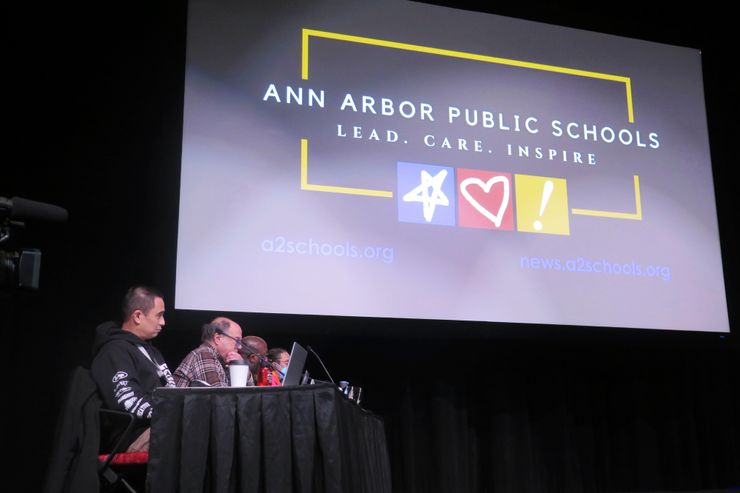
ANN ARBOR, Mich. (AP) — A public school district in Michigan approved a resolution calling for a bilateral cease-fire in the Israel-Hamas war while also encouraging its teachers to discuss the conflict in its classrooms following an emotionally charged meeting Wednesday.

The resolution approved by the Ann Arbor Public Schools board appears to be among the first times that a public school system in the United States has made such a statement on the international conflict.

It followed an over five-hour meeting that stretched into the early hours of Thursday after 120 people gave public comments in both support and opposition of the resolution.

Tensions remained high throughout the meeting in Ann Arbor, a community close to 40 miles (64 kilometers) west of Detroit and home to the University of Michigan. Similar tensions have been seen across the nation in response to the war in Gaza, which is now entering its fourth month following a

deadly Oct. 7 attack by

Hamas militants.

The conflict has divided college campuses, where

long-simmering tensions

are occasionally erupting in violence and shattering the sense of safety that makes colleges hubs of free discourse. Dozens of U.S. cities, including Ann Arbor, have approved cease-fire resolutions that have no legal authority but reflect the pressure on local governments to speak up on the

Israel-Hamas war,

The resolution passed in Ann Arbor was one of the first times that a public school system in Michigan had considered such a statement, said Don Wotruba, executive director at Michigan Association of School Boards, prior to the scheduled vote.

“What they’re thinking about doing would be pretty rare, if not the first time. Particularly as it’s related to a more international situation,” Wotruba said.

The district “expresses support for a bilateral ceasefire in Gaza and Israel,” according to the resolution, and “encourages educators within the Ann Arbor School District to facilitate informed and respectful dialogue about the conflict.”

Four of the seven board members voted in favor of the resolution, with two abstaining from the vote. Rima Mohammad, who is Palestinian, had been one of the most outspoken members in support of it.

"This resolution says that kids who have names like mine are seen, heard and valued,” Mohammad said just prior to the vote.

Some parents in the district, which holds nearly 17,000 students, had expressed outrage about the resolution, and a petition opposing it collected nearly 2,000 signatures. The petition said that the issue has taken resources away from other important matters such as hiring a new superintendent, which the district is without.

“This resolution does not help advance the quality of life of one single child in this district,” said Daniel Sorkin, a parent of two students in the district who spoke out against the resolution Wednesday.

Tasneem Madani, a student teacher in the district, supported the resolution and stressed its importance, saying that “our students are watching us.”

“It is my responsibility, particularly as an English teacher, to help students develop the skills to engage in informed academic dialogue in safe spaces,” Madani said at Wednesday's meeting.

Other schools across the country have contemplated similar resolutions. In California, the Oakland Unified School District has considered a resolution calling for a cease-fire and release of hostages in Israel and Palestine, but has yet to pass it.

Ann Arbor has long been known for its progressive politics, but the city and its university has found itself

divided over

the Gaza conflict beyond the confines of its public schools.

Nearly 6,500 Jewish students attend the University of Michigan, a total of 15% of its entire student population, according to the University of Michigan Hillel. A significant number of Arab American students also attend the university, which is near one of the

largest Muslim populations

in the nation.

In December, University of Michigan President Santa Ono barred students from voting on two resolutions related to the Israel-Hamas war, calling them “controversial and divisive.” The Michigan chapter of the Council on American-Islamic Relations accused the university of suppressing free speech at the time.

"The proposed resolutions have done more to stoke fear, anger and animosity on our campus than they would ever accomplish as recommendations to the university,” Ono

said in an online post

at the time.

More News

This chart shows just how rapidly Ebola is spreading
Oct 21, 2026
This chart shows just how rapidly Ebola is spreading

The most recent Ebola epidemic has killed thousands in Congo. A few cases have spilled over to its neighboring countries, including Kenya and Uganda. | Lucas Mukasa/Anadolu via Getty Images The Ebola virus is spreading at an unprecedented rate this year.  In the first five months since the outbreak began in the Democratic Republic of Congo (DRC), the World Health Organization (WHO) has reported 9,415 confirmed cases and 4,536 deaths in the country. While the virus has remained relatively contained by the DRC’s borders, case counts in neighboring Kenya and Uganda are also climbing (albeit more slowly). There are 20 confirmed cases in Uganda and eight in Kenya, and much of central and eastern Africa has tightened its borders.  The last major Ebola epidemic of this scale began in 2014 and continued through 2016 in West Africa. Over that period, it ultimately killed more than 11,000 people throughout West Africa. Nearly four years later, a smaller outbreak plagued Congo in its North Kivu region, leading to 2,229 deaths before it was contained.  The 2026 crisis hasn’t yet reached the same levels as the 2014 outbreak, but the speed of its spread is far greater.  As the chart below shows, around 150 days after the outbreak was declared, 2,599 Ebola cases had been reported in the 2014 West African epidemic. At the same time point this year, the number of cases came to 8,978 and has continued to climb.  View Link There is no straightforward explanation for this rapid spread One of the reasons the latest epidemic has been so difficult to slow down can be traced back to the fact that it’s a different viral strain — known as Bundibugyo — than the ones behind previous epidemics.   The Bundibugyo virus comes from the same family as the Ebola virus that caused the 2014 West Africa and 2018 Congo epidemics, causing the fatal fevers associated with Ebola. But the rare strain is different enough that it doesn’t respond to the same medical solutions. While the Zaire virus led to vaccines and treatment to mitigate the spread, we still don’t have a vaccine for Bundibugyo.  That doesn’t mean Bundibugyo is entirely novel, though. The 2026 outbreak is the third outbreak related to the Bundibugyo viral strain: In 2007, Uganda faced a minor outbreak, and the eastern province of Congo, which is now the epicenter of the epidemic, saw a handful of cases in 2012.  Luckily, these two outbreaks were contained in a span of months, largely due to efforts by the country’s Ministry of Health and international aid partnerships with the WHO, the US Agency for International Development (USAID), and international humanitarian organizations such as the UN Children’s Fund and Red Cross. More than a decade later, these efforts have been substantially curbed by USAID cuts. Tracing requires physical testing capacity: the tests themselves, health workers, and protective equipment for those treating suspected cases. Reduced access to such resources is especially dangerous with strains like Bundibugyo – in the absence of an effective vaccine, tracing the spread of disease and isolating potential disease contacts is especially important.  But cuts to aid, which covers disease surveillance efforts, made it more difficult to identify this year’s Bundibugyo outbreak until it was too late, creating a “critical four-week detection gap between the onset of symptoms of the presumed index case…and the laboratory confirmation of the outbreak,” according to a WHO situation report from May.  In August, the United States aimed to close at least some part of the vacuum it left, providing an additional $242 million to its $23 million original pledge in May.  Aside from international efforts, DRC faces the added layer of internal conflict and humanitarian crisis. The eastern provinces, including Ituri, have experienced years of conflict that have weakened the public infrastructure, including the healthcare system. Last year, nearly 25 percent of Congolese people faced food insecurity, and 4.5 million children were clinically malnourished, creating a population especially vulnerable to disease. The violence has also overwhelmed hospitals and displaced millions, disrupting the public health response, especially as mistrust in health authorities also runs rampant.  Even as emergency trials for a vaccine are underway, many of the factors that have facilitated the rapid spread may make treatment and outreach still more difficult. It’s hard to predict when the current outbreak will be handled, and how many more people will be affected before it does.

Expert Features

The Expert Features reports on the issues and the world’s everyday news. Handled by experts in different niches, you will find different subjects and perspectives.