Biden extends Trump-era solar tariffs, but loosens some
Feb 4, 2022
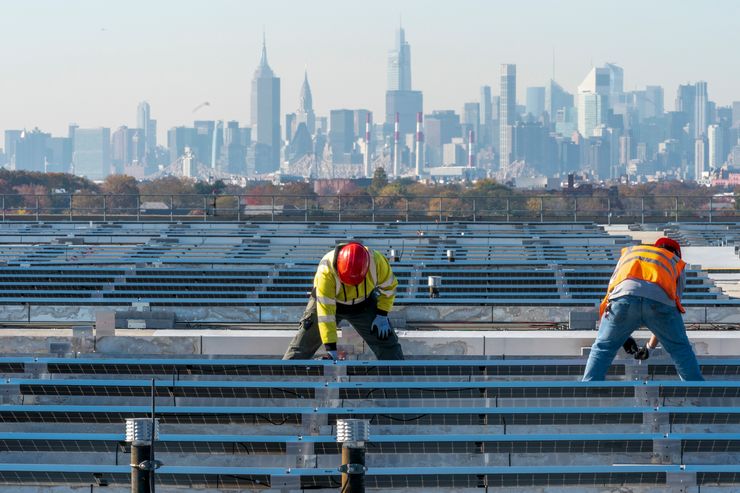
President Joe Biden has extended tariffs imposed by former President Donald Trump on most solar panels imported from China and other countries
WASHINGTON (AP) — President Joe Biden on Friday extended tariffs imposed by former President Donald Trump on most solar panels imported from China and other countries. But in a nod to his efforts to combat climate change and boost clean energy, Biden excluded tariffs on some panels used in large-scale utility projects.
Biden said he will continue for four more years tariffs imposed by Trump on imported solar cells and panels, but he exempted so-called bifacial solar panels that can generate electricity on both sides and are now used in many large solar projects. The technology was still emerging when the tariffs were first imposed by Trump.
“By excluding bifacial panels, we will ensure that solar deployment continues at the pace and scale needed to meet the president’s ambitious climate and clean energy targets and create good jobs at home,'' Biden said in a statement. Along with clean-energy provisions in his still-stalled ”Build Back Better" initiative, the actions on solar power "will enable us to rebuild a sustainable, competitive, and technologically-advanced domestic solar industry,'' Biden said.
Biden also doubled an import quota on solar cells — the main components of panels that go on rooftops and utility sites — to 5 gigawatts, allowing a greater number of imported cells used by domestic manufacturers. The U.S. does not currently produce solar cells, and the administration wants to make sure domestic suppliers "do not have to pay a tariff on a key input for their manufacturing process,'' a senior administration official said Friday.
The cells come from places like Vietnam or Malaysia — not China, the official said. "There is no reason to think that making the (import quota) larger will somehow help China,'' the official said, a claim that some U.S. solar manufacturers disputed. The official spoke on the condition of anonymity because they were not authorized to comment publicly.
Biden faced a choice among competing constituencies on solar power, a key part of his climate and clean-energy agenda. Labor unions support import restrictions to protect domestic jobs, while the solar industry relies in large part on cheap panels imported from China and other countries, including Vietnam, Malaysia and Singapore.
The American Clean Power Association, a renewable energy group representing both installers and manufacturers, praised the administration’s decision, calling it “a win for jobs and a win for the President’s climate agenda.”
Biden’s decision to extend the tariffs on imported solar cells and panels “gives the domestic solar manufacturing industry four more years to adjust to import competition as intended by the statute,” said Heather Zichal, the group’s CEO. She is a former energy adviser to President Barack Obama.
Biden has set a goal to cut planet-warming greenhouse gas emissions by at least 50% percent below 2005 levels by 2030, and solar power is a key part of that agenda. The administration approved two large-scale solar projects in California in December, with a third solar farm close to approval. A recent report by the Energy Department says solar has the potential to supply up to 40% of the nation’s electricity within 15 years — a 10-fold increase over current solar output.
Abigail Ross Hopper, president and CEO of the Solar Energy Industries Association, which represents solar installers, said she was disappointed with the tariff extension, but said Biden “arrived at a balanced solution in upholding the exclusion for bifacial panels and increasing the tariff rate quota for (solar) cells.”
Biden's decision “recognizes the importance of this innovative technology" and is "a massive step forward in producing clean energy in America and in tackling climate change,'' Hopper said.
Trump approved tariffs on imported solar-energy components in 2018, saying his administration would always defend American workers and businesses from unfair competition. The tariffs were initially set at 30% and later cut to 18% and then 15%. They were set to expire on Sunday without action by Biden.
Under Biden's decision, tariffs will be set at 14.75% and gradually be reduced to 14%.
Since the tariffs were imposed, solar-panel production in the U.S. has tripled. Chinese and South Korean companies have set up factories in Georgia, Florida and Alabama, and an American firm, First Solar Inc., expanded domestic production at a plant in Ohio.
Mark Widmar, chief executive of Arizona-based First Solar, said his company was “deeply disappointed” at Biden's decision to exclude bifacial panels from tariffs.
The exclusion tilts the playing field to China and other large producers “by providing unlawfully subsidized bifacial panels an instant, artificial advantage over other panel types,'' Widmar said. Since China dominates bifacial panel production, "this decision effectively allows China to outflank American efforts to grow self-reliant solar supply chains,'' he said.
A bipartisan group of Ohio lawmakers also blasted the decision, which they said "undermines American workers and manufacturers at a moment when domestic solar production is poised to dramatically expand.”
Sen. Rob Portman, R-Ohio, Democratic Sen. Sherrod Brown and Democratic Reps. Marcy Kaptur and Tim Ryan said in a joint statement that China "has a long history of heavily subsidizing its solar enterprises and dumping solar panels made with exploited workers into other markets. These kinds of products should not enter the United States duty free.''
In a related action, the Biden administration said it would begin talks with Canada and Mexico to export their products to the United States duty-free.
___
Associated Press reporter Josh Boak contributed to this report.