Biden's solar ambitions collide with China labor complaints
May 24, 2021
The Biden administration’s solar power ambitions are colliding with complaints the global industry depends on Chinese raw materials that might be produced by forced labor
BEIJING (AP) — The Biden administration’s solar power ambitions are colliding with complaints the global industry depends on Chinese raw materials that might be produced by forced labor.
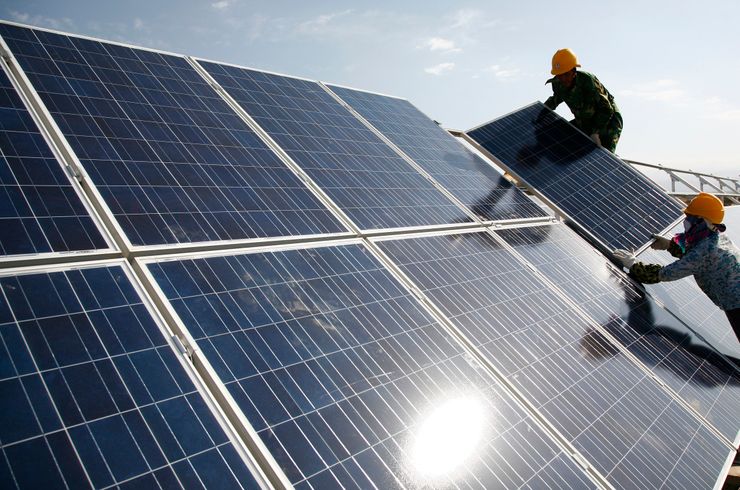
A big hurdle is polysilicon, used to make photovoltaic cells for solar panels. The global industry gets 45% of its supply from Xinjiang, the northwestern region where the ruling Communist Party is accused of mass incarceration of minorities and other abuses. Other parts of China supply 35%. Only 20% comes from U.S. and other producers.
Biden’s climate envoy, John Kerry, says Washington is deciding whether to keep solar products from Xinjiang out of U.S. markets. That sets up a conflict with President Joe Biden’s plans to cut climate-changing carbon emissions by promoting solar and other renewable energy while also reducing costs.
In Xinjiang, more than 1 million Uyghurs and other members of predominantly Muslim ethnic groups have been forced into detention camps, according to foreign researchers and governments. Authorities are accused of forced sterilizations of minorities and of destroying mosques.
Chinese officials reject accusations of abuse and say the camps are for job training aimed at economic development and deterring radicalism.
U.S. and some Chinese solar vendors have pledged to avoid suppliers that might use forced labor. It isn’t clear, however, whether they can meet rising demand without Xinjiang, where Beijing won’t allow independent inspections of workplaces.
The biggest manufacturers all use raw materials from Xinjiang and have a "high risk of forced labor in their supply chains,” according to a May 14 report by researchers Laura T. Murphy and Nyrola Elimaat of Britain’s Sheffield Hallam University.
The possibility of forced labor “is a problem,” Kerry told U.S. legislators last week. He cited “solar panels that we believe in some cases are being produced by forced labor.”
Western governments have imposed travel and financial restrictions on Chinese officials blamed for abuses. The U.S. government has banned imports of cotton and tomatoes from Xinjiang, citing concerns over forced labor.
The administration was assessing whether to extend that ban to solar panels and raw materials from Xinjiang, Kerry said. He said he didn't know the status of that review.
At issue is the government's “labor transfer” program, which places workers in Xinjiang with companies.
Chinese officials say it is voluntary, but Murphy and Elimaat argue it takes place in “an environment of unprecedented coercion" and is "undergirded by the constant threat of re-education and internment.”
“Many indigenous workers are unable to refuse or walk away from these jobs,” their report says. It says the programs are “tantamount to forcible transfer of populations and enslavement.”
Murphy and Elimaat said they found 11 companies engaged in forced labor transfers of Uyghurs and other minorities and 90 Chinese and foreign enterprises whose supply chains are affected. They said manufacturers need to make “significant changes” if they want to avoid suppliers that use forced labor.
Murphy and Elimaat say the biggest global solar equipment manufacturers — JinkoSolar Inc., LONGi Green Energy Technology Co., Trina Solar Energy Co. and JA Solar Holdings Co. — might have forced labor in their supply chains.
Trina and JinkoSolar also have “possible labor transfers” in factories, while a JinkoSolar facility is in an industrial park that also has a prison, according to Murphy and Elimaat.
JinkoSolar, LONGi, Trina and JA Solar didn't immediately respond to questions about the report.
At the same time, a supply crunch as demand surges has boosted polysilicon prices more than 100% since January to a 9-year high.
The market is “already undersupplied,” Johannes Bernreuter, head of Germany’s Bernreuter Research, said in an email.
China is both the biggest global market for solar equipment and the biggest producer.
That reflects multibillion-dollar government spending over the past two decades to promote solar energy. The ruling party wants to curb reliance on imported oil and gas, which it sees as a security weakness, and take the lead in an emerging industry.
A supply glut as hundreds of Chinese manufacturers rushed into the industry 15 years ago drove prices down. That hurt Western competitors but accelerated adoption of solar in the United States and Europe.
Seven of the top 10 global producers are Chinese. Canadian Solar Inc. is registered in Canada but its production is in China. South Korea's Hanwha Q-Cells is No. 6.
The only U.S. producer in the top 10, First Solar Inc., has no exposure to the Xinjiang polysilicon supply chain because the Tempe, Arizona, company uses thin film technology that requires no polysilicon.
Vendors serving U.S. and European markets probably can get enough polysilicon outside Xinjiang, Bernreuter said. But he said supplies might be squeezed if other countries impose the same requirement.
Potential non-Chinese suppliers include Germany’s Wacker Chemie AG and the Malaysian arm of South Korea's OCI Co.
However, those companies also buy polysilicon from Xinjiang's biggest supplier, Hoshine Silicon Industry Co., according to Murphy and Elimaat. They cited documents they said show Hoshine, also known as Hesheng, participates in “labor transfer.”
Hoshine didn't immediately respond to questions about the report.
U.S. solar equipment vendors have been trying since last year to overhaul supply chains to eliminate problem suppliers, according to their trade group, the Solar Energy Industries Association.
In February, 175 companies including the U.S. arms of JinkoSolar, LONGi, Trina and JA Solar signed a pledge to oppose use of forced labor by their suppliers.
Potential changes should be done by the end of June, according to the group’s president, Abigail Ross Hopper.
“If their customers and the U.S. government are demanding it, they will need to move quickly,” Ross Hopper told PV Magazine USA in February.
Bernreuter warned the Chinese government “might interfere” with an overhaul, though there is no sign that has happened.
____
Sheffield Hallam University report: www.shu.ac.uk/helena-kennedy-centre-international-justice/research-and-projects/all-projects/in-broad-daylight
Bernreuter Research: www.bernreuter.com
Solar Energy Industries Association: www.seia.org