Chaotic wave of attacks, reprisals in Middle East fuel worries of a broader regional war
Jan 16, 2024
A barrage of U.S., coalition and militant attacks in the Middle East are compounding U.S. fears that Israel’s war on Hamas in Gaza could expand
WASHINGTON (AP) — A barrage of U.S., coalition and militant attacks in the Middle East over the last five days are compounding U.S. fears that
Israel's war on Hamas in Gaza
could expand, as massive military strikes failed to stall the assault on Red Sea shipping by Yemen-based Houthis.Even as the U.S. and allies pummeled more than two dozen Iran-backed Houthi locations on Friday in retaliation for attacks on ships, the Houthis have continued their maritime assaults. And
Tehran struck sites in Iraq and Syria,
claiming to target an Israeli “spy headquarters,” then followed that Tuesday withreported missile and drone attacks in Pakistan.
The chaotic wave of attacks and reprisals involving the United States, its allies and foes suggested not only that last week’s assault had failed to deter the Houthis, but that the broader regional war that the U.S. has spent months trying to avoid was becoming closer to reality. And underscoring the gravity of the roiling situation, the Biden administration
is expected to announce plans to redesignate the Houthis
as global terrorists, according to people familiar with the decision who requested anonymity to discuss the matter ahead of its announcement.At the White House earlier Tuesday, National Security Council spokesman John Kirby stressed that the U.S. is "not looking for a war. We’re not looking to expand this. The Houthis have a choice to make.” But in a speech at the World Economic Forum in Davos, Switzerland,
White House national security adviser Jake Sullivan warned
that the expanding array of attacks mean that allies must “be vigilant against the possibility that in fact, rather than heading towards de-escalation, we are on a path of escalation that we have to manage.”Ever since the devastating attack by Hamas on Israel on Oct. 7 triggered a massive air and ground campaign by Israeli forces, the U.S. and other allies have worried about it expanding to a broader regional war. U.S. diplomatic and military officials have shuttled urgently across the Middle East, working to ease tensions but the enormous Palestinian death toll has fueled anger and is being touted as a reason for at least some of the attacks.
Since November, the Houthis have repeatedly targeted ships in the Red Sea, saying they were avenging Israel's offensive against Hamas. But they have frequently targeted vessels with tenuous or no clear links to Israel, imperiling shipping in a key route for global trade.
In rapid succession in recent days, the Houthis fired an anti-ship cruise missile toward a U.S. Navy destroyer over the weekend, but the ship shot it down. The Houthis then struck a U.S.-owned ship in the Gulf of Aden on Monday and a Malta-flagged bulk carrier in the Red Sea on Tuesday. The attacks came despite
the bombardment by U.S. and British
ships and fighter jets of more than 60 Houthi targets in 28 locations on Friday.Although the U.S. said that the subsequent Houthi maritime attacks have been smaller, and not as complex as earlier ones, it does appear that the militant group has not been deterred. And Iran’s Supreme Leader Ayatollah Ali Khamenei has praised the group's actions.
According to U.S. Central Command, the U.S. launched a new strike against the Houthis on Tuesday, hitting four anti-ship ballistic missiles that were prepared to launch and presented an imminent threat to merchant and U.S. Navy ships in the region. Hours later, the Houthis claimed responsibility for the attack on the Malta-flagged bulk carrier Zografia. The ship was hit, but no one was injured and it continued on its way.
The attack Monday on the U.S.-owned Gibraltar Eagle also resulted in damage but no injuries, and it too continued on its journey.
The Houthis' military spokesman, Brig. Gen. Yahya Saree, said in a pre-recorded statement that it fired at the Zografia after the ship’s crew refused to answer warning calls and that the vessel was heading for a port in Israel. According to the shipping tracking website Vessel Finder, Zografia was bound for Suez, Egypt.
While Iran arms and backs the Houthis, its not been clear how much it has helped plan or direct the attacks. But, Tehran launched its own assault on Israel's interests late Monday, firing missiles near the U.S. Consulate in northern Iraq at what it said was a headquarters of Mossad, the Israeli intelligence agency,
Four civilians were killed and six injured in the strike in Irbil, the seat of Iraq’s semi-autonomous Kurdish region, according to the security council of the Kurdish regional government.
Iran’s Revolutionary Guards
said in a statement that it also fired a number of ballistic missiles at “terrorist operations,” including Islamic State targets, in Syria and destroyed them.And on Tuesday, Iran struck targets inside Pakistan killing two “innocent children” and wounded three other people, the Pakistani government said. Iran described the targets as bases for the militant group Jaish al-Adl, state media reported.
Jaish al-Adl, or the “Army of Justice,” is a Sunni militant group which largely operates across the border in Pakistan. Iran has fought the militants in border areas, but a missile-and-drone attack on nuclear-armed Pakistan would be unprecedented for Iran.
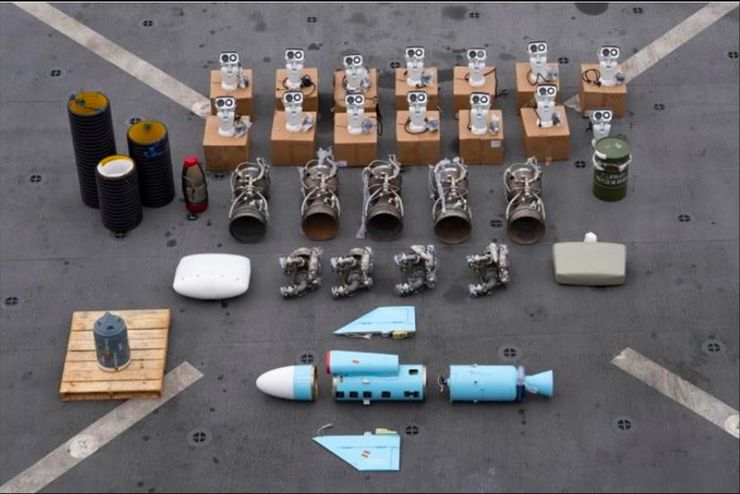
Amid the latest attacks, U.S. Navy SEALs seized Iranian-made missile parts and other weaponry from a ship bound for Yemen’s Houthi rebels in a raid last week that saw two of its commandos go missing, the U.S. military said Tuesday. The raid marks
the latest seizure by the U.S. Navy and its allies
of weapon shipments bound for the rebels.As they were boarding the ship in rough seas, one SEAL got knocked off by high waves and a teammate went in after him. Both remain missing.
The U.S. Navy ultimately sank the ship carrying the weapons and detained the 14 crew members. The Houthis have not acknowledged the seizure, and Iran's mission to the United Nations did not respond to a request for comment. A United Nations resolution bans arms transfers to Yemen’s Iranian-backed Houthi rebels. Tehran has long denied arming the rebels, despite
physical evidence, numerous seizures and experts tying the weapons back to Iran
.___
Associated Press writers Elena Becatoros in Athens, Greece, and Tara Copp and Aamer Madhani in Washington contributed to this report. Gambrell reported from Jerusalem.