Ecuador hunkers down for a government war on drug gangs after attack during live TV newscast
Jan 10, 2024

Schools and stores are shuttered, many people stayed home and soldiers are roaming the streets of Ecuador’s biggest cities after armed gang members invaded a television station live afternoon newscast

QUITO, Ecuador (AP) — Schools and stores sat shuttered, many people stayed home and soldiers roamed the streets of Ecuador’s biggest cities Wednesday, the day after armed men invaded a television station's live afternoon newscast and the president told the security forces to wipe out the

drug gangs terrorizing the country

.

The

group wielding explosives and guns

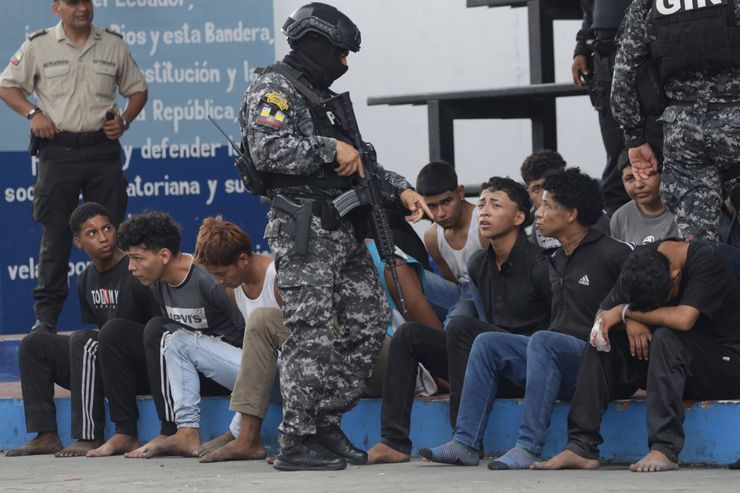
flashed across the televisions of Ecuadorians for 15 minutes on Tuesday as the intruders threatened and assaulted employees of the TC Televisión network's station in the city of Guayaquil. No one was killed and 13 suspects were arrested, but the violent broadcast stunned much of the region — and elicited a wide-ranging government response.

President Daniel Noboa

issued a decree saying his country was in an “internal armed conflict” and designated 20

drug-trafficking gangs

as terrorist groups that the military had authorization to “neutralize” within the bounds of international humanitarian law.

“We are in a state of war and we cannot give in,” Noboa said during an interview with Radio Canela on Wednesday.

He'd already declared a national state of emergency Monday after the leader of one of Ecuador’s most powerful drug gangs

disappeared from prison

. Since Adolfo Macías' apparent escape, Ecuador has seen police officers kidnapped and at least 125 corrections personnel taken hostage inside prisons.

The government said nearly 330 people, including the TC Televisión suspects, had been arrested for alleged acts of terrorism as of Wednesday afternoon. Security forces across Ecuador guarded hospitals, public transit and newsrooms. The government ordered teachers and students to hold classes remotely until Friday.

In the radio interview, Noboa promised to crack down on drug trafficking groups and consolidate peace in the Andean nation of 18 million.

“We are fighting against terrorist groups made up of more than 20,000 people,” Noboa said. “They wanted to be named as organized crime groups ... but they are terrorists."

The president warned that judges, prosecutors and officials who collaborated with the gangs would be considered part of a terrorist network.

Even in a country where a

presidential candidate was assassinated

last year, the show of force streamed into Ecuadorians’ homes and workplaces was unprecedented. The motive for targeting the station remained unclear.

“We are on air, so you know that you cannot mess with the mafia,” one of the assailants said during the broadcast attack. The words sounded like a warning addressed to Ecuadorian authorities and the nation at large.

Noboa's resolve was welcome to many Ecuadorians, who have watched their nation descend into chaos. While wedged between major cocaine producers Colombia and Peru, Ecuador has been comparatively peaceful. But traffickers tired of doing business in more militarized countries have set up shop there.

Humberto Poggi del Salto, 50, a businessman in Guayaquil, urged the government to come down on the armed groups with “a firmer hand, to have no mercy, no tolerance or (respect for) the human rights of criminals.”

“President Noboa must do what El Salvador did," he said. “The situation has gotten out of control. And it is because of lack of extreme measures.”

El Salvador's president,

Nayib Bukele

, two years ago suspended constitutional rights to wage an all-out war on violent gangs. Sharp declines in criminal violence since then have made the 42-year-old leader highly popular at home and

across Latin America

.

Yet mass arrests of tens of thousands of suspected gang members – many of them innocent – and the opening of a controversial “mega-prison” have fueled accusations of

widespread human rights abuses

in El Salvador.

An advisor to Bukele, who asked for his name to be withheld because he was not authorized to speak on the subject, told The Associated Press on Wednesday that Ecuador would not be seeing its current levels of violence if it had followed El Salvador's example.

Experts tracking criminal groups in Latin America said that while an immediate strong response is needed to show the government is in control, simply militarizing the country may only make things worse in the long term.

“Extreme policies might seem like the logical consequence we’ve seen," said Ivan Briscoe, Latin America and the Caribbean director for the International Crisis Group. But “if you move to a security policy which is purely based on repression and killing, you’re going to enter an extremely violent spiral.”

Countries like Colombia and

Mexico

have warred with armed cartels for decades, targeting drug lords as a strategy to take down entire criminal organizations. But warfare has caused such groups to splinter into factions and forced them to adapt, Briscoe said.

Over time, that has made it more difficult for authorities to dismantle criminal enterprises; when one armed group is taken down, five more pop up to take its place, he said.

What needs to happen in the long term, Briscoe said, is for authorities to root out corruption within the government that has allowed gangs to take control of prisons and many port cities, and to create a judicial system that breaks any links between organized crime and law enforcement.

“To be sent to prison in Ecuador is to be sent to the home of a criminal organization,” Briscoe said.

Juanita C. Francis Bone, a leader of the human rights group Mujeres de Asfalto in the coastal city Esmeraldas, worried that the path Noboa is taking could lead to a criminalization of poorer communities.

Esmeraldas has seen massacres of local fishermen, bodies hanging from bridges by nooses, and rounds of car bombs going off. A normal day there “is waking up and fearing that what you’re hearing aren’t fireworks, but gunshots.” Francis Bone said.

She said years of government neglect and poverty have fed the ranks of armed gangs with young people who see few options for themselves. More than additional guns on the streets, such Ecuadorians need access to education, health care and jobs, Francis Bone said.

“Deep inequality is always going to be the breeding group for recruiting people into criminal groups. It’s very hard for someone to speak of peace and security when they’re starving,” she said. “You can’t simply wash your hands of any blame by just saying you’re going to militarize.”

___

Janetsky reported from Mexico City. Allen Panchana in Guayaquil, Ecuador, contributed to this story.
More News

The Supreme Court may be about to make America’s prisons much crueler
Oct 21, 2026
The Supreme Court may be about to make America’s prisons much crueler

Update, October 21, 11:45 am ET: The Supreme Court released a brief order on October 21, which ruled against the Trump administration’s request to deny gender-affirming care to transgender prisoners. The order is two sentences long. It is temporary. And it does not explain the Court’s reasoning. So it is not clear why the Court ruled against Trump or even whether Trump will lose if this case reaches the Court again after it has be fully litigated in lower courts. Justices Clarence Thomas and Samuel Alito dissented. The article below was originally published on October 13. On the first day of his second term, President Donald Trump issued an executive order requiring the Bureau of Prisons to “ensure that no Federal funds are expended for any medical procedure, treatment, or drug for the purpose of conforming an inmate’s appearance to that of the opposite sex.” Issued alongside a record 26 other orders that day, it was an unsurprising development, because Trump had made this issue one of the centerpieces of his 2024 campaign. The fate of that executive order, as well as the US Bureau of Prisons’ (“BOP”) memoranda implementing the order, is now before the Supreme Court in a case called Trump v. Kingdom. And, while this case obviously has high stakes for incarcerated transgender people specifically, the Court’s resolution of this case could potentially have far greater reach — cutting off many cis and transgender people’s access to healthcare while they are incarcerated. That’s because one of the central questions in Kingdom — though this issue is not yet before the justices — is when the Constitution requires prisons to provide medical care to incarcerated people. In Estelle v. Gamble (1976), the Supreme Court held that the Eighth Amendment’s ban on “cruel and unusual punishments” imposes on the government an “obligation to provide medical care for those whom it is punishing by incarceration.” People in prison, after all, cannot simply drive themselves to the hospital if they get sick. If the prison does not give them adequate medical care, they will suffer untreated and potentially die. For procedural reasons, the Court is unlikely to opine on whether Estelle requires prisons to provide gender-affirming care to trans people right away. But the question of when the Eighth Amendment requires prisons to provide medical care to incarcerated people is front and center in the Kingdom case, which means the Court could potentially use Kingdom to limit all imprisoned people’s access to healthcare — or even to undercut the Constitution’s protections against cruel and unusual punishments more broadly. Ironically, this case also arises out of a famous political blunder by pro-trans advocates. In 2019, when then-Sen. Kamala Harris was seeking her party’s 2020 presidential nomination, the ACLU circulated a questionnaire to candidates that asked if they would use presidential authority “to ensure that transgender and nonbinary people who rely on the state for medical care — including those in prison and immigration detention — will have access to comprehensive treatment associated with gender transition, including all necessary surgical care?”  Harris responded that she would, and also said that she “pushed the California Department of Corrections and Rehabilitation to provide gender transition surgery to state inmates” while she was state attorney general.  Years later, during his 2024 debate with Harris, Trump claimed that the then-vice president “wants to do transgender operations on illegal aliens that are in prison.” And not long after, his opposition to gender-affirming care for trans people in prison became a key part of his campaign. It’s unclear why the ACLU thought it was a good idea to shine a light on this issue in 2019 because, at the time, the BOP provided gender-affirming care to people in federal prison. The ACLU — which represents the pro-trans side in the Kingdom case — now argues that transgender people in federal prison have had access to at least some forms of gender-affirming care “since at least 1992.” Indeed, Trump’s own administration concluded in a 2018 memo that the Bureau of Prisons’ “statutory mandate to provide basic medical and mental health care” to incarcerated people obligated it to provide “pharmaceutical interventions (e.g., cross-gender hormone therapy), hair removal and surgery (if individualized assessment indicates surgical intervention is applicable)” to transgender people in prison if their doctors determined that these interventions are “medically necessary care.” In any event, regardless of why Trump fixated on cutting off trans healthcare for people in federal prison, Kingdom is now before the Court. That means that the fate of trans people in prison — and, if the Eighth Amendment issue eventually reaches the Court, all incarcerated people — is now in the hands of a Republican Court that is often hostile to trans litigants, and that has, at times, signaled that it wants to drastically roll back the scope of the Eighth Amendment. What are the legal issues in the Kingdom case? At least since Estelle, the Court has held that people who are incarcerated are not also sentenced to live and die without medical care. As the Court said in Brown v. Plata (2011), “a prison that deprives prisoners of basic sustenance, including adequate medical care, is incompatible with the concept of human dignity and has no place in civilized society.” Under Estelle and Brown, transgender people often have a right to gender-affirming care during their incarceration. As the US Court of Appeals for the Ninth Circuit held in Edmo v. Corizon (2019), such a person must show that they have a “serious medical need” for such care — typically by demonstrating that the care was prescribed to them by their health provider. But the Constitution does not permit prisons to deny medically necessary care to incarcerated people. In Kingdom, the ACLU raised this Eighth Amendment argument in the lower courts, but those lower courts ruled in favor of transgender people in prison on different, much more technical legal grounds. For over three decades, from at least 1992 to 2025, according to the ACLU’s brief to the justices, the BOP provided at least some gender-affirming care, including hormone therapy, to transgender people. This matters because, when a federal agency changes its policies, a federal law typically requires it to “examine the relevant data and articulate a satisfactory explanation for its action, including a rational connection between the facts found and the choice made.” This explanation often must explain the agency’s justification for “disregarding facts and circumstances” that justified the previous policy. Both the ACLU and the lower courts that heard Kingdom argue that the Trump administration did not comply with this obligation when it cut off care for trans people in prison.  Among other things, the district court that heard this case determined that the administration cited “zero evidence from its own medical or mental health care professionals to support its conclusions” against providing transgender healthcare. While the Trump administration argues that providing gender-affirming care makes prisons less safe, the district court also noted that “the government has not cited a single instance of gender-affirming care giving rise to safety concerns despite having provided such care for many years.” Is this a persuasive legal argument against the Trump administration’s new policy? I think it is. And so did three federal judges that previously heard the Kingdom case. But the fate of trans people in prison is now in the hands of a Supreme Court that rarely rules in favor of transgender litigants, and that has a history of handing down legally incoherent opinions that are inconsistent with the Court’s own precedents, and that also deny legal rights to trans people. The current Court’s uncertain commitment to the Eighth Amendment Because the lower courts that heard Kingdom did not rule on the Eighth Amendment question, Kingdom should not currently give the justices an opportunity to roll back Estelle. But, in the likely event that this Court rejects the ACLU’s argument that the Trump administration did not adequately explain its new policy, the case will return to the lower courts and the Eighth Amendment issue will be fully litigated — teeing up the Eighth Amendment question for the justices to decide in the near future. This issue could arise, moreover, at the exact moment that some justices are pushing for sweeping changes to how their Court understands the term “cruel and unusual punishments.” Indeed, at least some of the Supreme Court’s recent Eighth Amendment precedents suggest that the Republican justices want a wholesale rewrite of the Court’s previous precedents laying out what constitutes cruel and unusual punishment. Since the mid-to-late twentieth century, the Court has held that, in Chief Justice Earl Warren’s words, the Eighth Amendment “must draw its meaning from the evolving standards of decency that mark the progress of a maturing society.” Thus, as certain forms of punishment grow more uncommon, they become more constitutionally dubious. This “evolving standards of decency” framework is front and center in nearly every major Supreme Court decision interpreting the Eighth Amendment for the last five or six decades, including Estelle. In Bucklew v. Precythe (2019), however, the Court’s Republican majority seemed to abandon this framework. Although decades worth of pre-Bucklew decisions established that a punishment is unconstitutional if it is considered cruel and unusual today, Bucklew suggested that a method of punishment is unconstitutional only if it “had fallen out of use” at “the time of the founding.”  Bucklew did list some methods of punishment that fail this test, but they are things like “disemboweling” or “burning alive.”   Thus, if taken seriously, Bucklew’s new approach to Eight

Expert Features

The Expert Features reports on the issues and the world’s everyday news. Handled by experts in different niches, you will find different subjects and perspectives.