Eurovision explained, from ABBA to Zorra, as the Israel-Hamas war overshadows the song contest
May 9, 2024
Scores of musicians, hundreds of journalists and thousands of music fans are gathering in the Swedish city of Malmo for the exuberant, glitter-drenched final of the Eurovision Song Contest
MALMO, Sweden (AP) — Scores of musicians, hundreds of journalists and thousands of music fans have gathered in Malmo, Sweden, where the
Eurovision Song Contest
is building towards Saturday'sexuberant, glitter-drenched final
.But even Eurovision can’t escape the world’s divisions. Thousands of
pro-Palestinian protesters
are also expected in the city for demonstrations urging a cease-fire in theIsrael-Hamas war
and criticizing Israel’s participation in the contest.Here’s a guide to what
Eurovision
means,how it works
and what to watch for:WHAT IS EUROVISION?
The short answer: Eurovision is a music competition, in which performers from countries across Europe, and a few beyond it, compete under their national flags with the aim of being crowned continental champion. Think of it as the Olympics of pop music.
The longer answer is that Eurovision is an extravaganza that melds pop, partying and politics — a cross between a music festival, an awards show and a meeting of the United Nations Security Council. It’s an event full of silly fun, a celebration of music’s unifying power, but also a place where politics and regional rivalries play out.
HOW DOES IT WORK?
Thirty-seven countries are entered in the contest, which this year is taking place over several days in the Swedish port city of Malmo. The country is hosting after
Swedish singer Loreen
won last year’s competition in Liverpool, England.Through two semifinals, the acts have been narrowed to the 26 scheduled to compete in Saturday’s final in front of thousands of spectators in the Malmo Arena and a global television audience estimated at 180 million. There is a question mark over the participation of the Netherlands' Joost Klein, who is being investigated by organizers over an unspecified “incident.”
Nations can enter a solo act or a band. They can perform in any genre and language, but the rules state they must sing live and songs must be no more than three minutes long. Staging has grown ever more elaborate, incorporating flashy pyrotechnics and elaborate choreography. This year is particularly strong on topless male dancers.
Once all the acts have performed, the winner is chosen by a famously complex mix of phone and online voters from around the world and rankings by music-industry juries in each of the Eurovision countries. As the results are announced, countries slide up and down the rankings and tensions build. Ending up with “nul points,” or zero, ranks as a national humiliation.
The musical style of Eurovision has diversified dramatically since the contest was founded in 1956. The early years of crooners and ballads gave way to perky pop – epitomized by perhaps the greatest Eurovision song of all time, ABBA’s “Waterloo,” which won the contest 50 years ago.
Nowadays, Euro-techno and power ballads remain popular, but viewers have also shown a taste for rock, folk-rap and eccentric, unclassifiable songs.
WHO ARE THE FAVORITES?
According to bookmakers, a leading contender is
Swiss singer Nemo
, who is performing a melodic, operatic song titled “The Code.” Nemo would be the first performer who identifies as nonbinary to win the contest, which has a huge LGBTQ+ following. The contest had its first transgender winner, Dana International, a quarter century ago.Another nonbinary performer generating huge buzz is Ireland’s Bambie Thug, whose song “Doomsday Blue” is Gothic, intense, over the top and a real crowd-pleaser. They’re the only contestant known to have brought a "scream coach" to Malmo.
Other acts tipped to do well include operatic Slovenian singer Raiven,
Ukrainian rap-pop duo Alyona Alyona and Jerry Heil
and Spain's Nebulossa,whose song "Zorra”
caused a stir because its title can be translated as an anti-female slur.The act with the most momentum is Croatian singer Baby Lasagna. His song “Rim Tim Tagi Dim” is quintessential Eurovision: exuberant, silly, a little emotional and incredibly catchy. It’s already a huge fan favorite.
WHY ARE SOME PEOPLE PROTESTING?
Eurovision’s motto is “united by music,” and its organizer, the European Broadcasting Union, strives to
keep politics out of the contest
. But it often intrudes.Belarus was expelled from Eurovision in 2021 over its government’s clampdown on dissent, and Russia was kicked out in 2022 after its full-scale invasion of Ukraine.
This year, there have been calls for Israel to be excluded because of its conduct in its war against Hamas.
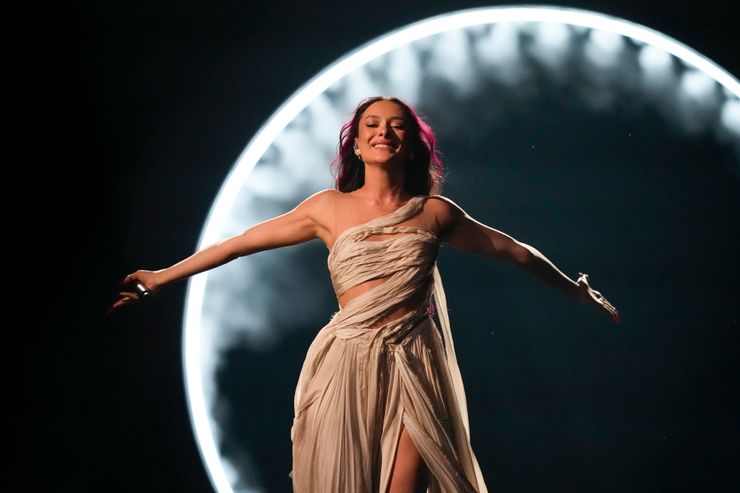
Israel is competing, but was told to change the title of its song, originally called “October Rain” in apparent reference to Hamas’ Oct. 7 cross-border attack. It’s now called “Hurricane” and is performed by 20-year-old singer Eden Golan.
Thousands of pro-Palestinian demonstrators
marched through Malmo hours before Golan performed at Thursday's semifinal, and another demonstration is planned for Saturday. Swedish police have mounted a major security operation, with officers from across the country bolstered by reinforcements from Denmark and Norway.