Harris meets with Ghana's president as Africa trip begins
Mar 27, 2023
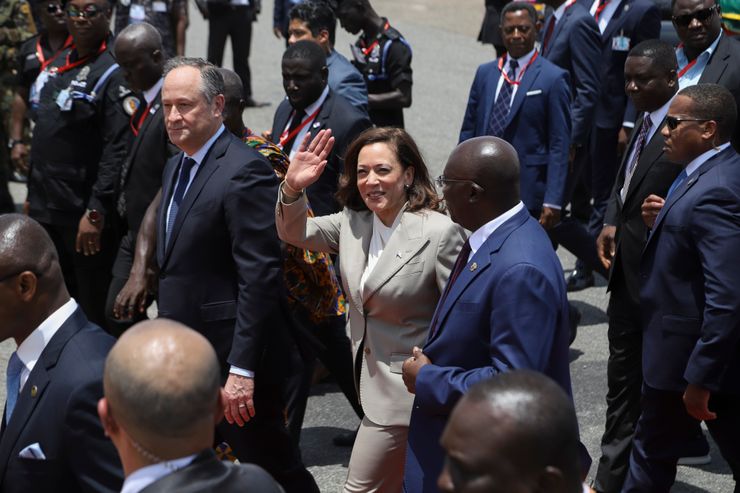
U.S. Vice President Kamala Harris is beginning her first full day in Africa as she meets with Ghanaian President Nana Akufo-Addo
ACCRA, Ghana (AP) — U.S. Vice President Kamala Harris is meeting with Ghanaian President Nana Akufo-Addo Monday, in a show of support for the West African leader, who's facing rising discontent over inflation and fresh concerns about regional security.
Harris is just beginning
a weeklong trip
to the continent that will also take her to Tanzania and Zambia, part of a concerted effort tobroaden U.S. outreach
at a time when China and Russia have entrenched interests of their own in Africa.Harris entered the Jubilee House, the presidential palace, to the Ghanaian national anthem, clasping hands with the president and delegation members.
“Thank you for having me,” she said, as the two began formal talks inside the palace.
Akufo-Addo oversaw one of the world’s fast-growing economies before the COVID-19 pandemic. However, the cost of food and other necessities has been skyrocketing, and the country is facing a debt crisis as it struggles to make payments.
In addition, sporadic fighting has increased in Ghana's north, which borders the more tumultuous nation of Burkina Faso and the Sahel, a region where local offshoots of al-Qaida and the Islamic State group have been operating.
“Ghana is experiencing a very tough moment,” said Rama Yade, senior director of the Atlantic Council’s Africa Center.
Harris will announce $139 million in U.S. assistance for Ghana, according to her office. Some of that money will require congressional approval, which could prove difficult amid sharp partisan differences over the federal budget. The Treasury Department also plans to dispatch an adviser to Accra to help manage the country's burdensome debt.
Other programs are intended to reduce child labor, improve weather forecasting, support local musicians and defend against disease outbreaks.
The United States has already
sent troops to train militaries
from Ghana and other countries in the hopes of bolstering their defenses. However, other countries have turned to the Russian mercenary force known as Wagner, which has been on the front lines ofRussia's war in Ukraine
but also has a presence in Africa.Wagner began operating in Mali, which ousted French troops based there, and there are concerns that it will also deploy to Burkina Faso, where France also ended its military presence. Ghana recently accused Burkina Faso's leaders, which took power in a coup last year, of already
turning to Wagner for help
, something Akufo-Addo said would be “unsettling.”U.S. Secretary of State Antony Blinken
recently visited Niger
, which borders Mali and Burkina Faso, to announce more assistance for the region."We’ve seen countries find themselves weaker, poorer, more insecure, less independent as a result of the association with Wagner,” he said.
Although China’s influence in Africa has been a leading concern for U.S. foreign policy, Russia’s own attempts to make inroads has alarmed Washington as well. Some countries have longstanding ties dating back to the Soviet era.
The Russian foreign minister, Sergey Lavrov, has made multiple trips to the continent in an effort to show that the West has failed to isolate Moscow for its invasion of Ukraine.
“The Russians are continuing to make the first move in Africa, and the U.S. is continuing to play catch-up," said Samuel Ramani, associate fellow at the Royal United Services Institute, a London-based defense and security think tank.
“It’s really unclear how Russia will really be able to expand its influence in the long term," he added. "But in the short term, they’re creating goodwill for themselves.”
Mucahid Durmaz, a senior analyst at Verisk Maplecroft, a global risk intelligence company, said that Moscow's overall investments in Africa “are very modest” compared with Washington's but adds that it's been able to leverage anti-Western sentiment in some areas of the continent.
“The Ukraine war has boosted Africa’s importance in international politics and increased geopolitical jostling among global powers for the support of its governments and nations," he said.
U.S. officials have steered clear of framing their approach in terms of global rivalries, something that could swiftly sour Africans who are wary of being caught in the middle.
“They remain cautious about becoming collateral damage to geopolitical competition by repeating the same mistakes of the Cold War era,” Durmaz said.
___
Mednick reported from Dakar, Senegal.