Heading for UN, Ukraine's president questions why Russia still has a place there
Sep 19, 2023

Ukraine's leader and Russia’s top diplomat could cross paths at the United Nations this week

NEW YORK (AP) — Days before potentially crossing paths with Russia’s top diplomat at the United Nations, Ukrainian President

Volodymyr Zelenskyy

suggested Monday that the world body needs to answer for allowing his country's invader a seat at the tables of power.

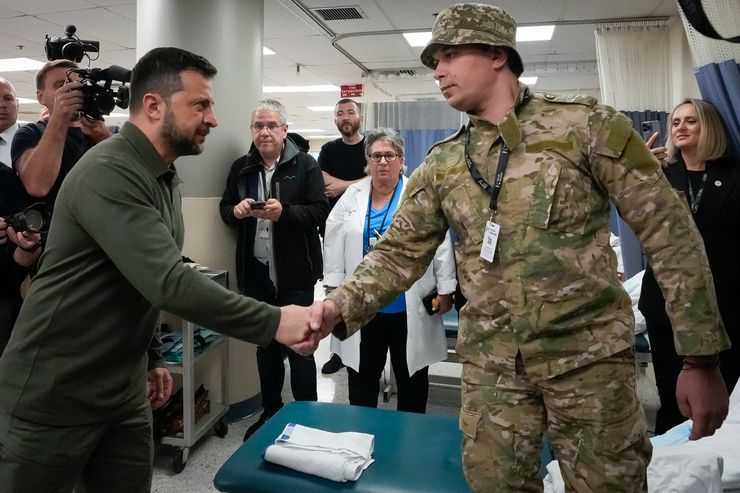
"For us, it’s very important that all our words, all our messages, will be heard by our partners. And if in the United Nations still — it’s a pity, but still — there is a place for Russian terrorists, the question is not to me. I think it’s a question to all the members of the United Nations,” Zelenskyy said after visiting wounded Ukrainian military members at a New York hospital.

He had just arrived in the U.S. to make his country’s case to the world and to Washington for continued help in trying to repel Russia’s invasion, nearly 19 months into what has become

a grinding war

. Russia says it is justified.

Ukraine’s Western allies have supplied weapons and other assistance, and the U.S. Congress is currently weighing

President Joe Biden’s request

to provide as much as $24 billion more in military and humanitarian aid.

U.S. lawmakers are increasingly divided over providing additional money to Ukraine. Zelenskyy is scheduled to spend some time Thursday on Capitol Hill and

meet with Biden

at the White House.

Before that, Zelenskyy is due to address world leaders at the U.N. General Assembly on Tuesday and speak Wednesday at a U.N. Security Council meeting about Ukraine. Russia is a permanent, veto-wielding member of the council, and Foreign Minister Minister Sergey Lavrov is expected to make remarks.

Asked whether he'd stay in the room to listen, Zelenskyy said, “I don't know how it will be, really.”

Zelenskyy has taken the United Nations to task before — even before the war launched by a neighbor that, as a Security Council member, is entrusted with maintaining international peace and security. In one memorable example, he lamented at the General Assembly in 2021 that the U.N. was

”a retired superhero

who's long forgotten how great they once were."

Traveling to the U.S.

for the first time since December

, he began his trip with a stop at Staten Island University Hospital. The medical facility has, to date, treated 18 Ukrainian military members who lost limbs in the war, said Michael J. Dowling, the CEO of hospital parent company Northwell Health.

With help from a New Jersey-based charity called Kind Deeds, the injured have gotten fitted for prostheses and are undergoing outpatient physical therapy.

Zelenskyy greeted several injured troops as they exercised in a rehab gym. He asked about their wounds, wished them a speedy recovery and thanked them for their service.

“How are you doing? Is it difficult?” Zelenskyy asked one military member, who paused and then said it was OK.

“Stay strong,” Zelenskyy replied, later telling the group their country was grateful and proud of them.

Later, in a hospital conference room, he awarded medals to the injured, posed for photos, signed a large Ukrainian flag and thanked medical personnel and the injured troops.

“We all will be waiting for you back home,” he said. “We absolutely need every one of you.”
More News

The far-right just lost. Twice.
Oct 26, 2026
The far-right just lost. Twice.

Supporters of Serbia’s Students’ List movement celebrate in Belgrade on October 26, 2026. | Milos Milanovic/AFP via Getty Images This story appeared in Today, Explained, a daily newsletter that helps you understand the most compelling news and stories of the day. Subscribe here. Vox isn’t typically in the business of covering elections in far-flung locales like the central Balkans. (No offense whatsoever to anyone from the central Balkans!) But on Sunday, an insurgent student-backed movement in Serbia successfully toppled the country’s ruling right-wing political machine, creating an unexpected opening for democratic reform.  Then, in another upset halfway around the globe, Brazilian voters reelected incumbent President Luiz Inácio Lula da Silva over his far-right challenger, Flávio Bolsonaro. “Democracy always, dictatorship never again,” Lula said in his victory speech. That’s two big repudiations of the nationalist right in 24 hours. Not quite enough to declare a trend, maybe, but sufficient to remind us that there’s still hope for the world’s embattled democratic institutions.  More than that, these results offer evidence of something that sounds naive and Pollyannish in our current moment, but can (apparently!) still prove true: Organizing can be a powerful force for electoral change — both abroad and maybe here at home. Go a little deeper View Link To be fair, the two elections differed considerably, and I don’t want to suggest it’s all sunshine and democratic renewal ahead for Brazil and Serbia. Bolsonaro is refusing to concede, for instance. And in Serbia, the victorious Student List still has to stand up a government, a prime minister, and a full policy platform — something the nascent movement has never done before.  But academics and elections-watchers in both countries have credited the results in large part to mass protests and grassroots organizing that helped mobilize unexpected numbers of voters. Serbian students began their movement in 2024, following the partial collapse of a railway station that killed 16 people. The government’s failure to fully explain the cause of the collapse — or hold anyone responsible — fueled months of marches, protest bike rides, and other demonstrations. That movement eventually grew into the Student List: an opposition electoral slate that fielded 250 candidates in Sunday’s parliamentary elections.  The story in Brazil is quite different. Lula, the country’s leftist president, was actually poised to lose. Brazil uses a two-round popular vote to elect its president, and if no candidate secures more than half the vote in the first round, then the top two candidates proceed to a runoff election. Lula placed second in that first vote, after Flávio Bolsonaro, the son of former Brazilian President Jair Bolsonaro and the heir to his father’s far-right political movement.  To many Brazilians, that second-place finish served as a kind of wake-up call. “No runoff campaign in Brazil has ever brought so many people to the streets and onto social media,” Guilherme Casarões, an associate professor of Brazilian studies at Florida International University, wrote in an analysis of the surprise results. One WhatsApp channel dedicated to turning voters out for Lula grew to nearly 11 million followers, up from just 50,000 after his first-round loss.  Looking at these projects abroad, I’m struck that American pro-democracy movements like No Kings haven’t achieved that kind of influence. Arguably, that’s in part a consequence of their failure to turn protest energy into actual political organizing — things like registering voters, knocking on doors, and fielding candidates.  But there are some signs that may be shifting. No Kings has lately pivoted its focus, for instance, from mostly organizing protests to urging Americans — of both parties — to vote in the midterms. And Indivisible, one of the groups behind the movement, claims that early voting surged during the latest protests in the zip codes where they occurred. It’s not exactly a central Balkan moment, but maybe it’s a hint of things to come. Elections can surprise you, after all. Just ask a Serb or a Brazilian.  One link for later ➨ Leave your big life decisions to chance. (Sort of.) A team of researchers invited people to make a big life decision by flipping a coin and then tracked their happiness with the outcome. They found that, of the people who obeyed the results of the toss, the ones who changed something big were overwhelmingly happier. That doesn’t literally mean we should all resort to coin tosses, but it should tell us something important: We often tend to be too cautious about making major changes.  Before you go… Did you know…that in the 1870s and ’80s, spectators flocked to Madison Square Garden for long-distance walking competitions? Athletes walked up to 600 miles in six days, just going round and round the stadium.  Today’s trivia: Which New Jersey city was the first predominantly white community in the US to vote in favor of school integration? (You can find this and other brain puzzles in Vox’s daily crossword. Look for the answer in tomorrow’s edition.) Yesterday’s trivia: Last week we asked you for the radioactive noble gas with the chemical symbol Rn. That would be radon, once a trendy (deadly) ingredient in quack medicines.

Expert Features

The Expert Features reports on the issues and the world’s everyday news. Handled by experts in different niches, you will find different subjects and perspectives.