Israel orders new evacuations in Gaza's last refuge of Rafah as it expands military offensive
May 11, 2024
Israel has ordered new evacuations in Rafah
RAFAH, Gaza Strip (AP) — Israel ordered new evacuations in Gaza's southern city of Rafah on Saturday, forcing tens of thousands more people to leave as it prepared to expand its military operation deeper into what is considered Gaza’s last refuge, in defiance of growing pressure from close ally the United States and others.
As
pro-Palestinian protests
continued againstthe war
, Israel's military also said it was moving into an area of devastated northern Gaza where it asserted that the Hamas militant group has regrouped after seven months of fighting.Israel has now evacuated the eastern third of Rafah, and top military spokesman Rear Adm. Daniel Hagari said dozens of militants had been killed there as “targeted operations continued.” The United Nations has warned that the planned full-scale Rafah invasion would
further cripple humanitarian operations
and cause a surge in civilian deaths.Rafah borders Egypt near the main aid entry points, which already are affected. Israeli troops have
captured the Gaza side
of the Rafah crossing, forcing it to shut down. Egypt has refused to coordinate with Israel on the delivery of aid though the crossing because of “the unacceptable Israeli escalation,” the state-owned Al Qahera News television channel reported, citing an unnamed official.U.S. President Joe Biden has said he won't provide offensive weapons to Israel for Rafah. On Friday, his administration said there was “reasonable”
evidence that Israel had breached international law
protecting civilians — Washington's strongest statement yet on the matter.In response, Ophir Falk, foreign policy adviser to Israeli Prime Minister
Benjamin Netanyahu
, told The Associated Press that Israel acts in compliance with the laws of armed conflict and the army takes extensive measures to avert civilian casualties, including alerting people to military operations via phone calls and text messages.More than
1.4 million Palestinians
— half of Gaza’s population — have been sheltering in Rafah, most after fleeing Israel’s offensives elsewhere. The latest evacuations are forcing some to return north, where areas are devastated from previous attacks. Aid agencies estimate that 110,000 had left before Saturday's order that adds 40,000.“Do we wait until we all die on top of each other? So we’ve decided to leave,” Rafah resident Hanan al-Satari said as people rushed to load mattresses, water tanks and other belongings onto vehicles.
"The Israeli army does not have a safe area in Gaza. They target everything,” said Abu Yusuf al-Deiri, displaced earlier from Gaza City.
Many people have been displaced multiple times. There are few places left to go. Some Palestinians are being sent to what Israel has called humanitarian safe zones along the Muwasi coastal strip, which is already packed with about 450,000 people in squalid conditions.
Georgios Petropoulos, with the U.N. humanitarian agency in Rafah, said that aid workers had no supplies to help people set up in new locations.
“We simply have no tents, we have no blankets, no bedding,” he said.
The World Food Program had said it would run out of food to distribute in southern Gaza by Saturday, Petropoulos said — a further challenge as parts of Gaza face what the WFP chief has called
“full-blown famine.”
Aid groups have said that fuel will be depleted soon, forcing hospitals to shut down critical operations.Heavy fighting was also underway in northern Gaza, where Hagari said that the air force was carrying out airstrikes. Palestinians in Jabaliya, Beit Lahiya and surrounding areas were told to leave for shelters in the west of Gaza City, warned that Israel would strike with “great force.”
Northern Gaza was the first target of Israel's ground offensive launched after Hamas and other militants attacked southern Israel on Oct. 7, killing around 1,200 people, mostly civilians, and taking another 250 hostage. They still hold about 100 captives and the remains of more than 30. Hamas on Saturday said that hostage Nadav Popplewell had died after being wounded in an Israeli airstrike a month ago, but provided no evidence.
Israel’s bombardment and ground offensives have killed more than 34,800 Palestinians, mostly women and children, according to Gaza's Health Ministry, which doesn't distinguish between civilians and combatants in its figures. Israel blames Hamas for civilian casualties, accusing it of embedding in densely populated residential areas.
Civil authorities in Gaza gave more details of mass graves that the Health Ministry announced earlier at Shifa hospital, the largest in northern Gaza and the target of an earlier Israeli offensive. Authorities said most of the 80 bodies were patients who died from lack of care. The Israeli army said “any attempt to blame Israel for burying civilians in mass graves is categorically false."
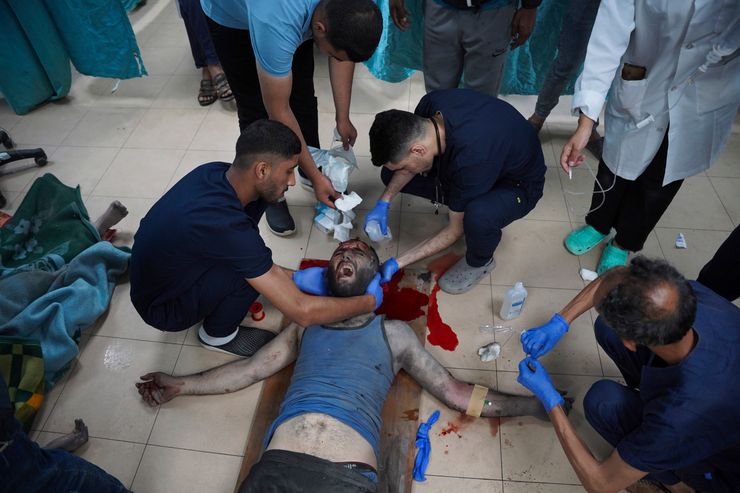
At least 19 people, including eight women and eight children, were killed overnight in central Gaza in strikes that hit Zawaida, Maghazi and Deir al-Balah, according to Al Aqsa Martyrs Hospital and an AP journalist who counted the bodies.
“Children, what is the fault of the children who died?” one relative said. A woman stroked the face of one of the children lying on the ground.
Another round of cease-fire talks in Cairo ended earlier this week without a breakthrough, after Israel rejected a deal that Hamas said it accepted.
Tens of thousands of people attended the latest anti-government protest in Israel on Saturday evening amid growing pressure on Netanyahu to make a deal.
“I think the (Rafah) operation is not meant for the hostages and not meant for killing the Hamas, it’s meant for just for one thing, save the government,” protester Kobi Itzhaki said.
___
Sam Mednick reported from Tel Aviv and Samy Magdy from Cairo. Jack Jeffery contributed to this story from Jerusalem.
___
Follow AP’s coverage of the war at
https://apnews.com/hub/israel-hamas-war