Israeli forces storm the main hospital in southern Gaza, saying hostages were likely held there
Feb 15, 2024
Israeli forces have stormed the main hospital in southern Gaza in what the army says is a limited operation seeking the remains of hostages taken by Hamas
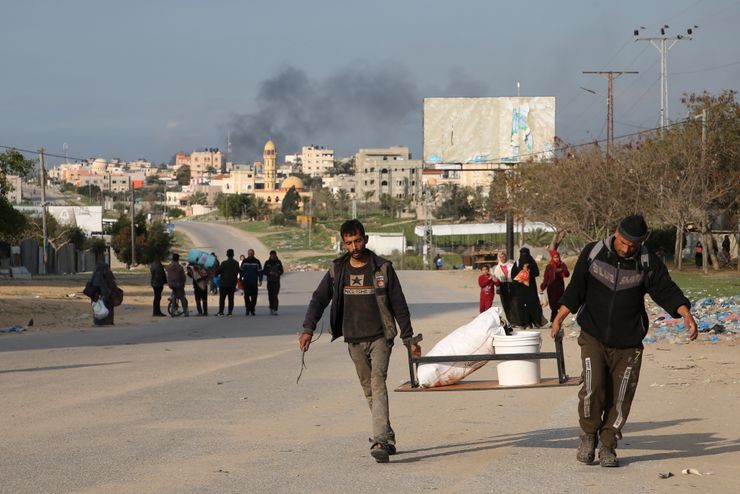
RAFAH, Gaza Strip (AP) — Israeli forces stormed the main hospital in southern Gaza on Thursday, hours after Israeli fire killed a patient and wounded six others inside the complex. The Israeli army said it was a limited operation seeking the remains of hostages taken by Hamas.
The raid came a day after the
army sought to evacuate thousands of displaced
people who had taken shelter at Nasser Hospital in the city of Khan Younis, the focus of Israel's offensive against Hamas in recent weeks. The war shows no sign of ending, and the risk of a broader conflict is growing as Israel and Lebanon's Hezbollah step up attacks after a particularly deadly exchange on Wednesday.The military said it had "credible intelligence” that Hamas had held hostages at the hospital and that the remains of hostages might still be inside. Rear Adm. Daniel Hagari, the chief military spokesperson, said forces were conducting a “precise and limited” operation there and would not forcibly evacuate medics or patients. Israel accuses Hamas of using hospitals and other civilian structures
to shield its fighters
.A released hostage
told The Associated Press
last month that she and over two dozen other captives had been held in Nasser Hospital. International law prohibits the targeting of medical facilities, butthey can lose those protections
if they are used for military purposes.Gaza's Health Ministry spokesperson Ashraf al-Qidra said Israel had launched a “massive incursion” with heavy shooting that wounded displaced people still sheltering there. He said the military had ordered medics to move all patients into an older building that was not properly equipped for their treatment.
“Many cannot evacuate, such as those with lower limb amputations, severe burns, or the elderly,” he said in an interview with the Al Jazeera network.
Separately, Israeli launched airstrikes in southern Lebanon for a second day after
killing 10 civilians and three Hezbollah fighters
on Wednesday in response to a rocket attack that killed an Israeli soldier and wounded several others.It was the deadliest exchange of fire along the border since the start of the Israel-Hamas war. Israel and Hezbollah — an ally of Hamas — have traded fire on a daily basis,
raising the risks of a broader conflict
.Hezbollah has not claimed Wednesday's rocket attack. But Sheikh Nabil Kaouk, a senior member of the group, said it is “prepared for the possibility of expanding the war” and would meet “escalation with escalation, displacement with displacement, and destruction with destruction.”
Negotiations over a cease-fire in Gaza meanwhile
appear to have stalled
, and Israeli Prime Minister Benjamin Netanyahu has vowed tocontinue the offensive
until Hamas is destroyed and scores of hostages taken duringthe Oct. 7 attack
that sparked the war are returned.SCENES OF PANIC IN A HOSPITAL
Nasser Hospital has been the latest focus of operations that have gutted Gaza’s health sector as it struggles to treat scores of patients wounded in daily bombardments.
Video of the aftermath of the strike overnight showed medics scrambling to wheel patients on stretchers through a corridor filled with smoke or dust. A medic used a cellphone flashlight to illuminate a darkened room where a wounded man screamed out in pain as gunfire echoed outside. The Associated Press could not authenticate the videos but they were consistent with its reporting.
Dr. Khaled Alserr, one of the remaining surgeons at Nasser Hospital, told the AP that the seven patients hit early Thursday were already being treated for past wounds.
“The situation is escalating every hour and every minute,” he said.
The military had ordered the evacuation of Nasser Hospital and surrounding areas last month. But as with other health facilities, medics said patients were unable to safely leave or be relocated, and thousands of people displaced by fighting elsewhere remained there.
“People have been forced into an impossible situation," said Lisa Macheiner of the aid group Doctors Without Borders, which has staff in the hospital.
"Stay at Nasser Hospital against the Israeli military’s orders and become a potential target, or exit the compound into an apocalyptic landscape where bombings and evacuation orders are a part of daily life.”
NO END IN SIGHT TO THE MONTHSLONG WAR
The war began when Hamas militants burst through Israel’s formidable defenses on Oct. 7 and rampaged through several communities, killing some 1,200 people and
taking another 250 hostage
. More than 100 of the captives were freed during a cease-fire last year in exchange for 240 Palestinian prisoners.Around 130 captives remain in Gaza, a fourth of whom are believed to be dead. Netanyahu has come under intense pressure from families of the hostages and the wider public to make a deal to secure their freedom, but his far-right coalition partners could bring down his government if he is seen as being too soft on Hamas.
Israel responded to the Oct. 7 attack by launching
one of the deadliest and most destructive military campaigns
in recent history. Over 28,000 Palestinians have been killed, 80% of the population have fled their homes and a quarter are starving amid a worsening humanitarian catastrophe. Large areas in northern Gaza, the first target of the offensive,have been completely destroyed
Hamas has continued to attack Israeli forces in all parts of Gaza, and says it will not release all the remaining captives until Israel ends its offensive and withdraws. Hamas is also demanding the release of a large number of Palestinian prisoners, including top militants.
Netanyahu has rejected those demands, calling them “delusional.” He says Israel will soon expand its offensive into Gaza's southernmost city of Rafah, on the Egyptian border. Over half of Gaza’s population of 2.3 million
has sought refuge in Rafah
after fleeing fighting elsewhere in the coastal enclave.At least 28,663 Palestinians have been killed since the war began, mostly women and children, according to Gaza’s Health Ministry, which does not distinguish between civilians and combatants. Over 68,000 people have been wounded in the war.
Airstrikes late Wednesday in central Gaza killed at least 11 people, including four children and five women, according to hospital records. Relatives gathered around bodies wrapped in white shrouds outside Al-Aqsa Martyrs Hospital in the central town of Deir al-Balah before the remains were placed in a truck to be taken for burial.
One man struggled to let go, lying down and holding one of the bodies on the truck as he wept.
___
Mroue reported from Beirut. Associated Press writers Kareem Chehayeb in Beirut and Melanie Lidman in Jerusalem contributed to this report.
___
Find more of AP’s coverage at
https://apnews.com/hub/israel-hamas-war