Israeli military raid kills 3 in West Bank. Officials say 4th man killed by Israeli fire in Gaza
Sep 19, 2023
Palestinian health officials say at least three people have been killed in an Israeli military raid in the northern West Bank
JERUSALEM (AP) — Israeli troops raided the Jenin refugee camp in the northern West Bank late Tuesday, killing three people and wounding some 30 others, according to Palestinian health officials. A fourth Palestinian was killed by Israeli fire in separate unrest in the Gaza Strip, officials said.
The bloodshed in Jenin was the latest in a deadly wave of fighting in the West Bank, where the Israeli military has stepped up its activities over the past year and a half in what it says is an effort to crack down on Palestinian militants. Tensions now appear to be spreading to Gaza.
The Israeli army gave few details about the operation in the camp — a stronghold of Palestinian militants where the army often carries out deadly raids. In July, Israel launched its
most intense operation in the West Bank
in nearly two decades, leaving widespread destruction in the camp.The army said that forces carried out a rare strike with a suicide drone during the operation and exchanged fire with gunmen in the camp. While leaving the camp, the army said, an explosive detonated underneath an army truck as gunmen opened fire, damaging the vehicle. No soldiers were injured.
Palestinian health officials said three people were killed and some 30 people wounded by Israeli gunfire, some in critical condition.
Videos posted on social media showed medics unloading the wounded at a hospital, while in other videos, explosions and gunfire could be heard echoing in the camp. As Israeli soldiers withdrew, a crowd of young men chanted: “Oh, you who ask, who are we? We are the Jenin Brigade.”
Motasem Abu Hasan, a resident who works at the Freedom Theater in Jenin, a cultural center in the camp, said that he saw drones fire toward a mosque and heard strikes from drones in other locations.
When Israeli forces entered the camp in the evening, the Freedom Theater was hosting its annual Feminist Theater Festival, which attracts a host of foreigners and regional artists.
The fighting erupted outside the door of the theater, spoiling the night’s performances and forcing all the attendees to hunker down inside. “It was incredibly difficult on us, you had all elderly people and small children cramming together, all terrified,” said Abu Hasan.
All the attendees’ cars that were parked outside the theater were destroyed. “It’s so much pressure and we just wanted to try to complete the show, to help people here feel like they’re human,” he said.
After the Israeli military withdrew, dozens of gunmen and residents poured into the streets to protest against the Palestinian Authority and its failure to protect them, according to footage shared by residents.
“You infidel! You heretic!” they screamed as they chanted Palestinian President Mahmoud Abbas' name.
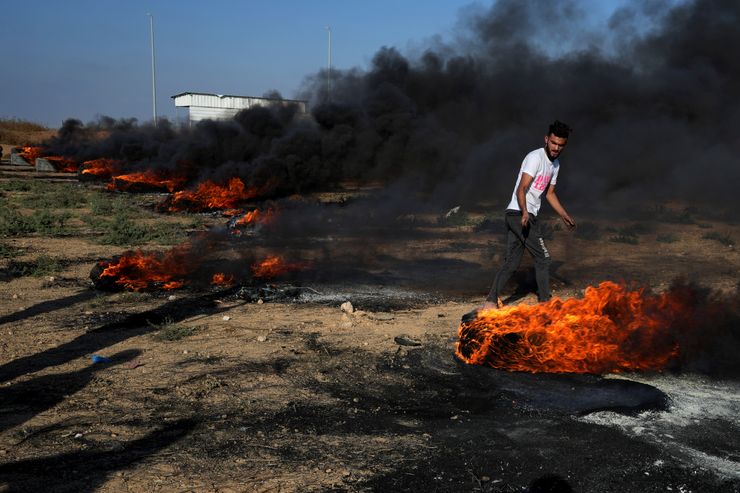
In Gaza, meanwhile, health officials said the Israeli military killed a 25-year-old Palestinian along the volatile border with Israel as youths mounted violent protests at the separation fence.
Unrest over the past week has escalated tensions and prompted Israel to bar entry to thousands of Palestinian laborers from the impoverished enclave.
The army said it had opened fire after hundreds of people gathered along the separation fence and detonated a number of explosive devices. It confirmed shooting several people, but had no details on their conditions.
Palestinian officials in Gaza confirmed one death and said nine people were wounded, one critically.
Over the last week, dozens of Palestinians — burning tires and
hurling explosive devices at Israeli soldiers
— have streamed toward the fence separating Israel from Gaza, which has been under an Israeli-Egyptian blockade since 2007. Israel says the blockade is needed to prevent the ruling Hamas militant group from arming itself.Hamas says youths have organized the protests in response to Israeli provocations.
The week’s events recall a
bloody protest campaign organized by Hamas
in 2018 and 2019 during which over 350 Palestinians were killed by Israeli fire.Earlier Tuesday, the Israeli military sentenced an army commander in
the occupied West Bank
to 10 days in military prison after an investigation found he had shot an innocent Palestinian motorist.The Israeli military said security forces stationed at the Israeli settlement of Rimonim, east of Jerusalem, had received reports of gunshots and spotted a Palestinian vehicle they believed to be behind the shooting.
The forces opened fire at the Palestinian man's car, the military said, hitting and wounding the 23-year-old driver, Mazen Samarat. The army arrested him and took him to a hospital for treatment before releasing him the next day.
An Israeli military investigation determined the army's shooting was the result of mistaken identity. “This is a serious incident in which the force acted contrary to procedures,” the army said, announcing that the force's commander had been sentenced to 10 days in military prison.
The driver, Samarat, a water mechanic from the Palestinian city of Jericho, remains in the hospital, unable to get up from his bed because of the gunshot wound to his leg.
He told The Associated Press that he and his cousin had been driving home after hanging out with friends in the city of Ramallah. He said he had no idea what prompted the gunfire.
“I thought I was dead,” he said. “In that moment they changed my entire life.”
Rights groups
have accused Israeli soldiers and police officers of being too quick to pull the trigger, particularly in response to arecent surge in attacks by Palestinians
that have killed 31 people so far this year.Critics also have noted that Israeli military investigations into accusations of crimes committed against Palestinians
rarely lead to prosecutions in the West Bank
, which Israel captured along with east Jerusalem and the Gaza Strip from Jordan in the 1967 Mideast war.