Live updates | A deal to get medicine to Hamas hostages includes aid for Gaza
Jan 17, 2024
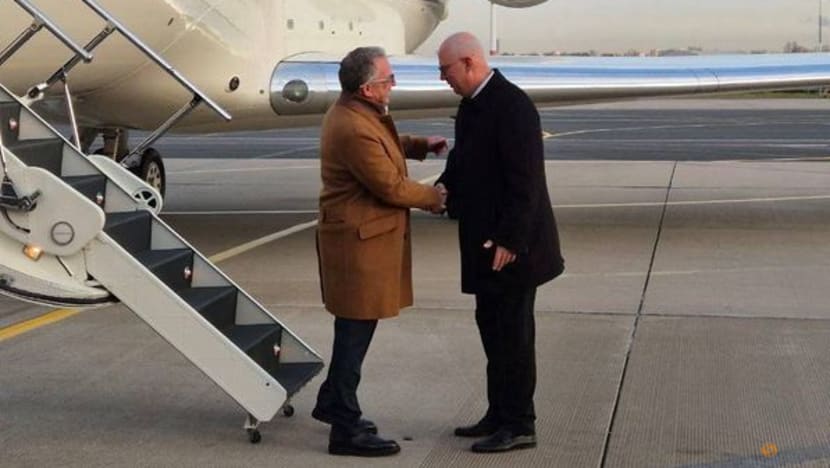
Medicine for hostages is en route to Gaza after Qatar and France mediated a deal between Israel and Hamas
Medicine for hostages was en route to Gaza on Wednesday after Qatar and France mediated a deal between Israel and Hamas — the first agreement between the two since a weeklong cease-fire broke down in November.
The deal came more than 100 days into a conflict that shows no sign of ending and has sparked tensions across the Middle East, with
a dizzying array of strikes and counterstrikes
in recent days from northern Iraq to the Red Sea and from southern Lebanon to Pakistan.The United States launched the third strike
in recent days
against the Houthi rebel group in Yemen, according to a U.S. official. The Houthis have attacked shipping in the crucial Red Sea corridor, saying they seek to haltIsrael’s war in Gaza against Hamas
.In northern Gaza, Palestinian militants battled Israeli forces and launched a barrage of rockets from farther south. The Palestinian death toll rose to 24,285 people, Gaza's Health Ministry said Tuesday. In Israel, around 1,200 people were killed during
Hamas' Oct. 7 attack
that sparked the war and saw some 250 people taken hostage by the militants.Currently:
— A
freed Israeli hostage relives the horrors
of captivity. She fears for her husband, still held in Gaza.— U.S. Senators
reject Bernie Sanders’ effort to curb
Israel-Hamas war. The vote signals rising unease.—
Iran attacks alleged militant bases
in Pakistan. Islamabad says unprovoked strikes kill 2 children.— A chaotic wave of attacks and reprisals in the Middle East
fuel worries of a broader regional war
.— Find more of AP's coverage at
https://apnews.com/hub/israel-hamas-war
.Here's the latest:
UN AGENCY SEEKS REVIEW OF ALLEGED PRO-HAMAS ACTIVITY IN ITS RANKS
JERUSALEM — The head of the U.N. agency for Palestinian refugees says he has requested an independent review of claims by pro-Israel groups of unchecked pro-Hamas activity in his organization.
Philippe Lazzarini told reporters Wednesday he would soon appoint a professional consulting group or some other “independent entity” to look into the claims.
Israeli officials and their allies have repeatedly alleged that the refugee agency, known by its acronym UNRWA, allows anti-Israeli incitement to be taught in its hundreds of schools. They also alleged that some of the agency's tens of thousands of staff members support or collaborate with the Hamas militant group or have written inappropriate social media posts.
UNRWA serves millions of Palestinians across the Middle East whose families fled or were forced from properties inside what is Israel during the war surrounding Israel’s creation in 1948. Israel rejects a return of the refugees to their former lands, saying it would undermine the country’s Jewish character.
Those pushing back against the allegations say the refugee agency is being tarnished as part of a campaign diminish the long-festering issue of Palestinian refugees and their descendants. Israeli critics have accused UNRWA of perpetuating the Palestinian refugee issue – a charge Lazzarini rejected.
Lazzarini said Wednesday that the behavior alleged by critics runs counter to the U.N.’s principles and that his agency has internal safeguards to deal with violations.
But he said the “constant scrutiny” has had an impact on the agency’s already stretched operations by encouraging some donor nations to consider defunding the organization. He said it also has hurt morale at a time when UNRWA is conducting “this huge humanitarian operation in Gaza.”
Lazzarini said he wants the review to determine “what is true or untrue” and to look at how the agency deals with problematic cases. He says he is confident the investigation will find there is “no systemic policy” violating U.N. standards and that there is a proper system of oversight in place.
He said the assessment would also look at “what is disingenuous, what is politically motivated” among the critics.
JORDAN SAYS A MEDIC FROM A HOSPITAL IT RUNS WAS WOUNDED IN GAZA
AMMAN, Jordan — The Jordanian military says a medic working at a field hospital it operates in Gaza was wounded by clashes nearby.
An army statement released Wednesday said the individual was wounded in the thigh and hand and would be evacuated to the kingdom. It did not provide further details about the individual.
It said a Palestinian who was receiving treatment was also wounded. It says the hospital in Khan Younis suffered “severe material damage” as a result of “continuous Israeli bombing” nearby.
The Israeli military said it was looking into the incident.
Jordan’s military says it holds Israel responsible for the safety of the hospital’s staff and described the attack on the hospital as a “flagrant violation of international humanitarian law.”
Jordan, a close Western ally, made peace with Israel in 1994 but supports the Palestinian cause and has repeatedly called for a cease-fire in Gaza.
ISRAELI ARMY TRAINS FOR A POSSIBLE OFFENSIVE IN LEBANON
JERUSALEM — The Israeli army has held a training exercise simulating an offensive in southern Lebanon as it continues to exchange fire with Hezbollah fighters along the border.
Maj. Gen. Ori Gordin, head of the army’s Northern Command, said in a statement issued Tuesday: “We’re more prepared for this than ever before, even for tonight if needed.”
More than 2,000 rockets have been fired toward Israel from Lebanon, the home of Hezbollah, since the start of the war in Gaza, killing 12 Israeli soldiers and six civilians, including a mother and son on Monday.
Israel’s airstrikes in Lebanon have killed around 150 militants and 20 civilians, according to Hezbollah. Earlier this week, Israel said it stopped an infiltration of militants into the contested Golan Heights.
Gordin says reserve soldiers are spread out along the border to bolster Israel’s defenses.
Hezbollah says its attacks are aimed at tying down Israeli forces
and will continue until there is a cease-fire in Gaza
. Israel has warned of an all-out war if Hezbollah does not pull back from the border in accordance with a U.N. resolution that ended the 2006 Israel-Hezbollah war.HAMAS OFFICIAL: GAZA RESIDENTS TO GET MEDICINE AS PART OF HOSTAGE AID DEAL
CAIRO — Hamas has provided more details about an agreement brokered by France and Qatar to deliver medicine to Israeli hostages held by its fighters in Gaza.
Senior Hamas official Moussa Abu Marzouk said Wednesday that for each box of medicine provided to the hostages, 1,000 boxes would be sent for use by Palestinian civilians.
In a posting on X, he said the International Committee of the Red Cross would deliver all the medicines, including those destined for the hostages, to hospitals serving all parts of Gaza.
The agreement also includes the delivery of additional food and humanitarian aid to Gaza.
Abu Marzouk says Israeli authorities will not have the chance to inspect the shipments. He says Hamas insisted that Qatar provide the medications and not France because of the European country’s support for Israel.
This is the first agreement reached between the warring sides since a weeklong cease-fire in November. Hamas and other militants are still holding around half of the estimated 250 hostages they captured during the Oct. 7 attack that triggered the war. Most of the rest were freed in November in return for the release of Palestinians imprisoned by Israel.
Those remaining in captivity in Gaza include several older men and others who require medication for chronic illness.
ISRAELI AIRSTRIKE IN WEST BANK KILLS SENIOR PALESTINIAN MILITANT, ARMY SAYS
JERUSALEM — The Israeli army says it killed a senior Palestinian militant in an airstrike in the West Bank.
Ahmed Abdullah Abu Shalal, who the Israeli military said was responsible for infrastructure and had planned multiple attacks against Israelis in Jerusalem, was killed along with four others early Wednesday in the built-up Balata refugee camp in the city of Nablus.
The Palestinian Red Crescent says Israeli forces prevented medics from reaching the site of the strike, saying in a social media post that “gunfire was directed at our teams.”
The military alleged that Abu Shalal and his cell planned to carry out an imminent attack and had received funding and guidance from “Iranian sources.” It did not provide evidence for the allegation.
Violence has surged in the Israeli-occupied West Bank
since the start of the war in Gaza. Over 350 Palestinians have been killed in the last three months, according to the Palestinian Health Ministry, mainly during Israeli arrest raids and violent protests.Israel has increasingly used airstrikes in the West Bank as the fighting has grown more intense, but targeted killings are still relatively rare in the territory.