Live updates | Only a cease-fire deal can win hostages' release, an Israeli War Cabinet member says
Jan 19, 2024
A member of Israel’s War Cabinet says that only a cease-fire deal can win the release of dozens of hostages held by Hamas in Gaza
A member of Israel’s War Cabinet says that only a cease-fire deal can win the release of dozens of hostages held by Hamas in Gaza. Gadi Eisenkot added that those claiming hostages can be freed through military pressure were spreading illusions.
The former army chief 's comments, broadcast on Israel’s Channel 12 television station late Thursday, were the latest sign of a growing rift among political and military leaders over the direction of Israel’s war on Hamas.
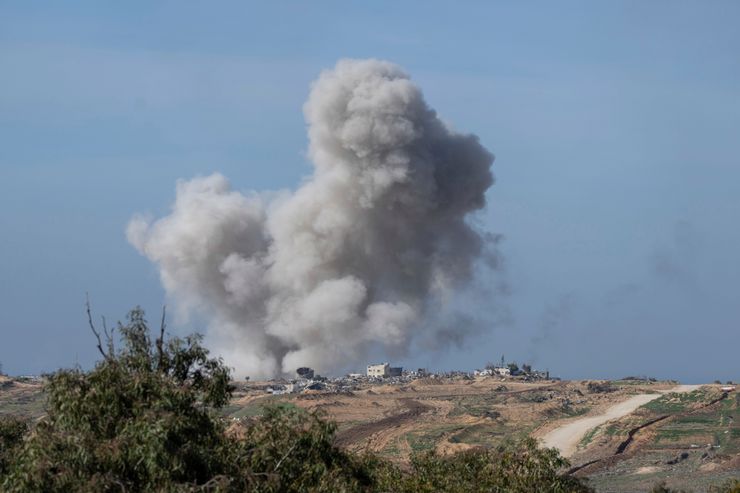
Across the Gaza Strip, Hamas militants are putting up stiff resistance. The conflict, now in its fourth month and showing no sign of ending, has also
inflamed tensions across the Middle East
.Gaza’s Health Ministry
says more than 24,400 Palestinians have died, and the United Nations saysa quarter of the 2.3 million people
trapped in Gaza are starving. In Israel, around 1,200 people were killed during theOct. 7 attack
by Hamas that sparked the war and saw some 250 people taken hostage by militants.Currently:
—
EU Parliament adopts a resolution
calling for a permanent cease-fire in Gaza, but says Hamas must go.— Mexico and Chile ask International Criminal Court to
investigate possible crimes in Gaza
.— Snubbed by Netanyahu, the Red Cross toes a fine line
trying to help civilians
in the Israel-Hamas conflict.— Another Turkish soccer club
ends its contract with an Israeli player
over his posting on Gaza hostages.— Find more of AP's coverage at
https://apnews.com/hub/israel-hamas-war
.Here's the latest:
A MEMBER OF ISRAEL'S WAR CABINET SAYS LOUD OBJECTIONS PREVENTED A ‘STRATEGIC MISTAKE’ EARLY IN THE WAR
JERUSALEM — A member of Israel’s War Cabinet confirmed reports that, early in the war against Hamas, an Israeli preemptive strike against Lebanon’s Hezbollah militia was called off at the last minute.
Gadi Eisenkot, a former army chief, said he was among those arguing against such a strike in what he described as a stormy Oct. 11 Cabinet meeting that left him hoarse from shouting.
Such a strike would have been a “strategic mistake” and would likely have triggered a regional war, Eisenkot said in a wide-ranging interview late Thursday with the investigative program “Uvda” on Israel’s Channel 12 TV. The interview marked the first time Eisenkot spoke in public about the handling of the war.
Eisenkot said loud objections raised by him and others during the Cabinet session were key to preventing the strike.
Since the Oct. 7 start of the war, Israel and Hezbollah have traded cross-border strikes with gradually escalating intensity. Neither side is believed to seek an all-out war which is bound to devastate both countries. Hezbollah is believed to have tens of thousands of missiles that can reach any target in Israel.
NETANYAHU'S REJECTION OF A TWO-STATE SOLUTION GOES AGAINST THE OSLO ACCORDS, NORWAY’S FOREIGN MINISTER SAYS
COPENHAGEN, Denmark — Norwegian Foreign Minister Espen Barth Eide told Norway’s news agency NTB that Israeli Prime Minister Benjamin Netanyahu's rejection of a two-state solution was "completely contrary to the agreements Israel and the PLO (Palestine Liberation Organization) entered into in Oslo.”
“The Israeli Prime Minister’s statements are out of step with an almost unified international community,” Barth Eide said in a statement to NTB.
The Norwegian foreign minister said that “a real political solution is needed” to solve the situation.
“Norway believes that there is no credible alternative to a two-state solution, just like the Palestinians themselves, the USA, the EU, the U.N. and the neighboring Arab countries,” Barth Eide said.
A MEMBER OF ISRAEL'S WAR CABINET SAYS ONLY A CEASE-FIRE DEAL CAN BRING HOSTAGES HOME
JERUSALEM — A member of Israel’s War Cabinet said that only a cease-fire deal can win the release of dozens of hostages held by Hamas in Gaza and that those claiming they can be freed through military pressure are spreading illusions.
Former army chief Gadi Eisenkot, whose son was killed several weeks before while fighting in Gaza, told the investigative program “Uvda,” broadcast on Israel’s Channel 12 television station late Thursday, that “the hostages will only return alive if there is a deal, linked to a significant pause in fighting.”
He said dramatic rescue operations are unlikely because the hostages are apparently spread out, many of them in underground tunnels. Claiming hostages can be freed by means other than a deal “is to spread illusions.”
Prime Minister Benjamin Netanyahu and Defense Minister Yoav Gallant have said the fighting will continue until Hamas is crushed, and argued that only military action can win the release of the hostages.
In a thinly veiled criticism of Netanyahu, Eisenkot also said strategic decisions about the direction of the war, now in its fourth month, must be made urgently, and that a discussion about an endgame should have begun immediately after fighting started Oct. 7 in response to the deadly Hamas attack on southern Israel.
THERE CAN BE NO SECURITY WITHOUT A PALESTINIAN STATE, THE PRESIDENT'S SPOKESPERSON SAYS
RAMALLAH, West Bank — The spokesperson for Palestinian President
Mahmoud Abbas
says there can be “no security and stability in the region” without a Palestinian state.The remarks come in response to Israeli Prime Minister
Benjamin Netanyahu's rejection Thursday
of calls by the United States to take steps toward the establishment of a Palestinian state after the war.“Without the establishment of an independent Palestinian state with East Jerusalem as its capital on the borders of 1967, there will be no security and stability in the region,” Palestinian state news agency Wafa quoted Abbas’ spokesperson Nabil Abu Rdeineh as saying Thursday. The Palestinians seek Gaza, the West Bank and east Jerusalem — which were captured by Israel in 1967 — for their state.