Misery deepens in Gaza's Rafah as Israeli troops press operation
May 13, 2024
Aid workers are struggling to distribute dwindling food to hundreds of thousands of Palestinians displaced by what Israel says is a limited operation in Rafah
RAFAH, Gaza Strip (AP) — Aid workers struggled Monday to distribute dwindling food and other supplies to hundreds of thousands of Palestinians displaced by what Israel says is a limited military operation in Rafah, as the two main crossings near the southern Gaza city remained closed.
The United Nations' agency for Palestinian refugees said 360,000 Palestinians have fled Rafah over the past week, out of 1.3 million who were sheltering there before the operation began. Most had already fled fighting elsewhere during
the seven-month war between Israel and Hamas
.Israel has portrayed Rafah as the last stronghold of the militant group, brushing off warnings from the United States and other allies that any major operation there would be catastrophic for civilians.
Hamas has meanwhile regrouped
and is battling Israeli forces in parts of Gaza that Israel bombarded and invaded earlier in the war.U.N. deputy spokesman Farhan Haq said Monday that another 100,000 Palestinians have been displaced in northern Gaza following recent Israeli evacuation orders there. That would mean that around a fifth of Gaza's population of 2.3 million people have been displaced over the past week.
Thirty-eight trucks of flour arrived through the western Erez Crossing, a second access point to northern Gaza, said Abeer Etefa, a spokeswoman for the U.N.’s World Food Program. Israel announced the crossing's opening Sunday.
But no food has entered the two main crossings in southern Gaza for the past week.
The Rafah crossing into Egypt has been closed since Israeli troops seized it a week ago. Fighting in Rafah city has made it impossible for aid groups to access the nearby Kerem Shalom crossing with Israel, though Israel says it is allowing supply trucks to enter from its side.
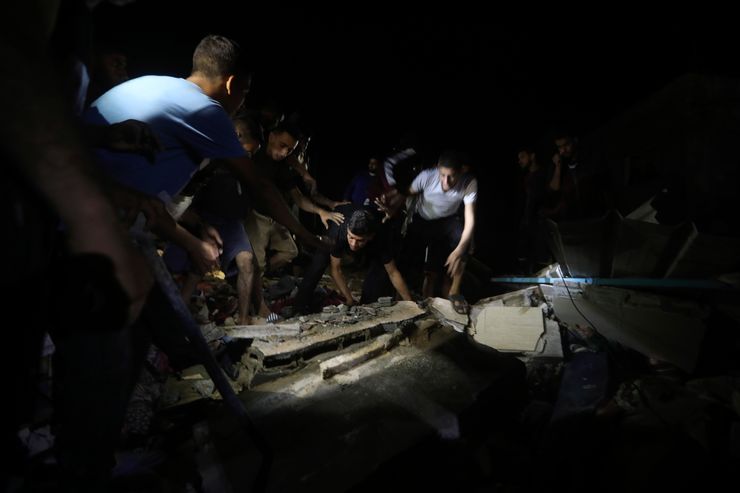
For the past week, the Israeli military has intensified bombardment and other operations in Rafah while ordering the population to evacuate from parts of the city. Israel insists it is a limited operation focused on rooting out tunnels and other militant infrastructure along the border with Egypt.
Israeli forces were also battling Palestinian militants in Zeitoun and the urban Jabaliya refugee camp in northern Gaza, areas where the army had launched major operations earlier in the war.
Etefa said WFP was distributing food from its remaining stocks in the areas of Khan Younis in the south and Deir al-Balah farther north, where many of those escaping Rafah have fled.
Inside Rafah, only two organizations partnering with WFP were still able to distribute food, and no bakeries were operating.
“The majority of distributions have stopped due to the evacuation orders, displacement and running out of food,” she said.
Israeli protesters halted a convoy of aid bound for Gaza at a checkpoint between the occupied West Bank and Israel. Videos circulating online showed them hurling some of the aid off trucks and destroying it. Police said a number of arrests were made, without elaborating.
Almost the entire population of Gaza relies on humanitarian aid to survive. Israeli restrictions and ongoing fighting have hindered humanitarian efforts, causing widespread hunger and a
“full-blown famine”
in the north, according to the U.N.The director of the Kuwait Hospital, one of the last functioning medical centers in Rafah, said medical staff and residents living near the facility have been told to evacuate. Sohaib al-Hams warned that any evacuation of the hospital itself would have “catastrophic consequences.”
The international charity Oxfam, meanwhile, warned of disease outbreaks in Gaza following an estimated $210 million worth of damage to water and sanitation infrastructure, mass displacement and the onset of summer.
“Oxfam staff in Gaza have described piles of human waste and rivers of sewage in the streets, which people are having to jump between. They also reported people having to drink dirty water and children being bitten by insects swarming around the sewage,” it said in a statement.
The war began when Hamas and other militants stormed into southern Israel on
Oct. 7
, killing around 1,200 people, mostly civilians, and taking another 250 hostage. Militants still hold about 100 captives and the remains of more than 30 after most of the rest were released during a cease-fire last year.Israel’s offensive has killed more than 35,000 Palestinians, mostly women and children, according to Gaza’s Health Ministry, which doesn’t distinguish between civilians and combatants in its figures. Israel says it has killed over 13,000 militants, without providing evidence.
Israel marked
an especially somber Memorial Day
on Monday, with ceremonies commemorating fallen soldiers, including the more than 600 killed since Oct. 7, more than half of them in the initial attack. Sirens announced two minutes of silence at 11 a.m.At a ceremony at Mount Herzl cemetery on the outskirts of Jerusalem, Israeli Prime Minister Benjamin Netanyahu vowed once again to defeat Hamas.
“We exacted and will exact a high price from the enemy for their criminal acts. We will realize the goals of victory and at the center of them the return of all our hostages,” he said.
Protesters and hecklers interrupted some of the ceremonies, reflecting growing discontent with Israel's leaders that has brought thousands of protesters into the streets in recent months. Critics blame Netanyahu for the security and intelligence failures that allowed the attack to happen and for the failure to reach a deal with Hamas to release the hostages.
Months of internationally mediated talks over a cease-fire and hostage release ground to an apparent standstill last week after Israel launched its incursion into Rafah. Israel has refused Hamas' central demands for an end to the war and the withdrawal of its forces from the territory, saying that doing so would allow the militant group to regain control and launch more Oct. 7-style attacks.
U.S. President Joe Biden's administration, which has provided crucial military and diplomatic support for the overall offensive, has expressed growing impatience with Israel, saying it won't supply offensive arms for a full-scale Rafah assault.
Secretary of State Antony Blinken warned Sunday that
Israel could face an "enduring insurgency"
if it doesn't come up with a realistic plan for postwar governance in Gaza.Israel has rejected U.S. proposals
for the Palestinian Authority to govern Gaza with help from Arab states because those plans depend on progress toward the establishment of a Palestinian state, which Netanyahu opposes.___
Krauss reported from Jerusalem and Magdy from Cairo. Associated Press writers Lee Keath in Cairo, Jack Jeffery in Jerusalem and Edith Lederer at the United Nations contributed.
___
Follow AP’s coverage of the war at
https://apnews.com/hub/israel-hamas-war