Navalny's family is laying the opposition leader to rest after his death in prison
Mar 1, 2024
Relatives and supporters of Alexei Navalny are bidding farewell to the opposition leader at a funeral in southeastern Moscow, following a battle with authorities over the release of his body after his still-unexplained death in an Arctic penal colony
Relatives and supporters of
Alexei Navalny
are bidding farewell to the opposition leader at a funeral Friday in southeastern Moscow, following a battle with authorities over the release of his body after his still-unexplained death in an Arctic penal colony.His supporters say several churches in Moscow refused to hold the service before Navalny’s team got permission from one in the capital’s Maryino district, where he once lived before his 2020 poisoning, treatment in Germany and subsequent arrest on his return to Russia.
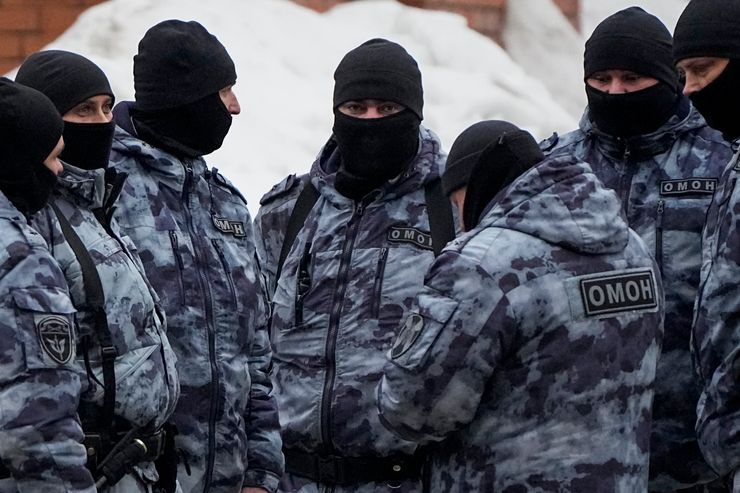
The Church of the Icon of the Mother of God Soothe My Sorrows, which agreed to hold the service, did not mention it on its social media page. Authorities lined the road from from a nearby subway station to the church with crowd-control barriers, and riot police deployed in big numbers early Friday.
Burial was to follow in the nearby Borisovskoye Cemetery, where police also showed up in force.
Navalny's mother, Lyudmila Navalnaya, spent eight days trying to get authorities to release the body following his Feb. 16 death at Penal Colony No. 3 in the town of Kharp, in the Yamalo-Nenets region about 1,900 kilometers (1,200 miles) northeast of Moscow.
Authorities originally said they couldn't turn over the body because they needed to conduct post-mortem tests. Navalnaya, 69, made
a video appeal
to President Vladimir Putin to release the body so she could bury her son with dignity.Once it was released, at least one funeral director said he had been “forbidden” to work with Navalny’s supporters, the spokeswoman for Navalny's team, Kira Yarmysh, said on social media. They also were unable to find a hearse for the funeral.
“Unknown people are calling up people and threatening them not to take Alexei’s body anywhere,” Yarmysh said Thursday.
Russian authorities still haven’t announced the cause of death for Navalny, 47, who crusaded against official corruption and organized big protests as Putin’s fiercest political foe. Many Western leaders
blamed the death on the Russian leader, which the Kremlin angrily rejected
.It was not immediately clear who among Navalny’s family or allies would attend the funeral, with many of his associates in exile abroad due to fear of prosecution in Russia. Navalny’s Foundation for Fighting Corruption and his regional offices were designated as “extremist organizations” by the Russian government in 2021.
The politician’s team said the funeral would be streamed live on Navalny’s YouTube channel.
His widow,
Yulia Navalnaya
, accused Putin and Moscow Mayor Sergei Sobyanin of trying to block a public funeral.“We don’t want any special treatment — just to give people the opportunity to say farewell to Alexei in a normal way,” Yulia Navalnaya wrote on X. In a speech to European lawmakern Wednesday in Strasbourg, France, she also expressed fears that police might interfere with the gathering or would "arrest those who have come to say goodbye to my husband.”
Moscow authorities refused permission for a separate memorial event for Navalny and slain opposition leader Boris Nemtsov on Friday, citing COVID-19 restrictions, politician Yekaterina Duntsova said Thursday. Nemtsov, a 55-year-old former deputy prime minister, was shot to death as he walked on a bridge adjacent to the Kremlin on the night of Feb. 27, 2015.
Yarmysh also urged Navalny's supporters around the world to lay flowers in his honor Friday.
“Everyone who knew Alexei says what a cheerful, courageous and honest person he was,” Yarmysh said Thursday. “But the greater truth is that even if you never met Alexei, you knew what he was like, too. You shared his investigations, you went to rallies with him, you read his posts from prison. His example showed many people what to do when even when things were scary and difficult.”
Ivan Zhdanov, director of Navalny’s Anti-Corruption Foundation, said that his funeral had initially been planned for Thursday — the day of Putin’s annual state-of-the-nation address — but no venue agreed to hold it then.
In an interview with the independent Russian news site Meduza, Zhdanov said authorities had pressured Navalny’s relatives to “have a quiet family funeral.”