Nearly two years after invasion, West still seeking a way to steer frozen Russian assets to Ukraine
Jan 18, 2024
The U.S. and its allies are looking for a legal way to unfreeze $300 billion in Russian Central Bank funds sitting mostly in Europe and use them for the benefit of Ukraine
WASHINGTON (AP) — It's been nearly two years since the United States and its allies froze hundreds of billions of dollars in Russian foreign holdings in retaliation for
Moscow's invasion of Ukraine
. That roughly $300 billion in Russian Central Bank money has been sitting untapped as the war grinds on, while officials from multiple countries have debated the legality of sending the money to Ukraine.The idea of using Russia's frozen assets is gaining new traction lately as continued allied funding for Ukraine becomes more uncertain and the U.S. Congress is in a stalemate over providing more support. But there are tradeoffs since the weaponization of global finance could harm the U.S. dollar's standing as the world's dominant currency.
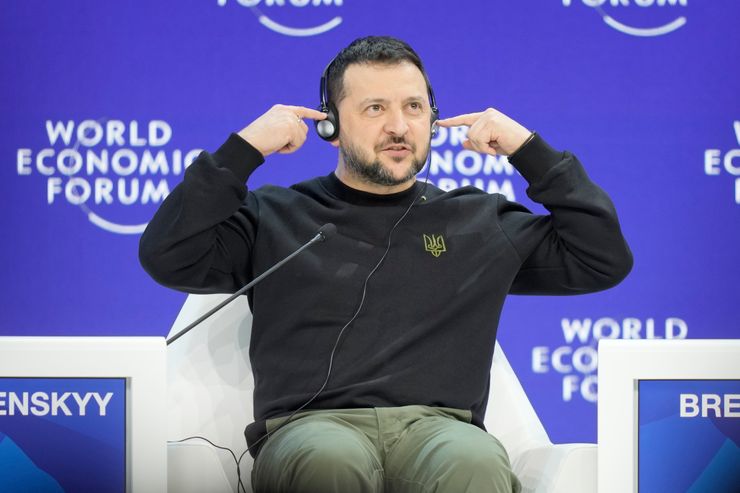
At this week's World Economic Forum meetings in Davos, Switzerland, Ukrainian President
Volodymyr Zelenskyy
called for a “strong” decision this year for the frozen assets in Western banks to “be directed towards defense against the Russian war and for reconstruction” of Ukraine.“Putin loves money above all,” he said. “The more billions he and his oligarchs, friends and accomplices lose, the more likely he will regret starting this war.”
Biden administration officials who previously dismissed the idea as legally cumbersome are showing growing openness to the idea.
Penny Pritzker, the U.S. special representative for Ukraine’s economic recovery, said at the Davos forum that the U.S. and Group of Seven allies are still looking for an adequate legal framework to pursue the plan.
“Get all the lawyers and all the various governments and all the parties really to come together to sort that through,” she said. “It’s hard, it’s complicated, it’s difficult, and we need to work.”
Administration officials caution that even if a legal way can be found to transfer the frozen dollars to Ukraine, the war-torn nation has immediate needs for funds that must be met by other means since U.S. assistance to Ukraine's military
has ground to a halt.
Bipartisan legislation circulating in Washington called the
Rebuilding Economic Prosperity and Opportunity for Ukrainians Act
would use assets confiscated from the Russian Central Bank and other sovereign assets for Ukraine.A senior official who spoke on condition of anonymity to relay internal discussions said the administration was generally supportive of legislation to give the U.S. more flexibility in making sure Russia pays for the damage it has caused and is in “active conversations” with allies on how best to do that.
But even if legislation were enacted, Nicholas Mulder, a sanctions expert at Cornell University, cautioned that seizing frozen assets could have the unintended effect of undermining efforts to ensure longer-term funding for Ukraine.
“Right now it is being advanced by Washington as a substitute rather than a complement to long-term Western support for Ukraine,” he said. “If the assets are transferred, these funds too will run out sooner or later. But by that time Western leaders will have ceased to make any political case for supporting Ukraine, and getting support back up will be much harder."
The U.S. announced at the start of Russia’s invasion that America and its allies had blocked access to more than $600 billion that Russia held outside its borders — including roughly $300 billion in funds belonging to Russia's Central Bank. Since then, the U.S and its allies have continued to impose rounds of targeted sanctions against companies and the wealthy elite with ties to Russian President Vladimir Putin.
The World Bank’s latest
damage assessment
of Ukraine, released in March 2023, estimates that costs for reconstruction and recovery of the nation stand at $411 billion over the next 10 years, which includes needs for public and private funds.Since the war began in February 2022, the United States has given
Ukraine roughly $111 billion in weapons, equipment, humanitarian assistance
and other aid. Other countries also have provided Ukraine with substantial support — the U.K. announced a $3 billion assistance package on Friday.At the White House, Office of Management and Budget Director Shalanda Young this month told a group of reporters that while the possibility of seizing Russian assets is being studied, it would not have an immediate impact on Ukraine's financial needs.
“That does not absolve the need to provide funding now,” Young said. "That is a future benefit to Kyiv I think we should look at and take seriously.”
Sergey Aleksashenko, a former Russian Central Banker who is now a member of the
Russian Antiwar Committee
with other dissidents, said that while he strongly believes Russia should be forced to compensate Ukraine, "I do not believe that there is any way to confiscate assets of the Russian Central Bank without a court deciding on the matter.”“Because if there is no legal basis to confiscate Russian assets, and if it is done by the decision of the administration, that means that there is no rule of law in the U.S. and there is no protection of private property.”
He said an administrative decision to confiscate Russia's assets could prompt nations like China — the biggest holder of U.S. Treasuries — to determine that it is not safe to keep its reserves in U.S. dollars.
There are some efforts under way to seize Russian funds and those of sanctioned oligarchs under limited circumstances. Last May, the Justice Department announced that it had transferred $5.4 million seized from Russian tycoon Konstantin Malofeyev to a State Department fund for rebuilding Ukraine.
And in December, Germany’s federal prosecutor
filed a motion for asset forfeiture
concerning more than 720 million euros ($789 million) deposited by a Russian financial institution in a Frankfurt bank account because of a suspected attempt to violate embargo regulations.Belgium, which is holding the rotating presidency of the European Union bloc for the next six months, is now leading the talks on whether to seize Russia's assets. Belgium is also the country where most frozen Russian assets under sanctions are being held.
The country is collecting taxes on the assets. Belgian Prime Minister Alexander De Croo said in October that 1.7 billion euros ($1.8 billion) in tax collections was already available and that the money would be used to buy military equipment, humanitarian aid and help with the rebuilding of the war-torn country.
But EU countries are worried that going further by confiscating the assets could pave the way for serious legal problems and could also destabilize the financial system.
De Croo said this week he is hearing “a lot of prudence” when the issue of seizing assets is raised.
“It's crucial that we stay within a legal framework,” he said.
Maria Snegovaya, a senior fellow at the Center for Strategic and International Studies, cautioned that if Ukraine's immediate needs aren't met, “no amount of seized Russian assets is unfortunately going to compensate for what may happen."
"And by then it is going to be very overwhelming.”
___
Associated Press writers Ellen Knickmeyer, Lisa Mascaro, Seung Min Kim, Zeke Miller and Aamer Madhani in Washington and Sam Petrequin in Brussels and Jamey Keaton in Davos contributed to this report.