Putin pays tribute to Russian national unity as fighting grinds on in Ukraine
Feb 29, 2024

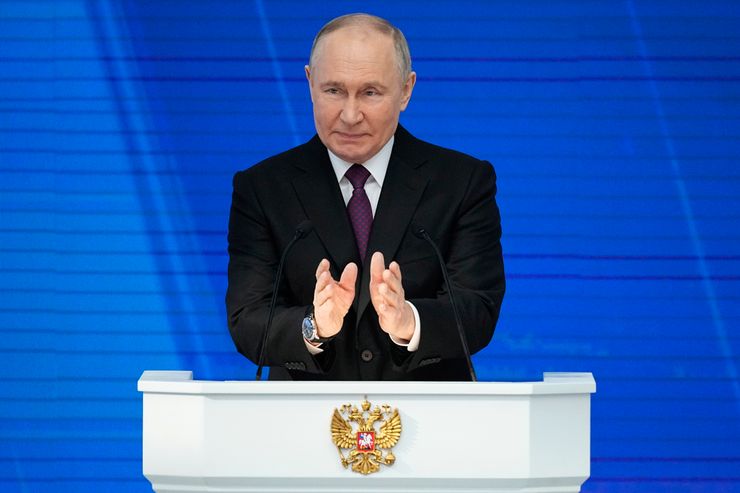
President Vladimir Putin has hailed Russian national unity, even as fighting rages on in Ukraine, in a state-of-the-nation address ahead of next month’s election he’s all but certain to win

MOSCOW (AP) — President

Vladimir Putin

on Thursday hailed Russian national unity, even as fighting raged on in Ukraine, in a state-of-the-nation address ahead of next month’s

election

he’s all but certain to win.

Speaking to an audience of lawmakers and top officials televised live nationwide, Putin said that Russia was “defending its sovereignty and security and protecting our compatriots” in Ukraine.

He hailed Russian soldiers and honored those who were killed in fighting with a moment of silence.

Putin, 71, who is running as an independent candidate in the March 15-17 presidential election, relies on the tight control over Russia’s political system that he has established during

24 years in power

.

Prominent critics who

could challenge him

have either been imprisoned or are living abroad, while most independent media have been banned, meaning that Putin’s reelection is all but assured. He faces token opposition from three other candidates nominated by Kremlin-friendly parties represented in parliament.

Russia’s best-known opposition leader Alexei Navalny

, whose attempt to run against Putin in 2018 was rejected,

died suddenly in an Arctic prison colony

earlier this month, while serving a 19-year sentence on extremism charges. Navalny’s funeral is set for Friday.

Putin has repeatedly said that he sent troops into Ukraine in February 2022 to protect Russian interests and prevent Ukraine from posing a major security threat to Russia by joining NATO. Kyiv and its allies have denounced it as an unprovoked act of aggression.

The Russian leader has repeatedly signaled a desire to negotiate an end to the fighting but warned that Russia will hold onto its gains.

More News

Record El Niño? Depends who’s counting
Oct 19, 2026
Record El Niño? Depends who’s counting

WASHINGTON — Britain’s Met Office says this year’s El Niño is “unprecedented.” Japan’s weather agency has called it the strongest ever observed. US forecasters say it still trails the biggest events in its record books. How can they all be right? The answer lies in how they measure El Niño’s strength, with meteorological agencies using different methods to assess the climate phenomenon that make direct comparisons difficult. “By any measure, we are looking at a very strong El Niño,” climate scientist Emily Becker of the University of Miami told AFP, adding that only once it is over will scientists be able to assess how big it is and “where it fits in the context of history.” Natural climate driver  The Pacific Ocean’s El Niño Southern Oscillation (ENSO) is the planet’s main natural climate driver. Normally, trade winds blow east to west along the equator, pushing warm water from South America toward Asia, while cold water rises from the depths to replace it. READ: El Niño affects over 451,000 people in PH – NDRRMC El Niños, which occur every two to seven years on average and last nine to 12 months, disrupt this pattern. The trade winds weaken and warm water is pushed back east toward the Americas. That shift in where ocean heat is released into the atmosphere ripples across global weather, making some regions cooler and wetter and others hotter and drier. In describing the El Niño as unprecedented, the Met Office points to raw temperatures in the Pacific. “Our observations confirm that sea-surface temperatures in the central equatorial Pacific have now surpassed levels recorded during previous El Niño events,” it said in a statement to AFP. But absolute temperatures are just one way of measuring El Niño’s strength. Agencies also look at anomalies — how far temperatures rise above a historic baseline — to assess the event. The Japan Meteorological Agency last week declared this El Niño the strongest on record based on how far sea surface temperatures were above normal in the Niño3 region of the eastern Pacific. By its count, the event beat 1997 in observations going back to 1949. The US watches a neighboring box, Niño3.4, in the east-central Pacific. It declares an El Niño when temperatures there run at least 0.5C above normal and the atmosphere responds, weakening the trade winds and shifting tropical rainfall eastward. This process is known as “ocean-atmosphere coupling.” Accounting for climate change  How “normal” is defined has been a matter of significant debate. The US National Oceanic and Atmospheric Administration (NOAA) and other agencies including the UN’s World Meteorological Organization long used the Oceanic Niño Index (ONI), which compares temperatures to a 30-year average that is updated every five years, so that the baseline keeps pace with a warming climate. READ: Super El Niño demands urgent, science-based governance  But with climate change speeding up and warming oceans worldwide, NOAA now uses the Relative Oceanic Niño Index (RONI), and the WMO is in the process of switching. RONI also relies on a 30-year average but goes on to measure how warm or cool the east-central Pacific is compared to the rest of the tropical ocean, because it is that difference that drives the weather impacts we care about. “We were finding a mismatch between the temperature of the tropical Pacific and the impacts,” said Becker about the old index. La Niña years, when the central and eastern tropical Pacific is cooler than normal, were producing stronger effects than their rating suggested, and El Niños weaker ones. NOAA projects this El Niño will be the strongest in its records, which go back to 1950, if the three-month average RONI anomaly reaches 2.5C or higher, a level that would put it above the 1982-83, 2015-16, and 1997-98 events. The chances are rated “high,” but not yet certain. “Regardless of where we’re ranking or how we’re measuring this event, it’s an incredible opportunity to study and understand this very powerful phenomenon in the context of a warming world,” said Becker. /dl

Expert Features

The Expert Features reports on the issues and the world’s everyday news. Handled by experts in different niches, you will find different subjects and perspectives.