Russia claims capture of villages in northeast Ukraine as more than 1,700 civilians flee
May 11, 2024

Ukraine says Russian forces have captured five villages as part of a renewed ground assault in the northeastern Kharkiv region

KYIV, Ukraine (AP) — Russian forces have captured five villages as part of a renewed ground assault in Ukraine’s northeast, the country’s Defense Ministry said Saturday.

Ukrainian journalists reported Friday that Russian troops took the villages of Borysivka, Ohirtseve, Pylna and Strilecha, all of which lie in a militarily contested “grey zone” on the border of Ukraine's Kharkiv region and Russia.

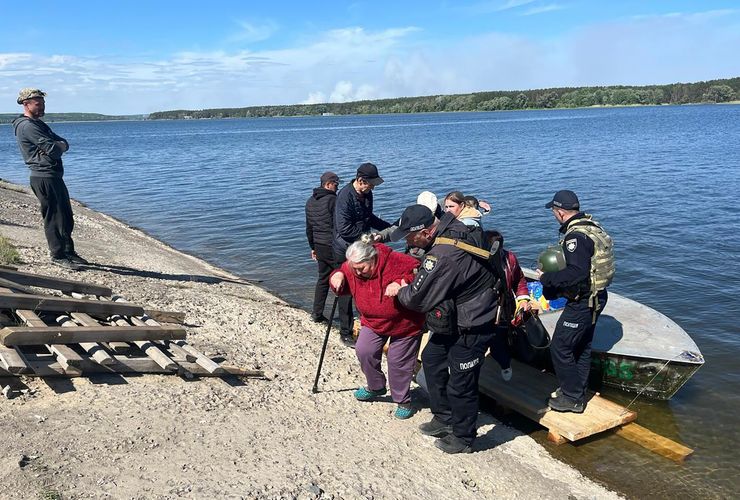
Russian officials said they had also captured another village, Pletenivka, in a renewed attack on the region that Ukrainian authorities said forced more than 1,700 civilians to flee.

Artillery, mortar, and aerial bombardments hit more than 30 different towns and villages, killing at least three people and injuring five others, said Kharkiv Gov. Oleh Syniehubov.

Ukraine rushed reinforcements to the

Kharkiv region

on Friday to hold off a Russian attempt to breach local defenses, authorities said.

Ukrainian forces also launched a barrage of drones and missiles on Saturday night, Russia’s Ministry of Defense said, with air defense systems downing 21 rockets and 16 drones over Russia’s Belgorod, Kursk and Volgograd regions. One person died in a drone strike in the Belgorod region, and another in the Kursk region, local officials said.

Another strike set ablaze an oil depot in Ukraine’s Russian-occupied Luhansk region, killing four people and injuring eight more, Leonid Pasechnik, the region’s Moscow-installed leader said on the messaging app Telegram on Saturday.

Russian forces

stepped up their bombardment

of Kharkiv, Ukraine’s second-largest city, in late March. Friday’s attack signaled a tactical switch in

the war

by Moscow that Ukrainian officials had been expecting for weeks.

Russian military bloggers said the assault could mark the start of a Russian attempt to carve out a “buffer zone” that President

Vladimir Putin

vowed to create earlier this year to halt

frequent Ukrainian attacks on Belgorod

and other Russian border regions.

Ukrainian President Volodymyr Zelenskyy confirmed Friday evening that Russian forces were expanding their operations. He also called on the country’s Western allies to ensure that promised deliveries of military aid would swiftly reach the front lines.

“It is critical that partners support our warriors and Ukrainian resilience with timely deliveries. Truly timely ones,” he said in a video statement on X. “A package that truly helps is the actual delivery of weapons to Ukraine, rather than just the announcement of a package.”

The Kremlin’s forces have repeatedly sought to exploit Ukraine’s shortages of ammunition and personnel as the flow of Western military aid to Kyiv has tapered off in recent months, with

promised new support

still yet to arrive.

Ukraine previously said it was aware that Russia was assembling thousands of troops along the northeastern border, close to the Kharkiv and Sumy regions. Intelligence officials also said they had expected an attack there though Russia’s most recent ground offensive had been focused on parts of

eastern Ukraine

farther south.

While Russia’s gains in the region have so far been limited, analysts at the U.S. think tank Institute of the Study of War described them Friday as “tactically significant.”

They said Russia had only “committed relatively limited manpower to their initial assaults” but that the offensive in Kharkiv “is meant to ... (draw) Ukrainian manpower and materiel from other critical sectors of the front in eastern Ukraine.”

The Russian military could also try to cut key supply routes and try to blockade Kharkiv, home to roughly 1.1 million people and only about 30 kilometers (about 20 miles) south of the border.

In the war's early days, Russia made a botched attempt to quickly storm Kharkiv but retreated from its outskirts after about a month. In the fall of 2022, seven months later, Ukraine’s army

pushed them out of Kharkiv

. The

bold counterattack

helped persuade Western countries that Ukraine could defeat Russia on the battlefield and merited military support.

___

Follow AP’s coverage of the war in Ukraine at

https://apnews.com/hub/russia-ukraine
More News

West Bank settlers brutally attack a Washington Post journalist
Oct 16, 2026
West Bank settlers brutally attack a Washington Post journalist

Photojournalist Heidi Levine is transferred on a stretcher into an ambulance after she was attacked by Israeli settlers while photographing Palestinian farmers harvesting their olives on October 16, 2026. | Ahmad Gharabli/AFP via Getty Images This story appeared in Today, Explained, a daily newsletter that helps you understand the most compelling news and stories of the day. Subscribe here. On Friday, Israeli settlers attacked Palestinians living in the West Bank, as well as a Washington Post photographer, who was hospitalized with serious injuries. Photojournalist Heidi Levine was knocked down, beaten, and robbed of her camera equipment by masked settlers in an attack captured on video by other journalists. Those other members of the press rescued her from the attackers while Israel Defense Forces soldiers reportedly stood by. Levine had lacerations and a wound to her hand that split her finger to the bone, according to the Post, which condemned the attack in a statement. Jasper Nathaniel, an independent journalist who helped Levine escape the attack, said that Levine also had cracked ribs, and may have been stabbed. Assaults like this one are becoming more common in the West Bank, where settler violence — which is currently targeting the ongoing olive harvest — has worsened. Last week, another photojournalist for the news wire Agence France-Presse was beaten with rifles by settlers, and Palestinian residents of the West Bank have been shot, beaten, and terrorized while the Israeli settlers targeting them face few consequences. Why settler violence is growing in the West Bank As my colleague Zack Beauchamp recently explained, under international law, the settler movement in the West Bank is clearly illegal. Nevertheless, it’s continued to grow, and it has a friend in the current Israeli government led by Benjamin Netanyahu. It’s also becoming increasingly violent.  Two current Israeli officials, Bezalel Smotrich and Itamar Ben Gvir, are settlers themselves, and both have used their offices — as ministers of finance and national security, respectively — to further the settler cause, including by making it easier for settlers to commit unchecked violence against Palestinians.  The United Nations reported in June that settler attacks had reached “the highest sustained levels ever recorded…with [an average of] six daily attacks that have resulted in casualties, property damage or both,” and in many Palestinians being forced from their homes by settlers. In late September, the International Committee of the Red Cross said that expanding Israeli settlements and violence by settlers was “making everyday life untenable” for Palestinian residents of the West Bank. As Zack has reported, settlements and settler violence are both intentional tactics, serving to force more Palestinians off their land, isolate the ones who stay, and push any potential two-state solution further out of reach.  That kind of violence is likely only to worsen in the weeks to come: Israel will hold elections on October 27, which could well result in Netanyahu’s settler-friendly government losing power. As a result, the Washington Post reported earlier this month, settlers are “racing to lock down gains” before the election with ever more extreme violence. One link for later ➨ Agentified kind of life. My colleague Adam Clark Estes turned the keys to his life over to a passel of AI agents for two weeks to see what would happen. They successfully saved him some times, he writes, largely with mundane tasks — but he left with mixed feelings about the experiment, including the possibility of contributing to a world with more AI slop. Before you go… Did you know…that the aerodynamic crouch used by jockeys in horse racing — known as the “martini glass position” — made race times roughly 5 to 7 percent faster? Jockeys maintain it with only a few toes resting on each stirrup. Today’s trivia: Who is the author of the 1952 self-help book The Power of Positive Thinking? (You can find this and other brain puzzles in Vox’s daily crossword. Look for the answer in Monday’s edition.) Yesterday’s trivia: We asked about the answer to the ultimate question of life, the universe, and everything in The Hitchhiker’s Guide to the Galaxy. That would be the number 42 (take it up with Douglas Adams).

Expert Features

The Expert Features reports on the issues and the world’s everyday news. Handled by experts in different niches, you will find different subjects and perspectives.