Russia has turned food, energy and even children into weapons against Ukraine, Zelenskyy says at UN
Sep 19, 2023
Ukrainian President Volodymyr Zelenskyy says Russia is “weaponizing” everything from food and energy to abducted children in its war against Ukraine
UNITED NATIONS (AP) — Ukrainian President
Volodymyr Zelenskyy
said Tuesday that Russia is “weaponizing” everything from food and energy to abducted children in itswar against Ukraine
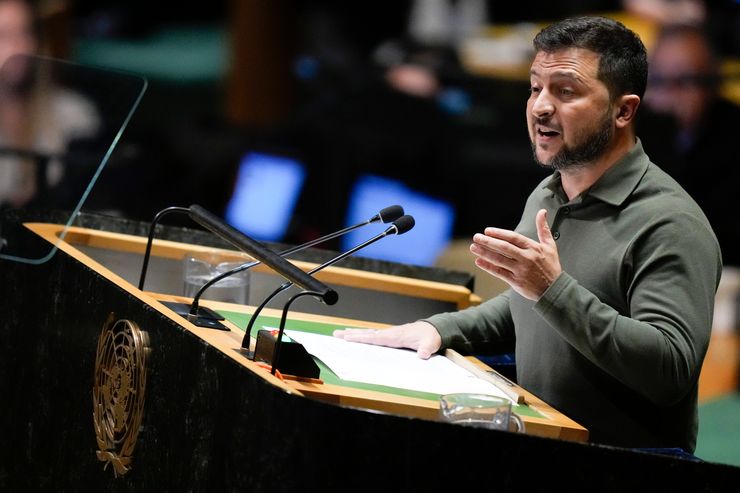
— and he warned world leaders that the same could happen to them.“When hatred is weaponized against one nation, it never stops there," he said at the U.N. General Assembly’s annual top-level meeting. “The goal of the present war against Ukraine is to turn our land, our people, our lives, our resources into weapons against you — against the international rules-based order.”
The war in Ukraine has deepened major global supply disruptions caused by the pandemic, driving a huge spike in food and energy prices, jolting the global economy and increasing hardship in many developing countries.
Decades-old energy supply channels to Europe from Russia, a major oil and gas producer, were halted or severely disrupted by the war due to sanctions, trade disputes, pipeline shutoffs and a major push by Western countries to find alternative sources. Both Russia and Ukraine also are major grain exporters, and Russia
withdrew this past summer from a deal
that allowed shipments of Ukrainian grain through the Black Sea.Zelenskyy pointed to the food and fuel crunches, and he highlighted what Ukraine says were kidnappings of at least tens of thousands of
children taken from Ukraine
after Moscow's invasion: “What will happen to them?”"Those children in Russia are taught to hate Ukraine, and all ties with their families are broken. And this is clearly a genocide,” Zelenskyy said in remarks that ran 15 minutes — the meeting's often-disregarded time limit.
The International Criminal Court
issued an arrest warrant in March for Russian President Vladimir Putin and another official,accusing them
of abducting children from Ukraine. Russian officials have denied any forced transfers of children, saying some Ukrainian youngsters are in foster care.Russia gets its chance to address the General Assembly on Saturday. Deputy U.N. Ambassador Dmitry Polyansky sat in Russia’s seat during Zelenskyy’s address.
“Did he speak?” Polyansky said with a wry smile when an Associated Press reporter asked about his reaction to the address. “I didn’t notice he was speaking. I was on my phone.”
Zelenskyy took to the world stage at a sensitive point in his country’s campaign to maintain international support for its fight. Nearly 19 months after Moscow launched a full-scale invasion, Ukrainian forces are three months into a counteroffensive that has not gone as fast or as well as initially hoped.
Ukraine and its allies cast the country’s cause as a battle for the rule of international law, for the sovereignty of every country with a powerful and potentially expansionist neighbor, and for the stability of global food and energy supplies.
“We must stand up to this naked aggression today and deter other would-be aggressors tomorrow,” U.S. President Joe Biden told the assembly Tuesday in his own speech. As he pledged support to Ukraine, there was a round of applause, including from Zelenskyy.
Russia insists its war is justified, claiming that it is defending Russian speakers in Ukraine from a hostile government and protecting Russian interests against NATO encroachment, and more.
The war has raged longer and losses have been greater than Russia hoped, and the fighting has spurred widespread international condemnation against Moscow.
But the Kremlin also has influential friends that haven’t joined the chorus of censure: China and
India
, for instance, have staked out neutral positions. So havemany Middle Eastern
andAfrican nations
. ManyLatin American and Caribbean countries
prefer to focus world attention on other global issues, including climate change and conflict in Africa.Moscow is keen to display its global influence and its relationship with China and insists that it cannot be internationally isolated by the U.S. and its European allies.
Meanwhile, Ukraine is concerned that backing from its allies may be ebbing. They have supplied billions of dollars’ worth of arms but fear that their stockpiles are shrinking and that defense contractors are struggling to boost production lines.
Hours before Zelenskyy spoke at the U.N.,
allied defense leaders convened
at a U.S. military base in Germany to discuss next steps. Some nations pledged further money and weapons. But a key sticking point is whether to supply longer-range missiles that Kyiv insists it needs.The U.S. Congress is weighing
Biden’s request
to provide as much as $24 billion more in military and humanitarian aid to Ukraine, amid a growing partisan divide over spending on the conflict. Zelenskyy is scheduled to spend time Thursday on Capitol Hill and tomeet with Biden
at the White House.After landing Monday in New York, Zelenskyy suggested that the U.N. needs to answer for allowing his country's invader a seat at the tables of power.
If there is still “a place for Russian terrorists” in the United Nations, "it’s a question to all the members of the United Nations,” Zelenskyy said after visiting wounded Ukrainian service members at Staten Island University Hospital.
Russia is a permanent, veto-wielding member of the U.N. Security Council, which is entrusted with maintaining international peace and security.
Zelenskyy took the United Nations to task even before the war. In one memorable example, he lamented at the General Assembly in 2021 that the U.N. was
”a retired superhero
who's long forgotten how great they once were."A former comedian and actor who took office in 2019, Zelenskyy later became a wartime leader, wearing military fatigues, rallying citizens at home and appearing virtually and in person before numerous international bodies.
At the Staten Island hospital, he awarded medals to military members who had lost limbs. With help from a New Jersey-based charity called Kind Deeds, 18 troops have been fitted for prostheses and are undergoing outpatient physical therapy, hospital leaders said.
“We all will be waiting for you back home,” Zelenskyy told those he met. “We absolutely need every one of you.”
___
Gatopoulos reported from Athens. Associated Press writer Edith M. Lederer contributed from the United Nations.