Sleepy far-flung towns in the Philippines will host US forces returning to counter China threats
May 13, 2024
After withdrawing from two huge U.S. military bases in the Philippines at the end of the Cold War in the early 1990s, American forces are returning and building a new presence in nine sites on Philippine bases under a 2014 defense pact to counter China's increasingly assertive actions
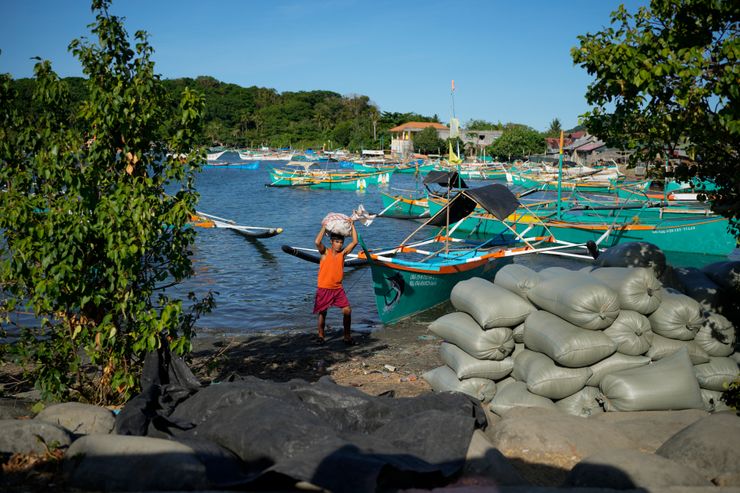
SANTA ANA, Philippines (AP) — The far-flung coastal town of Santa Ana in the northeastern tip of the Philippine mainland has long been known by tourists mostly for its beaches, waterfalls, fireflies and a few casinos.
But that’s changing after the laid-back town of about 35,000 people, which still has no traffic light, became strategically important to America.
The United States and the Philippines, which are longtime treaty allies, have identified Santa Ana in northern Cagayan province as one of nine mostly rural areas where rotating batches of American forces could encamp indefinitely and store their weapons and equipment on local military bases under the
Enhanced Defense Cooperation Agreement
.Thousands of U.S. forces withdrew from two huge Navy and Air Force bases in the Philippines in the early 1990s at the end of the Cold War, ending nearly a century of American military presence in the country. In recent years, Washington has been reinforcing an arc of military alliances in Asia to counter an increasingly assertive China, which it now regards as its
greatest security challenge.
That dovetails with Philippine efforts to bolster its external defenses after an alarming spate of
territorial hostilities with Beijing in the South China Sea that started last year
. The high seas confrontations have injured several Filipino navy personnel, damaged their boats and strained diplomatic ties.The remote town of Santa Ana is caught in the geo-political rivalry between Washington and Beijing because of its strategic location. It lies across a sea border from Taiwan, the self-governing island that China regards as a renegade province to be reclaimed by force if necessary. The U.S. has vowed to defend
the territory
.Some villagers in Santa Ana have expressed apprehension over the prospect of living near U.S. forces. Their governor, Manuel Mamba, has vehemently opposed the looming U.S. military presence, saying it would turn Cagayan into a military target of China.
Other villagers say the Philippines needs the Americans as a crucial counterweight to China, which they say has been using its military might to threaten Manila’s territorial interests in the South China Sea.
“There’s no choice. If you compare the number of our forces with that of China, they have much, much more,” Romeo Asuncion, a planning and economic development officer in Santa Ana, told The Associated Press. “If the Americans are here, they would protect us whatever happens.”
There’s also the prospect of economic benefits and aid from the U.S. military presence.
“If they donate a school that will be good,” Asuncion said.
Rowena Castillo, a consultant to the town's mayor, expressed hope the wider attention on Santa Ana would boost tourism. She recently handed out brochures promoting the town’s beach resorts, waterfalls, a historic lighthouse, a crocodile-shaped island and an area that teems with fireflies.
Some villagers acknowledged that even without the U.S. forces, the town would likely be affected in any major-power military showdown due to Santa Ana’s relative proximity to Taiwan.
Authorities and village leaders recently met at the initiative of the local military to discuss contingency plans, including the possibility of setting up emergency shelters for refugees, in case tensions between China and Taiwan flare into an armed conflict, Marion Miranda, Santa Ana’s disaster-mitigating officer, told The AP.
"One problem is where we could bring potential refugees and the budget for that,” Miranda said.
In another rural Cagayan town southwest of Santa Ana called Lal-lo, part of the airport was designated as a possible encampment site for American forces.
Unlike the two massive military bases that American forces used to occupy, including a Navy base at Subic Bay that was about the size of Singapore and had a vibrant red-light district, the U.S. military is building a new presence in a much smaller area within Philippine camps.
During
largescale combat drills called Balikatan
— Tagalog for “shoulder-to-shoulder” — that ended Friday, Black Hawk and Chinook helicopters carrying allied forces, their weapons and other supplies landed and took off at the Lal-lo airport and the navy camp in Santa Ana. A few journalists, including from The AP, were invited to witness the combat maneuvers."It’s an important location. It’s critical because it is an EDCA site so it’s a very big deal to both the United States and to the Philippines,” U.S. Marine Lt. Col. Matthew Schultz told journalists at Lal-lo airport.
"One of the challenges that we have in this airfield now is there is not a lot of parking space or taxiways or additional apron space in order to facilitate a lot of aircraft,” Schultz said.
The EDCA accord, which was signed in 2014, had an initial term of 10 years and has been automatically extended with both sides in agreement, Ambassador to the U.S. Jose Manuel Romualdez said by telephone from Washington.
The agreement allows rotating batches of U.S. forces to stay rent-free at the military sites and store their defense equipment — except nuclear weapons — there.
The U.S. has allocated more than $82 million for the construction of ammunition and fuel storage, an urban combat training facility, aircraft parking, runway repairs and warehouses for humanitarian response items in the first five EDCA sites.
President Ferdinand Marcos Jr.
agreed to add four more EDCA sites where U.S. forces could stay
, including the Philippine navy camp in Santa Ana and the Lal-lo airport, last year.Marcos and other Philippine officials say the renewed U.S. military presence would bolster Philippine external defense and help Filipinos respond more rapidly to natural disasters and is not directed at any country.
China, however,
has expressed alarm over the increased U.S. troop deployments in the Philippines
and elsewhere in Asia and said the EDCA sites in the northern Philippines could serve as surveillance outposts and staging grounds for U.S. forces to contain Beijing.Such a display of combat readiness by the U.S. and the Philippines, according to Romualdez, aims to prevent a major conflict by making Chinese leader Xi Jinping realize the cost of a wrong move.
“We're precisely doing all of these things as a deterrence,” Romualdez said. “We’re trying to tell Xi, when you wake up in the morning, you’ll tell yourself, ‘I’m not gonna do it.’ Not today, not tomorrow and hopefully never.”
___
Associated Press journalist Joeal Calupitan in Manila contributed to this report.