The Biden-Netanyahu relationship is strained like never before. Can the two leaders move forward?
May 9, 2024
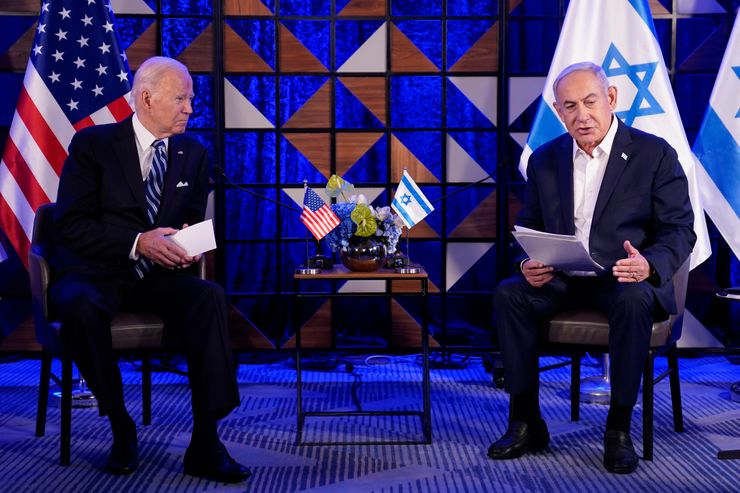
President Joe Biden and Israeli Prime Minister Benjamin Netanyahu have long managed a complicated relationship
WASHINGTON (AP) —
President Joe Biden
andIsraeli Prime Minister Benjamin Netanyahu
have long managed acomplicated relationship
, but they're running out of space to maneuver as their views on theGaza war
diverge and their political futures hang in the balance.Their ties have hit a low point as Biden holds up the
delivery of heavy bombs to Israel
— and warns that the provision of artillery and other weaponry also could be suspended if Netanyahu moves forward with awidescale operation
in the southern Gaza city of Rafah.Netanyahu, for his part, is
brushing off Biden’s warnings
and vowing to press ahead, saying, “If we have to stand alone, we will stand alone.”“If we need to, we will fight with our fingernails. But we have much more than fingernails,” he said.
Biden has long prided himself on being able to manage Netanyahu more with carrots than sticks. But the escalation of friction over the past seven months suggests that his approach may be long past its best-by date.
With both men balancing an explosive Mideast situation against their own domestic political problems, Netanyahu has grown increasingly resistant to Biden’s public charm offensives and private pleading, prompting the president's more assertive pushback in the past several weeks.
“If they go into Rafah, I’m not supplying the weapons that have been used historically to deal with Rafah, to deal with the cities, that deal with that problem,"
Biden said
in a CNN interview Wednesday, laying bare his growing differences with Netanyahu.Biden aides nonetheless insist the president is unwilling to allow the U.S.-Israel relationship to truly rupture on his watch. They cite not only the political imperative — a majority of Americans support Israel — but also
Biden’s personal history with the country
and his belief in its right to defend itself.The president's aides, watching how
pro-Palestinian protests
have roiled his party and the college campuses that have been breeding grounds for Democratic voters, have mused for months that Biden could be the last classically pro-Israel Democrat in the White House.Their optimism about their ability to contain Netanyahu may be falling into the same trap that has vexed a long line of American presidents who have clashed with the Israeli leader over the decades.
White House national security spokesman John Kirby on Thursday declined to say whether Biden informed Netanyahu of his decision
to suspend shipment of 3,500 bombs
when the leaders spoke earlier this week. But he said Biden has been “direct and forthright” with Netanyahu about his concerns.Biden and Netanyahu
have known each other
since Biden was a young senator and Netanyahu was a senior official in Israel's embassy in Washington.They've hit rough patches before.
There were differences over Israel building settlements in the West Bank during Barack Obama's administration when Biden was vice president. Later, Netanyahu vehemently opposed Biden's push to resurrect the Iran nuclear deal sealed by Obama and scrapped by Donald Trump. Netanyahu chafed at Biden prodding him to de-escalate tensions during Israel's
bloody 11-day war
with Hamas in 2021.The leaders
went more than a month
earlier this year without talking asBiden's frustration
with Netanyahu grew over the humanitarian crisis in Gaza.The relationship remained workable despite such differences between the center-left Democrat and the leader of the most far-right coalition government in Israel's history.
But with the Biden-Netanyahu relationship now coming under greater strain than ever before, it is unclear how the leaders will move forward.
Netanyahu is caught between public pressure for
a hostage deal
and hard-liners in his coalition who want him to expand the Rafah invasion, despite global alarm about the harm it could do to some 1.3 million Palestinians sheltering there. He's made clear that he will push forward with a Rafah operationwith or without a deal for hostages.
The Israeli leader vowed to destroy Hamas after its Oct. 7 rampage in southern Israel in which 1,200 people were killed and some 250 were captured and taken hostage. But his public standing has cratered since then, as he faces pressure to find a pathway to a truce that would bring home the remaining hostages and the remains of Israelis who have died in captivity.
He's resisted an investigation into what led to the intelligence and military failures leading up to the Hamas attack. All the while, he's still facing legal problems, including a long-running
corruption trial
in which he is charged with fraud and accepting bribes.Netanyahu’s political survival may depend on the Rafah offensive. If he reaches a hostage deal that stops short of conquering Rafah, hardliners in his coalition have threatened to topple the government and trigger new elections at a time when opinion polls forecast he would lose.
“To keep his partners on board and prevent them from pre-empting an election, in which Likud will be decimated and he will be turned out of office, he needs to keep the ‘total victory’ myth alive – and that is only possible by avoiding a deal with Hamas,” wrote Anshel Pfeffer, a columnist and author of a Netanyahu biography, in the Haaretz daily.
Aviv Bushinsky, a former spokesman and chief of staff for Netanyahu, said the Israeli leader remains focused on the war’s primary goal – defeating Hamas – because of concerns about his image and legacy.
He said Netanyahu has spent his career branding himself as the “tough guy on terror.”
“He thinks this is how he will be remembered. He’s been promising for a decade to cream Hamas," Bushinsky said. “If he doesn’t, in his mind he’ll be remembered as the worst prime minister of all time.”
Biden, meanwhile, faces mounting protests from young Americans, a segment of the electorate critical to his reelection. And he's faced
backlash from Muslim Americans,
a key voting bloc in the battleground state of Michigan. Some have threatened to withhold their votes in November to protest his administration's handling of the war.Vermont Sen. Bernie Sanders, a Biden ally who has been frustrated by the administration’s handling of the war, said Thursday Biden should go further and suspend delivery of all offensive weaponry to Israel.
“The United States does and should stand by its allies, but our allies must also stand by the values and the laws of the United States of America,” Sanders said. “We must use all of our leverage to prevent the catastrophe in Gaza from becoming even worse.”
At the same time, Biden is facing bruising criticism from Republicans, including presumptive 2024 GOP presidential nominee Trump, who say that his decision to hold back weapons is a betrayal of an essential Mideast ally.
“What Biden is doing with respect to Israel is disgraceful. If any Jewish person voted for Joe Biden, they should be ashamed of themselves. He’s totally abandoned Israel,” Trump told reporters on Thursday.
Idaho Sen. Jim Risch, the top Republican on the Senate Foreign Relations Committee, said Biden's move is “simply a nod to the left flank” that is handing “a great victory to Hamas.”
Friction between the U.S. and Israeli leaders is not without precedent.
President George H.W. Bush and Israeli Prime Minister Yitzhak Shamir’s relationship was strained as the Republican administration threatened to withhold $10 billion in loan guarantees to thwart new settlement activity in the West Bank. Obama and Netanyahu's relationship was marked by mutual distrust over the Democrat's effort to reignite the Middle East peace process and forge the
Iran nuclear deal.
“There were always workarounds if the heads of government really don’t get along. We may get to that,” said Elliot Abrams, a senior national security official in the George W. Bush administration. “But of course, this may be a sort of problem that solves itself in that one or both of them may be gone from office" in a matter of months.
___
AP writers Mary Clare Jalonick in Washington and Adriana Gomez Licon in Miami contributed reporting. Frankel reported from Jerusalem.