Ukraine's year of pain, death —and also nation-building
Feb 21, 2023
The first anniversary of Russia's invasion of Ukraine is both grim and vexing as milestones go
KYIV, Ukraine (AP) — In the final hours before
the Russian onslaught
, a last grasp at peace. Russian troops would soon pour across Ukraine's borders and Russian missiles would fill Ukrainian skies,taking Ukrainian lives
in the biggest air, sea and ground assault in Europe since World War II. But Ukrainian President Volodymyr Zelenskyy still appealed, on war's brink, for reason to prevail.Staring intently into the camera in a last-ditch, dead-of-night,
video-recorded plea
against the invasion, Zelenskyy warned Russia that the consequences would be “an abundance of pain, filth, blood and death.”“War is a huge calamity," Zelenskyy said, in what proved to be one of his last outings in a suit before his switch to military-style casual wear. “This calamity carries a huge cost — in every meaning of this word.”
The date was
Feb. 24, 2022 —
cataclysmic for Ukraine, course-changing for Russia, history-shaping for the wider world. Every hour of every day since has proven those words to be right.___
As milestones go,
the invasion's first anniversary
Friday is both grim and vexing. It marksa full year of killing
,destruction
, loss and pain felt even beyond the borders of Russia and Ukraine — withwar-related price shocks
being just one example. But it also raises a question that is unsatisfying because it can't be answered at this partway point: How much longer until this stops?"Not soon enough" might be one response, though any peace deal looks far off as Russia's invasion force meat-grinds into Year Two, with neither side close to reaching hoped-for objectives.
The misery of
365 days of bloodshed
and the full scale ofthe global repercussions
are difficult to sum up with mere words. Russia is more isolated than at any time since the Cold War. Western nations are banding together for Russian PresidentVladimir Putin
's defeat while also gambling thatthe ex-KGB spy
won't go nuclear. China isfiling away lessons
that could be used against Taiwan.And how to measure all the tears? How to adequately describe all
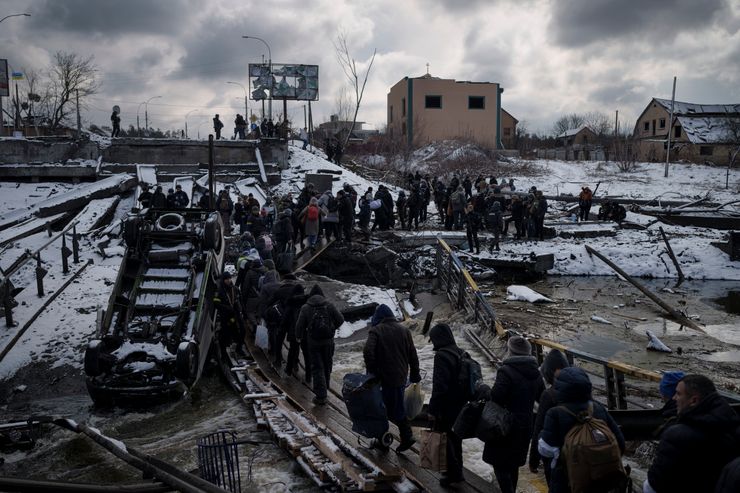
the suffering
andatrocities
? Or even the broken heart of just one ofthe children
who havelost loved ones and futures
?The numbers are dizzying: hundreds of thousands of
Russian men escaping abroad
to avoid being thrown into battle,millions of Ukrainians uprooted
from their homes, tens of billions of dollars poured into weaponry that is making warever-more lethal
, trillions more dollars estimatedlost for the global economy
. And even those figures don't do justice to the human and economic costs.Of the body count — surely the most important tally, but kept under wraps by both sides — all that can be said with certainty is that it is horrific. Western officials estimate it to be in the many tens of thousands and growing inexorably.
But Ukraine is still here. That in itself is a stinging defeat for the Kremlin. Putin seemingly believed his forces and secret services would have turned Ukraine into a puppet state by now. The invasion plan called for resistant Ukrainian officials to be liquidated, weeded out or flipped into collaborating, according to a British think tank’s
study
based in part on captured Russian documents.Instead, the threat of extinction as a free nation is pushing Ukraine into an ever-closer orbit with the European Union, the United States and the wider West — the very outcome Putin wanted to avoid. Each additional delivery of
NATO-standard weapons
, the billions of dollars in other Western aid, and pledges to stand with Ukraine for “as long as it takes” are hard-wiring bonds that, in peacetime, might have taken many more years to build.Ukraine, independent from the ex-Soviet Union only since 1991, has also grown in war as a nation. Fighting to remain Ukrainian has forced clarity about what exactly that means, sharpening the contours of national identity.
In what have become
daily video addresses
to share news from the fronts and boost morale, Zelenskyy sometimes wears black hoodies emblazoned on the front with the words, “I'm Ukrainian.” Many more Ukrainians have joined the president in ditching Russian for Ukrainian as their primary language. Statues of Russians are also being torn down,street names are being changed
and Russian history is being expunged from school textbooks.Says Olena Sotnyk, a lawyer and former legislator: “Putin did for us something which nobody did. He helped us to become a free nation."
___
Abroad, too, Ukraine has won hearts and minds, evidenced by the blue-and-yellow flags flying from town halls and the
foreign fighters
and aid workers risking — andsometimes losing
— their lives on Ukrainian battlefields pounded by shellfire into hellscapes hauntingly reminiscent of World War I.“No one will ever confuse Ukraine and Russia (again)," says Mykhailo Podolyak, one of Zelenskyy’s closest advisers. "No one will say, ‘It is something over there, near Russia.’”
Ukrainians argue that in resisting Putin, they've also done the world the favor of unmasking him as a cruel and dangerous foe. The Russian leader who bewitched George W. Bush (“I looked the man in the eye. I found him to be very straightforward and trustworthy," the then U.S. president
said in 2001
) and who waschauffeured on a golf cart
through the gardens of Versailles Palace by France's president in 2017, has become a pariah to Western leaders. But others remain close with him, notablyChinese leader Xi Jinping
.Despite
the failure to secure quick victory
, Putin's grip on power remains firm, withprotests quashed
and most Russians seemingly rallied behind the war effort. Still, Russia is making previously unimaginable sacrifices.In battle, Putin has increasingly had to turn to the mercenaries of
the notorious Wagner Group
, a private military company that has recruited fighters from prisons and tossed them into combat, with high casualty rates. Putin is also losing energy leverage over Europe as itveers away from Russian gas
andmost Russian oil
. Russia's economy is laboring under Western sanctions. AsPutin is boxed in
, some fear he could lash out in new ways, perhaps resort tomore nuclear saber-rattling
or worse.But history is written by war's victors. And at this point, the invasion's outcome is far from clear.
One of Putin's initial mistakes was trying to conquer a country the size of France with a force that Western estimates suggest was barely larger than the Allies' D-Day army in World War II. And the mission on
June 6, 1944,
was far narrower: assault five French beaches,opening the breach
from which the Allies then pushed through Nazi-occupied Europe.Putin is now throwing additional equipment and manpower at
the problem
of his own making, with300,000 mobilized troops
in his pipeline for a new offensive that Russia hasn't announced — but which Western and Ukrainian officials say is already underway in eastern Ukraine."Don't be seduced by ‘plucky little Ukraine,’ because Russia is much bigger. It could just grind Ukraine out,” cautions retired Air Marshal Edward Stringer, a former senior officer in Britain's Royal Air Force. “It could force Ukraine to run out of bullets by putting one Russian in front of every bullet until Ukraine runs out of bullets before Putin runs out of Russians.”
___
Certainly, Podolyak says, time is not on Ukraine's side. Just the opposite.
“A protracted war is the slow death of Ukraine,” he says. But the invasion's first anniversary, he insists, “means that we are on the right track.”
“It means that we have a different Ukraine," he says. "It looks completely different.”
So different that pre-invasion life is an ever-hazier memory. Back then, statues in the capital,
Kyiv
, hadn't disappeared behindwalls of protective sandbags
. People didn't need to fill bathtubs when air raid sirens sounded so they have water if Russian strikes knock out supplies. They didn't download phone apps that issue shrill alarms when Russian missiles and killer drones are en route.And those same apps didn't have “Star Wars” actor Mark Hamill announcing when the danger has passed, reassuringly saying in his Luke Skywalker voice: "The air alert is over. May the force be with you.” Surreal.
Sotnyk, the former legislator, recalls the panic that gripped her when Russia's missiles first started striking Kyiv a year ago. She called up her mother and ordered her to pack. Now Sotnyk knows better than to dash across town in an air raid.
“It’s not like we became braver," she says. "We (just) became more aware of what does it mean — ‘war.’”
Before the invasion,
Feb. 24
hadn't been much of a mover and shaker asa date in world history
. ThenPrince Charles and Lady Diana
announcedtheir engagement
on that day in 1981. Steve Jobs, co-founder of Apple, was born Feb. 24, 1955. In 1938, it was the launch day of the first nylon-bristle toothbrush, “Dr. West’s Miracle Toothbrush
."But in 1920, in Germany, it was also the day that
Adolf Hitler presented
a 25-point platform for the new Nazi Party. Back then, Hitler's audience couldn't have known that his speech in a Munich beer hall would prove to be a step toward World War II. Had they guessed, would they have turned back?Feb. 24, 2022, hasn't led to World War III — not “yet,” pessimists might add. But the past year was, as Zelenskyy forewarned, full of pain, filth, blood and death.
And ahead: a grim abundance of more to come.
___
Paris-based correspondent John Leicester has reported from more than two dozen countries for The Associated Press since 1993 and is on his third assignment in Ukraine since the invasion.
___
Follow AP’s coverage of the war in Ukraine:
https://apnews.com/hub/russia-ukraine