US calls on Iran to halt `unprecedented' weapons transfers to Yemen's Houthis for attacks on ships
May 13, 2024

The United States is calling on Iran to halt its transfer of an “unprecedented” amount of weaponry to Yemen’s Houthi rebels, enabling its fighters to attack ships in the Red Sea and elsewhere

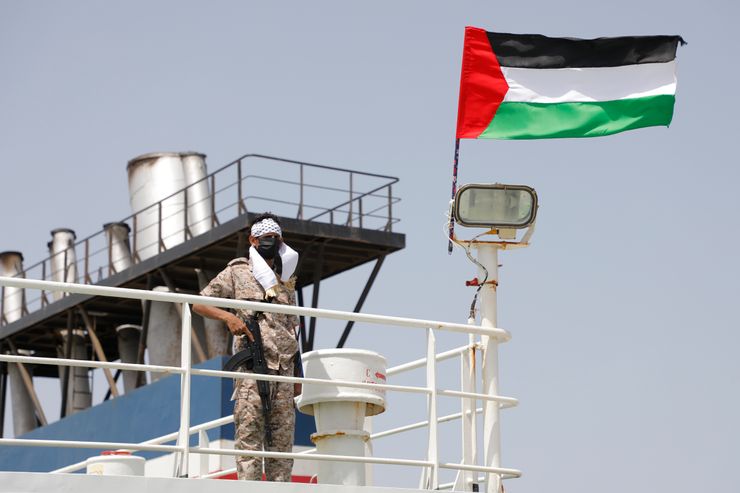
UNITED NATIONS (AP) — The United States called on Iran on Monday to halt its transfer of an “unprecedented” amount of weaponry to Yemen’s Houthi rebels, enabling its fighters to carry out “reckless attacks” on ships in the Red Sea and elsewhere.

U.S. deputy ambassador Robert Wood told the U.N. Security Council that if it wants to make progress toward ending the civil war in Yemen it must act collectively to “call Iran out for its destabilizing role and insist that it cannot hide behind the Houthis.”

He said there is extensive evidence that Iran is providing advanced weapons, including ballistic and cruise missiles, to the Houthis in violation of U.N. sanctions.

“To underscore the council’s concern regarding the ongoing violations of the arms embargo, we must do more to strengthen enforcement and deter sanctions violators,” Wood said.

The Houthis say their attacks on shipping in the Red Sea and Gulf of Aden are aimed at pressuring Israel to end its

war with Hamas in Gaza

, which has killed more than 35,000 Palestinians there. The war began after Hamas-led militants attacked Israel on Oct. 7, killing 1,200 people and taking some 250 others hostage.

The Houthis have

launched more than 50 attacks

on shipping, seized one vessel and sunk another since November, the U.S. Maritime Administration said late last month.

Houthi attacks have dropped in recent weeks as the rebels have been targeted by

a U.S.-led airstrike campaign

in Yemen. Shipping through the Red Sea and Gulf of Aden has declined because of the threat.

But Hans Grundberg, the U.N. special envoy for Yemen, warned the council that “hostilities continue” even though there has been a reduction in attacks on commercial and military vessels in the Red Sea,

Gulf of Aden

and the Indian Ocean as well as a reduction in the number of U.S. and British airstrikes on targets in Yemen.

He pointed to an announcement by the Houthis that they will “expand the scope of attacks," calling this "a worrisome provocation in an already volatile situation.”

Russian Ambassador Vassily Nebenzia told the council that the Israeli announcement on May 6 that it was starting its military operation in Gaza’s southern city of Rafah, where 1.2 million Palestinians had sought safety, ratcheted up the spiral of escalation in the region “another notch further.”

“There’s no doubt that this will have an impact on the situation in Yemen’s surrounding waters,” he said, noting the Houthis’ opposition to Israeli attacks that harm Palestinian civilians.

But, Nebenzia added, “We call for a swift cessation of the shelling of commercial vessels and any other actions that hamper maritime navigation."

He sharply criticized the United States and its Western allies, saying their “totally unjustified aggressive strikes” in Yemen violate the U.N. Charter. He said they further complicate an already complex situation and won’t improve the situation in the Red Sea.

The war between

the Houthis and pro-government forces in Yemen

backed by a coalition of Gulf Arab states has raged since 2014. The Houthis swept down from the mountains, seized much of northern Yemen and the country’s capital, Sanaa, and forced the internationally recognized government to flee into exile to Saudi Arabia. Since then, more than 150,000 people have been killed by the violence and 3 million have been displaced.

Fighting has decreased markedly in Yemen since a truce in April 2022, but there are still hotspots in the country

Grundberg recalled that in December the Houthis and the government “took a courageous step towards a peaceful solution” by agreeing to a series of commitments that would provide for a nationwide cease-fire, ensure desperately needed humanitarian aid, and initiate a political process to end the conflict.

But U.N. humanitarian chief Martin Griffiths reported “alarmingly high” levels of severe food deprivation across the country that are expected to worsen during the lean season for crops starting in June.

Griffiths also expressed serious concern about a rapidly worsening cholera outbreak. He cited reports of 40,000 suspected cholera cases and over 160 deaths — “a sharp increase” since last month, the majority in Houthi-controlled areas “where hundreds of new cases are reported every day.”

More News

West Bank settlers brutally attack a Washington Post journalist
Oct 16, 2026
West Bank settlers brutally attack a Washington Post journalist

Photojournalist Heidi Levine is transferred on a stretcher into an ambulance after she was attacked by Israeli settlers while photographing Palestinian farmers harvesting their olives on October 16, 2026. | Ahmad Gharabli/AFP via Getty Images This story appeared in Today, Explained, a daily newsletter that helps you understand the most compelling news and stories of the day. Subscribe here. On Friday, Israeli settlers attacked Palestinians living in the West Bank, as well as a Washington Post photographer, who was hospitalized with serious injuries. Photojournalist Heidi Levine was knocked down, beaten, and robbed of her camera equipment by masked settlers in an attack captured on video by other journalists. Those other members of the press rescued her from the attackers while Israel Defense Forces soldiers reportedly stood by. Levine had lacerations and a wound to her hand that split her finger to the bone, according to the Post, which condemned the attack in a statement. Jasper Nathaniel, an independent journalist who helped Levine escape the attack, said that Levine also had cracked ribs, and may have been stabbed. Assaults like this one are becoming more common in the West Bank, where settler violence — which is currently targeting the ongoing olive harvest — has worsened. Last week, another photojournalist for the news wire Agence France-Presse was beaten with rifles by settlers, and Palestinian residents of the West Bank have been shot, beaten, and terrorized while the Israeli settlers targeting them face few consequences. Why settler violence is growing in the West Bank As my colleague Zack Beauchamp recently explained, under international law, the settler movement in the West Bank is clearly illegal. Nevertheless, it’s continued to grow, and it has a friend in the current Israeli government led by Benjamin Netanyahu. It’s also becoming increasingly violent.  Two current Israeli officials, Bezalel Smotrich and Itamar Ben Gvir, are settlers themselves, and both have used their offices — as ministers of finance and national security, respectively — to further the settler cause, including by making it easier for settlers to commit unchecked violence against Palestinians.  The United Nations reported in June that settler attacks had reached “the highest sustained levels ever recorded…with [an average of] six daily attacks that have resulted in casualties, property damage or both,” and in many Palestinians being forced from their homes by settlers. In late September, the International Committee of the Red Cross said that expanding Israeli settlements and violence by settlers was “making everyday life untenable” for Palestinian residents of the West Bank. As Zack has reported, settlements and settler violence are both intentional tactics, serving to force more Palestinians off their land, isolate the ones who stay, and push any potential two-state solution further out of reach.  That kind of violence is likely only to worsen in the weeks to come: Israel will hold elections on October 27, which could well result in Netanyahu’s settler-friendly government losing power. As a result, the Washington Post reported earlier this month, settlers are “racing to lock down gains” before the election with ever more extreme violence. One link for later ➨ Agentified kind of life. My colleague Adam Clark Estes turned the keys to his life over to a passel of AI agents for two weeks to see what would happen. They successfully saved him some times, he writes, largely with mundane tasks — but he left with mixed feelings about the experiment, including the possibility of contributing to a world with more AI slop. Before you go… Did you know…that the aerodynamic crouch used by jockeys in horse racing — known as the “martini glass position” — made race times roughly 5 to 7 percent faster? Jockeys maintain it with only a few toes resting on each stirrup. Today’s trivia: Who is the author of the 1952 self-help book The Power of Positive Thinking? (You can find this and other brain puzzles in Vox’s daily crossword. Look for the answer in Monday’s edition.) Yesterday’s trivia: We asked about the answer to the ultimate question of life, the universe, and everything in The Hitchhiker’s Guide to the Galaxy. That would be the number 42 (take it up with Douglas Adams).

Expert Features

The Expert Features reports on the issues and the world’s everyday news. Handled by experts in different niches, you will find different subjects and perspectives.