US military seizes Iranian missile parts bound for Houthi rebels in raid where 2 SEALs went missing
Jan 16, 2024

U.S. Navy SEALs seized Iranian-made missile parts and other weaponry from a ship bound for Yemen’s Houthi rebels in a raid last week that saw two of its commandos go missing

JERUSALEM (AP) — U.S. Navy SEALs seized Iranian-made missile parts and other weaponry from a ship bound for Yemen's Houthi rebels in a raid last week that saw two of its commandos go missing, the U.S. military said Tuesday.

Meanwhile, a new ship came under suspected fire from the Houthis in the Red Sea and sustained some damage, though no one was wounded, officials said.

The raid marks

the latest seizure by the U.S. Navy and its allies

of weapon shipments bound for the rebels, who have launched a series of attacks now threatening global trade in the Red Sea and Gulf of Aden over Israel's war on Hamas in the Gaza Strip. The seized missile components included types likely used in those attacks.

The attacks, U.S.-led retaliatory strikes and the raid all have raised tensions across the wider Middle East, which also saw

Iran conduct ballistic missile strikes in both Iraq and Syria.

The SEAL raid happened last Thursday, with the commandos launching from the USS Lewis B. Puller backed by drones and helicopters, with the U.S. military's Central Command saying it took place in the Arabian Sea.

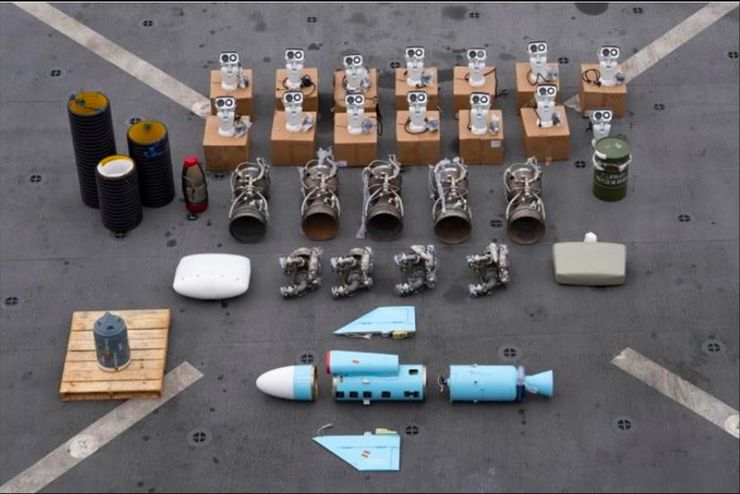
The SEALs found cruise and ballistic missile components, including propulsion and guidance devices, as well as warheads, Central Command said. It added that air defense parts also were found.

“Initial analysis indicates these same weapons have been employed by the Houthis to threaten and attack innocent mariners on international merchant ships transiting in the Red Sea,” Central Command said in a statement.

Images released by the U.S. military analyzed by The Associated Press showed components resembling rocket motors and others previously seized. It also included what appeared to be a cruise missile with a small turbojet engine — a type used by the Houthis and Iran.

The U.S. Navy ultimately sunk the ship carrying the weapons after deeming it unsafe, Central Command said. The ship's 14 crew have been detained.

The Houthis have not acknowledged the seizure and Iran's mission to the United Nations did not immediately respond to a request for comment.

A United Nations resolution bans arms transfers to Yemen’s Iranian-backed Houthi rebels. Tehran has long denied arming the rebels, despite

physical evidence, numerous seizures and experts tying the weapons back to Iran

.

Meanwhile Tuesday, a missile struck the Malta-flagged bulk carrier Zografia in the Red Sea. The vessel had been heading north to the Suez Canal when it was attacked, the Greek Shipping and Island Policy Ministry said.

The ship — managed by a Greek firm— had no cargo on board and sustained only material damage, the ministry said. The crew included 20 Ukrainians, three Filipinos and one Georgian.

Satellite-tracking data analyzed by The Associated Press showed the Zografia still moving after the attack.

The British military’s United Kingdom Maritime Trade Operations, which monitors incidents in the Mideast's waterways, earlier acknowledged an attack in the vicinity of the Zografia.

Since November, the Houthis have repeatedly targeted ships in the Red Sea, saying they were avenging

Israel’s offensive in Gaza against Hamas

. But they have frequently targeted vessels with tenuous or no clear links to Israel, imperiling shipping in a key route for global trade.

U.S.-led airstrikes targeted Houthi positions on Friday and Saturday. In response,

the Houthis launched a missile at a U.S.-owned bulk carrier

in the Gulf of Aden, further raising the risks in the conflict.

The SEALs traveled in small special operations combat craft driven by naval special warfare crew to get to the boat. As they were boarding it in rough seas, around 8 p.m. local time, one SEAL got knocked off by high waves and a teammate went in after him. Both remain missing.

___

Associated Press writers Elena Becatoros in Athens, Greece, and Tara Copp in Washington contributed to this report.

More News

This chart shows just how rapidly Ebola is spreading
Oct 21, 2026
This chart shows just how rapidly Ebola is spreading

The most recent Ebola epidemic has killed thousands in Congo. A few cases have spilled over to its neighboring countries, including Kenya and Uganda. | Lucas Mukasa/Anadolu via Getty Images The Ebola virus is spreading at an unprecedented rate this year.  In the first five months since the outbreak began in the Democratic Republic of Congo (DRC), the World Health Organization (WHO) has reported 9,415 confirmed cases and 4,536 deaths in the country. While the virus has remained relatively contained by the DRC’s borders, case counts in neighboring Kenya and Uganda are also climbing (albeit more slowly). There are 20 confirmed cases in Uganda and eight in Kenya, and much of central and eastern Africa has tightened its borders.  The last major Ebola epidemic of this scale began in 2014 and continued through 2016 in West Africa. Over that period, it ultimately killed more than 11,000 people throughout West Africa. Nearly four years later, a smaller outbreak plagued Congo in its North Kivu region, leading to 2,229 deaths before it was contained.  The 2026 crisis hasn’t yet reached the same levels as the 2014 outbreak, but the speed of its spread is far greater.  As the chart below shows, around 150 days after the outbreak was declared, 2,599 Ebola cases had been reported in the 2014 West African epidemic. At the same time point this year, the number of cases came to 8,978 and has continued to climb.  View Link There is no straightforward explanation for this rapid spread One of the reasons the latest epidemic has been so difficult to slow down can be traced back to the fact that it’s a different viral strain — known as Bundibugyo — than the ones behind previous epidemics.   The Bundibugyo virus comes from the same family as the Ebola virus that caused the 2014 West Africa and 2018 Congo epidemics, causing the fatal fevers associated with Ebola. But the rare strain is different enough that it doesn’t respond to the same medical solutions. While the Zaire virus led to vaccines and treatment to mitigate the spread, we still don’t have a vaccine for Bundibugyo.  That doesn’t mean Bundibugyo is entirely novel, though. The 2026 outbreak is the third outbreak related to the Bundibugyo viral strain: In 2007, Uganda faced a minor outbreak, and the eastern province of Congo, which is now the epicenter of the epidemic, saw a handful of cases in 2012.  Luckily, these two outbreaks were contained in a span of months, largely due to efforts by the country’s Ministry of Health and international aid partnerships with the WHO, the US Agency for International Development (USAID), and international humanitarian organizations such as the UN Children’s Fund and Red Cross. More than a decade later, these efforts have been substantially curbed by USAID cuts. Tracing requires physical testing capacity: the tests themselves, health workers, and protective equipment for those treating suspected cases. Reduced access to such resources is especially dangerous with strains like Bundibugyo – in the absence of an effective vaccine, tracing the spread of disease and isolating potential disease contacts is especially important.  But cuts to aid, which covers disease surveillance efforts, made it more difficult to identify this year’s Bundibugyo outbreak until it was too late, creating a “critical four-week detection gap between the onset of symptoms of the presumed index case…and the laboratory confirmation of the outbreak,” according to a WHO situation report from May.  In August, the United States aimed to close at least some part of the vacuum it left, providing an additional $242 million to its $23 million original pledge in May.  Aside from international efforts, DRC faces the added layer of internal conflict and humanitarian crisis. The eastern provinces, including Ituri, have experienced years of conflict that have weakened the public infrastructure, including the healthcare system. Last year, nearly 25 percent of Congolese people faced food insecurity, and 4.5 million children were clinically malnourished, creating a population especially vulnerable to disease. The violence has also overwhelmed hospitals and displaced millions, disrupting the public health response, especially as mistrust in health authorities also runs rampant.  Even as emergency trials for a vaccine are underway, many of the factors that have facilitated the rapid spread may make treatment and outreach still more difficult. It’s hard to predict when the current outbreak will be handled, and how many more people will be affected before it does.

Expert Features

The Expert Features reports on the issues and the world’s everyday news. Handled by experts in different niches, you will find different subjects and perspectives.