Zelenskyy takes center stage in Davos as he tries to rally support for Ukraine's fight
Jan 16, 2024

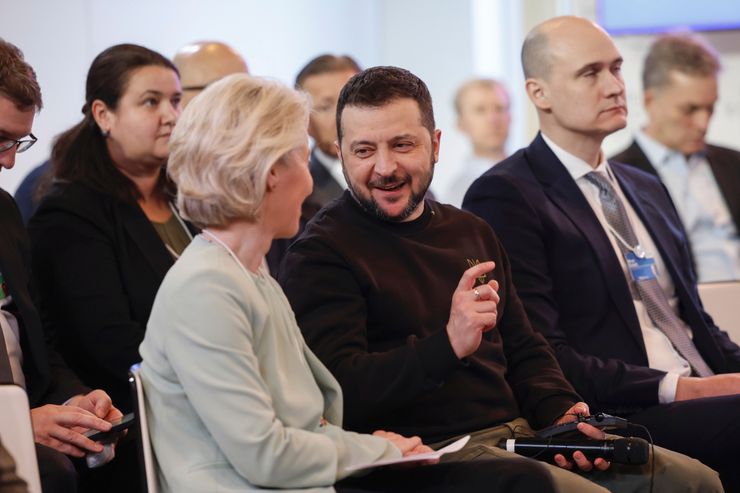
Ukrainian President Volodymyr Zelenskyy is headlining a frenzied first full day of the World Economic Forum’s annual meeting in the Swiss ski resort of Davos

DAVOS, Switzerland (AP) — Ukrainian President Volodymyr Zelenskyy is headlining a frenzied first full day of the

World Economic Forum's annual meeting

in the Swiss ski resort of Davos, where top officials from the United States, the European Union, China, the Middle East and beyond also will be prominent Tuesday.

Zelenskyy will endeavor to keep his country's

long and largely stalemated defense

against Russia on the minds of political leaders, just as

Israel's war with Hamas

, which passed the 100-day mark this week, has siphoned off much of the world's attention and sparked concerns about a

wider conflict in the Middle East

.

Tuesday's activities got rolling with a dizzying array of subjects in rooms at the Davos conference center, where discussions tackled issues as diverse as innovation in Europe, the economic impact of generative AI, corporate support for clean technologies and the interest-rate environment.

Conversations with the prime ministers of Qatar and Jordan will bookend the day's most visible events, with speeches by

Chinese Premier Li Qiang

, European Commission President Ursula von der Leyen and U.S. national security adviser Jake Sullivan in between.

Qatar's prime minister, Sheikh Mohammed bin Abdulrahman Al Thani, said concentrating on

attacks on ships in the Red Sea by Yemen’s Houthi rebels

— which have spurred

retaliatory strikes by the U.S. and Britain

— was “focusing on the symptoms and not treating the real issue” of Israel’s war on Hamas.

“We should focus on the main conflict in Gaza. And as soon as it’s defused, I believe everything else will be defused,” he said, adding that a two-state solution was required to end the conflict.

Sheikh Mohammed also warned a military confrontation “will not contain” the Houthi attacks.

“I think that what we have right now in the region is a recipe of escalation everywhere,” he added.

Zelenskyy, once reticent about leaving his war-torn country, has recently

gone on a whirlwind tour

to try to rally support for Ukraine's cause against Russia amid

donor fatigue in the West

and concerns that former U.S. President Donald Trump — who touted having good relations with Russian President Vladimir Putin — might return to the White House next year following his

commanding win in the Iowa caucuses

.

On Monday, Zelenskyy made a stop in Switzerland's capital, Bern, where President Viola Amherd pledged her country would start working with Ukraine to help organize a “peace summit” for Ukraine.

Zelenskyy followed that up with his first trip to Davos as president after speaking by video in previous years. He hopes to parlay the high visibility of the event into a bully pulpit to showcase

Ukraine's pressing needs

, and allies will be lining up: An invitation-only “CEOs for Ukraine” session preceded his afternoon speech.

The corporate chiefs heard “what kind of immediate assistance is needed” and laid out how private and public sectors can

help Ukraine rebuild one day

, forum organizers say. The session also drew von der Leyen, NATO leader Jens Stoltenberg, German Vice Chancellor Robert Habeck and the U.S. envoy for Ukraine's economic recovery, Penny Pritzker, among others.

Later Tuesday, leaders of some of Ukraine’s key European allies — Lithuanian President Gitanas Nauseda, Dutch Foreign Minister Hanke Bruins Slot and Spanish Foreign Minister José Manuel Albares Bueno — will participate in a session on the “horizons” for Ukraine.

The theme of the meeting in Davos is “rebuilding trust,” and it comes as that sentiment has been fraying globally: Wars in the Middle East and Europe have increasingly split the world into different camps.

While the geopolitical situation has oozed gloom, businesses appear more hopeful — in part from prospects that artificial intelligence can help boost productivity. Leading Western stock indexes shot up in 2023, and falling inflation raised

hopes of a decline in interest rates

.

The consulting firm PwC, in its 27th annual CEO survey, said

economic optimism has doubled

among executives over the past year — even if the prospects over the next decade appear less certain. With the pressure from climate change and

technology like artificial intelligence

, a growing number of executives say they are worried their businesses would not be viable in 10 years without reinvention.

AI is a major topic over the week in Davos, with a key talk by Microsoft CEO Satya Nadella — whose company has

invested billions in ChatGPT maker OpenAI

— among the sessions planned Tuesday.

More News

This chart shows just how rapidly Ebola is spreading
Oct 21, 2026
This chart shows just how rapidly Ebola is spreading

The most recent Ebola epidemic has killed thousands in Congo. A few cases have spilled over to its neighboring countries, including Kenya and Uganda. | Lucas Mukasa/Anadolu via Getty Images The Ebola virus is spreading at an unprecedented rate this year.  In the first five months since the outbreak began in the Democratic Republic of Congo (DRC), the World Health Organization (WHO) has reported 9,415 confirmed cases and 4,536 deaths in the country. While the virus has remained relatively contained by the DRC’s borders, case counts in neighboring Kenya and Uganda are also climbing (albeit more slowly). There are 20 confirmed cases in Uganda and eight in Kenya, and much of central and eastern Africa has tightened its borders.  The last major Ebola epidemic of this scale began in 2014 and continued through 2016 in West Africa. Over that period, it ultimately killed more than 11,000 people throughout West Africa. Nearly four years later, a smaller outbreak plagued Congo in its North Kivu region, leading to 2,229 deaths before it was contained.  The 2026 crisis hasn’t yet reached the same levels as the 2014 outbreak, but the speed of its spread is far greater.  As the chart below shows, around 150 days after the outbreak was declared, 2,599 Ebola cases had been reported in the 2014 West African epidemic. At the same time point this year, the number of cases came to 8,978 and has continued to climb.  View Link There is no straightforward explanation for this rapid spread One of the reasons the latest epidemic has been so difficult to slow down can be traced back to the fact that it’s a different viral strain — known as Bundibugyo — than the ones behind previous epidemics.   The Bundibugyo virus comes from the same family as the Ebola virus that caused the 2014 West Africa and 2018 Congo epidemics, causing the fatal fevers associated with Ebola. But the rare strain is different enough that it doesn’t respond to the same medical solutions. While the Zaire virus led to vaccines and treatment to mitigate the spread, we still don’t have a vaccine for Bundibugyo.  That doesn’t mean Bundibugyo is entirely novel, though. The 2026 outbreak is the third outbreak related to the Bundibugyo viral strain: In 2007, Uganda faced a minor outbreak, and the eastern province of Congo, which is now the epicenter of the epidemic, saw a handful of cases in 2012.  Luckily, these two outbreaks were contained in a span of months, largely due to efforts by the country’s Ministry of Health and international aid partnerships with the WHO, the US Agency for International Development (USAID), and international humanitarian organizations such as the UN Children’s Fund and Red Cross. More than a decade later, these efforts have been substantially curbed by USAID cuts. Tracing requires physical testing capacity: the tests themselves, health workers, and protective equipment for those treating suspected cases. Reduced access to such resources is especially dangerous with strains like Bundibugyo – in the absence of an effective vaccine, tracing the spread of disease and isolating potential disease contacts is especially important.  But cuts to aid, which covers disease surveillance efforts, made it more difficult to identify this year’s Bundibugyo outbreak until it was too late, creating a “critical four-week detection gap between the onset of symptoms of the presumed index case…and the laboratory confirmation of the outbreak,” according to a WHO situation report from May.  In August, the United States aimed to close at least some part of the vacuum it left, providing an additional $242 million to its $23 million original pledge in May.  Aside from international efforts, DRC faces the added layer of internal conflict and humanitarian crisis. The eastern provinces, including Ituri, have experienced years of conflict that have weakened the public infrastructure, including the healthcare system. Last year, nearly 25 percent of Congolese people faced food insecurity, and 4.5 million children were clinically malnourished, creating a population especially vulnerable to disease. The violence has also overwhelmed hospitals and displaced millions, disrupting the public health response, especially as mistrust in health authorities also runs rampant.  Even as emergency trials for a vaccine are underway, many of the factors that have facilitated the rapid spread may make treatment and outreach still more difficult. It’s hard to predict when the current outbreak will be handled, and how many more people will be affected before it does.

Expert Features

The Expert Features reports on the issues and the world’s everyday news. Handled by experts in different niches, you will find different subjects and perspectives.