Be an Example, Get the Covid Shot

Jan 15, 2021

JAMAICA, N.Y. - Jan. 15, 2021 - PRLog -- Today, I got the first dose of the Covid vaccine. I should have received it 4 weeks ago but passed the opportunity to do so. I blame the delay on a few people I met by chance, as well as my internal debate fueled by my insight as a physician.

For me, it was a roller coaster decision. While walking down the hospital corridor to get the vaccine 4 weeks ago, I encountered a hospital administrator. After we exchanged pleasantries, he asked, "What are you up to this morning?" "Going to get the Covid vaccine," I told him. Leaning in close as if he did not want anybody else to hear, he said, "Do you believe them? I do not." "Listen, doctor," he continued, "you better buy AstraZeneca stock; it is going to get approval soon." Then, he was on his way.

Right there and then, I changed my mind about getting the vaccine. Instead of walking toward the vaccination room, I turned around, walked into the doctor's lounge, and grabbed some bananas and a couple of small red apples that were put out for breakfast.

Two doctors were in the lounge when I entered. I asked them if they had gotten the Covid shot. One of them lifted his left arm to show me his band-aid.

"I got mine a couple of minutes ago," he said. "I fear getting the shot," I admitted. "Come on, now," he said to me, "you know us Africans! When we were small children, our mothers dragged us to the doctors to be vaccinated. And they did so without asking any questions, without knowing what was in the vaccines, and nothing happened to us. Go get it." Since he was convincing and because I admired him as a friend and colleague, I promised that I would go and get the vaccine immediately.

With my banana and two small red apples in my pockets, I walked towards the vaccination room. Two women were waiting for patients when I came in. One was the vaccine inoculator, and the other was handing out paperwork. Briefly, I asked myself, "Am I lucky to be the only person here? Or are others skeptical as well?" Both women looked at me quizzically.

"I am here for the Covid vaccine," I said to them. Across a small desk, three or four papers were handed to me to read and sign. Maybe I should have, but I did not consider signing consent forms before the shot. Nobody on television—not the commentators, not the infectious disease experts, not even Dr. Fauci—talked about signing consent papers. This piece of advice may look trivial, but it turned me away from getting the vaccine the first time it was offered to me. To the disappointment of the two women, and indeed to my disappointment, I left. I told them I was taking the papers home to carefully read before getting the shot. But really, I was looking for an excuse not to get vaccinated, and this scenario presented a perfect opportunity for me not to do so.

A week passed, and another week passed, and I still had not looked at the papers. One morning as I drove into a parking space at my pediatric office building, another physician, a 70-year internist, was arriving at the same time.

"Did you get the vaccine," I asked him.

"Yes, I did," he answered. "I work in a nursing home, and it is mandatory I get it. But I was sick afterward. It is a bad vaccine. I should not have gotten it." "It could be because you had a Covid infection months ago," I reminded him. "Perhaps, but let me tell you, it is not a good vaccine," he repeated.

The internist's personal experience got me thinking in another direction. I wanted to know if I had contracted a Covid infection in the past without even realizing it. I wanted to do a blood test to determine if had antibodies against the Covid virus. After all, what was the point of getting the vaccine if I had natural immunity, I wondered? At least, let me know what I have before I receive any shot.

It took me one week to obtain a Covid antibody test. "Oh my God…I do not have any antibodies," I thought as soon as I saw the results. I was like a sitting duck waiting for the virus. With all the children I see in my practice, and with all their parents that come with them, it is just a matter of time before I get attacked by the virus. What a motivating factor for me to get vaccinated. Also, when I told my son about how I was trying so hard to slink off from getting the shot, he exclaimed in disbelief, "What Dad? You should at least get it to show an example."

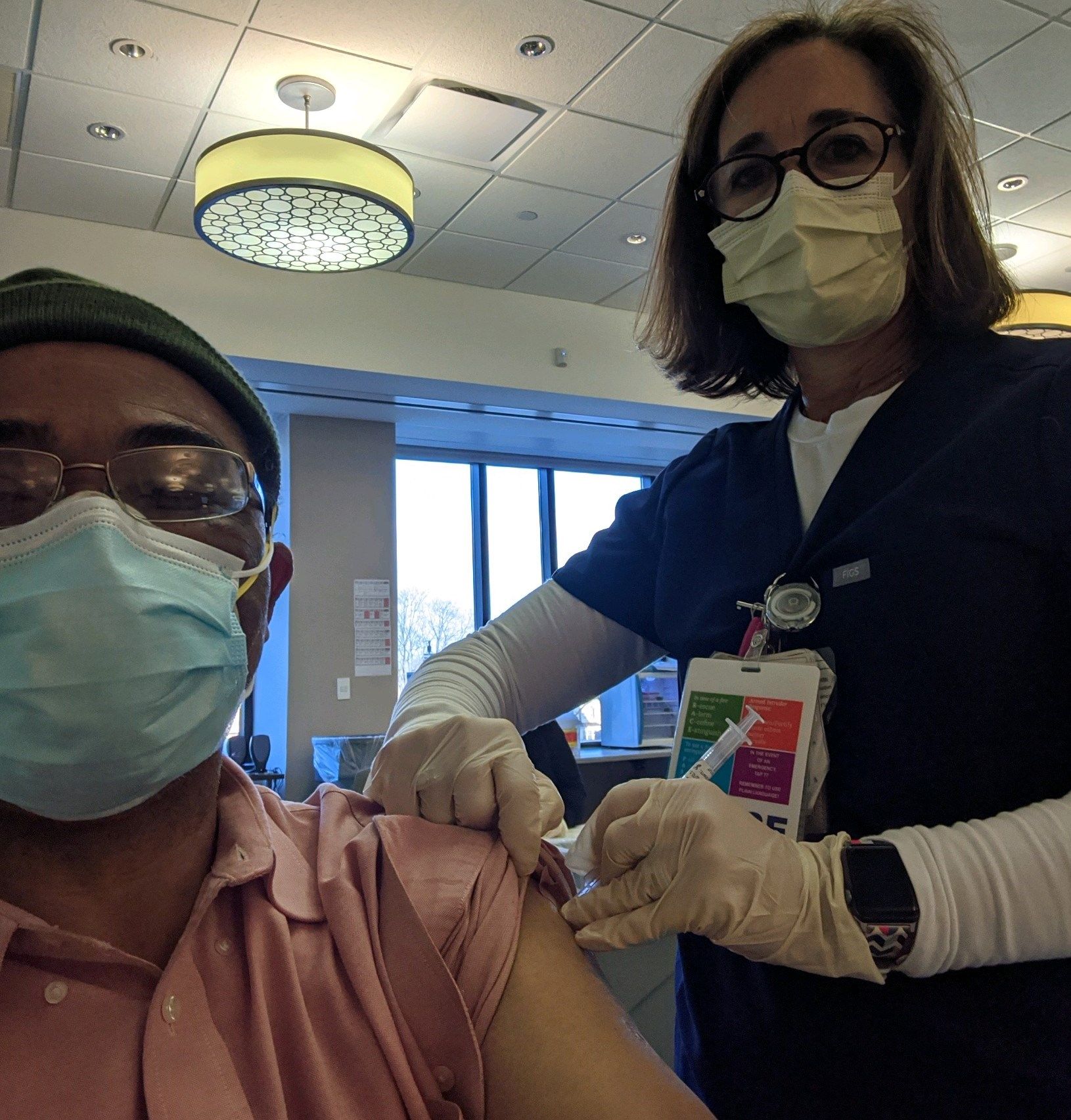
Pictures of famous people getting the shots in public were only transitory motivating for me. But my son's words sunk in—I needed to be an example. Rushing against the virus, I called and scheduled to be vaccinated at one of the Connecticut hospitals where I hold privileges. There, today, as shown in this picture, I got my first Covid shot—the Moderna one. Like other patients who had the shot that day, I waited for 15 minutes. Nothing happened. Everybody else was okay. The shot itself was not painful, but my left arm was sore and heavy for 48 hours. People have different experiences with the shot. But from my experience, I think it is a good shot. So, I think people should get it when they can unless they have a medical reason not to. I am eager to get my second shot in 28 days.

If you like this personal account, please donate to a nonprofit organization that reaches seniors in my hometown. You can also purchase my childhood memoirs about the Nigerian civil war or my book on how I lost thirty pounds.

Photos: (Click photo to enlarge)


Read Full Story - Be an Example, Get the Covid Shot | More news from this source

Press release distribution by PRLog

More News

The French youth revolt
Oct 19, 2026
The French youth revolt

A protester holds a smoke flare and French flag during a demonstration at Paris’s Place de la Republique on October 17, 2026. | Kiran Ridley/AFP via Getty Images This story appeared in Today, Explained, a daily newsletter that helps you understand the most compelling news and stories of the day. Subscribe here. French protests have long been the stuff of legend, literature, and Broadway musicals. But even by those storied standards, last weekend’s demonstrations were pretty remarkable. More than half a million people took to the streets in occasionally violent protests that are posing a mounting political challenge for the French government. The movement began roughly a month ago over concerns about the sorry state of public high schools, which are frequently underfunded and understaffed.  But in the weeks since, the student protests have rapidly expanded to encompass a wider range of grievances around inequality, high living costs and public services. The ranks of the protesters have also swelled to include some more opportunistic looters and agitators.   In Paris, masked rioters trashed businesses and set fires, while students blocked the Louvre Museum on Monday, forcing it to close. In Limoges, a city of roughly 130,000 people, the spire of a 19th-century town hall dramatically collapsed in flames. The national government has responded with curfews for parts of cities including Paris, Nice, and Lille, as well as emphatic condemnations of the violence. In a televised address on Sunday night, French President Emmanuel Macron also promised to partner with students, teachers, trade unions and other groups to identify “joint solutions.” But it’s unclear what solutions could possibly speak to the whole of this newly expanded movement. The initial student protesters were after concrete educational reforms, like smaller class sizes and less chaotic schedules. The demands now are more diffuse and disjointed, reflecting the sense that — as Macron himself put it — “there is no desirable future” for young people in France. It’s a situation that the French far right is already exploiting, just six months before the country’s next presidential election. Go a little deeper View Link If you’re getting a bit of déjà vu here — that’s French for “already seen,” FYI — please know you have good reason. The French also turned out for gigantic mass protests against a proposed retirement age increase three years ago. And a gas-tax hike five years before that. Some historians trace French protest culture all the way back to the 1300s. While it’s not necessarily true that the French demonstrate more than people in other Western countries, their protests do tend to attract outsize global attention. Youth protests over education, living costs, and government corruption have also recently taken place in Belgium, Portugal, Italy, Spain, and Albania, for instance. I’d hazard that you’ve heard less about them. But there’s a twofold explanation for why France’s protests loom so large. First, protest occupies a special place in French history and culture — and the world knows it. As one political scientist explained in a 1994 paper on the history of French protests, the French have an unusual, centuries-long track record of turning demonstrations into actual political change, arguably starting with the French Revolution. More recently, in 1968, student protests expanded into a larger worker strike that nearly toppled the government. Many of today’s young protesters have specifically referenced that heritage in interviews and slogans. But that’s not the only reason that French people always seem to be protesting. Conditions in France are also, well … pretty protestable. Consider just the narrow issue of public education, which sparked the current hullabaloo.  By some estimates, higher-education funding per student has fallen by 20 percent in just the past 10 years. High school classrooms are frequently overcrowded, and a government report cited by The Guardian concluded that the country’s aging schools are in need of billions of dollars of building repairs and climate mitigation. The government has pointed to France’s strained finances as a constraint on addressing these issues. (And, in fairness, France’s finances are indeed very strained.) There’s a sense, however, that young people are bearing the cost of that crisis more than other populations. Cost-cutting measures that would affect older people — such as raising the retirement age from 62 to 64 — have been delayed in the face of fierce opposition. And by “opposition,” of course, I mean protests.  One link for later ➨ Make your AI fallback plan. Artificial intelligence will cost many people their jobs; in some places, it already has. But instead of panic-learning the first available trade, first consider where you find meaning in your current occupation. That should help guide you to a fallback career that will still feel valuable, even if it’s…you know. Not your first pick. My colleague Sigal says she’d become a rabbi; I think I’d like to teach again.  Before you go… Did you know…that a single episode of Sex and the City is credited with launching the early aughts cupcake craze? Today’s food trends are much shorter-lived, by comparison. And they typically start on TikTok or Instagram.  Today’s trivia: What mass-market, imported beer is named for a river in the Netherlands? (You can find this and other brain puzzles in Vox’s daily crossword. Look for the answer in tomorrow’s edition.) Yesterday’s trivia: Last week we asked you for the author of the 1952 self-help book The Power of Positive Thinking. That would be Norman Vincent Peale, the Protestant minister who also preached at President Donald Trump’s childhood church and officiated his first wedding.

YOUR NEWS, OUR NETWORK.

Do you have Great News you want to tell the world?

Be it updates about your business or your community, you can make sure that it’s heard by submitting your story to our network reaching hundreds of news sites across 6 verticals.

Expert Features

The Expert Features reports on the issues and the world’s everyday news. Handled by experts in different niches, you will find different subjects and perspectives.