E&R Publishers New York announce release of Diamonds are For Cocktails-a murder mystery novel by Zarah

Nov 9, 2022

E&R Publishing announces a new and extraordinary murder mystery, Diamonds are For Cocktails—A Novel by Zarah. Murder—Mystery—Billionaires.

Beverly Hills, California, United States - November 9, 2022 /MarketersMEDIA/

From Diversity to Diamonds: TV personality and Music Artist Zarah Makes Headway in Billionaire’s Playground, French Rivera in her New Book Diamonds are For Cocktails.
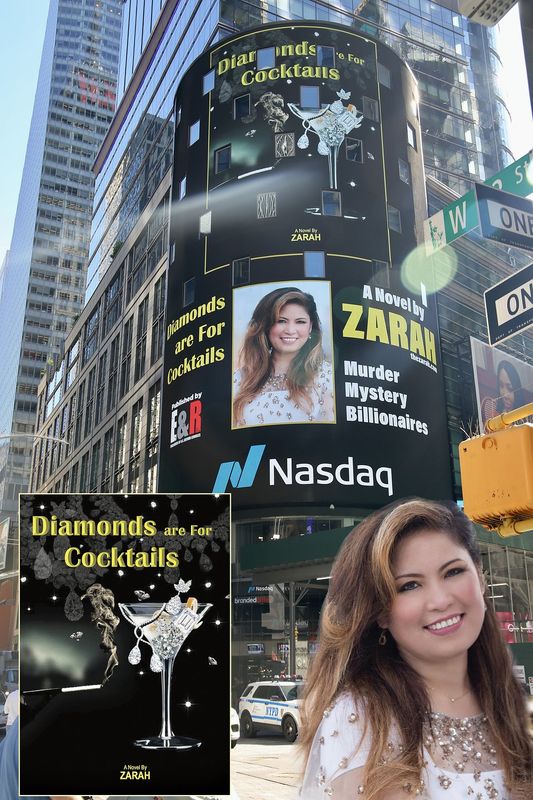
Zarah, a Filipino-American multi-hyphenate entertainer who performed with Goo Goo Dolls and hosted “B InTune TV” in 2005, announces the release of her first-in-series crime thriller Diamonds are For Cocktails with the publishing house E&R Publishers in New York, hitting the bookstores everywhere on October 27, 2022.

Zarah, who once attended galas and met with Prince Albert II in Monaco, a billionaire’s playground, became heavily inspired. Diamonds are For Cocktails is a fascinating tale of an adopted Monégasque diamond heiress who, despite her wealth and power, is still haunted by her past. The book details about the killer’s unraveling mysterious crimes investigated by the FBI and the allure that attracts ordinary people to the extraordinary, which begs the question — can money really buy you everything?

A riveting plot that promises intrigue and surprise, Diamonds are For Cocktails explores the human side of the heiress’ unbreakable bond with her childhood friend and her emotional journey back to life; A journey that Zarah herself knows all too well after losing her late husband, Eugene Maillard, once a Grammy executive whose life’s work was about championing a children’s cause.

Plans for the "Diamonds are For Cocktails VIP Tour with a Cause” are underway and road mapped are a series of events in elegant cities to help celebrate and support youth and children around the world in diverse communities, including those who are affected by the war in Ukraine.

"Zarah’s ‘Diamonds are For Cocktails’ is a glitzy literary adventure where…the rich indulge in endless pleasures. Somehow, we’re all invited to play. Mysteries are to be uncovered, but for readers, it’s all part of the escapade – one that doesn’t require renting a yacht.”

—Stephanie Nelasco, Fox News

Writing Diamonds are For Cocktails has allowed me to enter into a life-saving world of fantasy and illusion. When reading the book I had just written, it was like I was watching a movie; I couldn’t look away.”

— Zarah, author of Diamonds are For CocktailsThe book is available for purchase at all outlets globally in multiple formats including hardcover, softcover, Ebook, and Audio. See details at Amazon

E&R is a New York-based publisher that seeks out the best in their field to bring them to market.

About Us: Contact Information: Simon Mills. Publisher. [email protected] 917 733 1427 https://EandR.pub

Contact Info:
Name: Simon Mills
Email: Send Email
Organization: E&R Publishers, New York
Address: 304 W 115th St Penthouse B New York NY, 10026
Phone: 9177331427
Website: https://EandR.pub

Video URL: https://youtu.be/xy6r_iITfrc

Release ID: 89084518

If you detect any issues, problems, or errors in this press release content, kindly contact [email protected] to notify us. We will respond and rectify the situation in the next 8 hours.

More News

Scientists are finally starting to figure out Alzheimer’s
Sep 21, 2026
Scientists are finally starting to figure out Alzheimer’s

A scan of the brain of a patient affected by Alzheimer's disease. | BSIP/UIG Via Getty Images For decades, research into Alzheimer’s disease has made painfully little progress. More than 7 million Americans are living with the disease, which is the most common cause of dementia. It’s incurable, and treatments have been hampered by groupthink, as well as by systemic fraud from some of the field’s most famous researchers. But there are finally signs that the field is turning a corner, including two new drugs, rolled out in the last few years, that can treat Alzheimer’s directly. “If somebody walks into a clinic right now and is diagnosed with Alzheimer’s disease,” Vox senior correspondent Dylan Scott tells Today, Explained co-host Sean Rameswaram, the drugs “will hopefully have some effect in slowing down their cognitive decline.”  As Scott says, “The drug development pipeline is also starting to look much more robust” — even “revolutionary,” to quote one doctor he spoke with. The two talk about why researchers are more optimistic than they have been in years, whether GLP-1 drugs might help prevent Alzheimer’s, and an experimental surgery pioneered by doctors in China that has produced striking — but if unproven — reports of improvement in people with the disease. Below is an excerpt of their conversation, edited for length and clarity. There’s much more in the full podcast, so listen to Today, Explained wherever you get podcasts, including Apple Podcasts, Pandora, and Spotify. You mentioned two treatments. Tell us what they are, Dylan? We have two drugs right now that have been approved by the FDA: lecanemab and donanemab. And these are drugs that target the amyloid plaque in the brain that scientists have long thought might be associated with the development of Alzheimer’s disease. The amyloid hypothesis [the belief that Alzheimer’s is caused by the buildup of deleterious amyloid proteins in the brain] has been very controversial for a while, in part because there were these years and years where we weren’t seeing any progress despite this being the dominant hypothesis about the disease. But we do have these two drugs that in clinical trials have been shown to both clear out the amyloid plaque in somebody’s brain and they do seem to lead to slower cognitive decline for those patients. And the hope is that this is the ground floor. These are the worst drugs, hopefully, that we’re ever going to have and continued scientific discovery and progress with developing drugs will lead to even better treatments in the future. “The hope is that five, 10 years from now, we’ve got a much more robust suite of treatments that can help somebody who’s been diagnosed with Alzheimer’s.” Tell us more about the scientific discovery. You mentioned that there’s promising research beyond amyloid plaques? It’s not like the amyloid hypothesis has been invalidated, but I think our understanding of the disease has become more complex.  We’re realizing that there’s probably also a role for a different kind of protein called tau. There may also be a role with chronic inflammation, your vascular health, your body’s ability to just pump blood through your body may also be playing a role in the development of Alzheimer’s disease. And so now we’re starting to see treatments that target these other things.  The way I’ve been thinking about it is if we used to be putting all of our bets on amyloid, we’re still putting some bets on amyloid, but we’re also putting bets on these other things. And so now there are treatments in the works targeting, for example, these tau proteins. They’re still in the early stages of clinical trials — really at the stage where they’re just checking the safety of these drugs and making sure that somebody can take them without getting really sick, or God forbid, dying or something like that. But even when they’re doing those safety checks, they do start to collect qualitative data about, well, are we starting to see any effects?  Some of the preliminary results from some of these tau targeting treatments that are in the works have looked pretty promising. And so that’s encouraging, obviously. It’s possible that we’re moving towards a future where not unlike cancer treatment, there’s not just one drug for Alzheimer’s disease, but maybe you take a combination of different things that work on different mechanisms for the disease and the collective cumulative effect is that it stops the progression or even reverses it.  The hope is that five, 10 years from now, we’ve got a much more robust suite of treatments that can help somebody who’s been diagnosed with Alzheimer’s. Five, 10 years from now sounds nice, but is there anything else that’s in the cocktail now that people are discovering could be promising for Alzheimer’s? There are also, yes, drugs that millions of people are taking right now for other reasons that might also be able to help with Alzheimer’s disease. And GLP-1s in particular are the big ones. No way! Yeah, I know. These drugs — it seems like every day you see some new headline about this miraculous thing that they can do. Weight loss, smoking, my poker addiction, and…? And it might prevent dementia down the road.  If you step back and think about it, the theory does make some sense. Like I said before, scientists increasingly think there’s an association between your vascular health and your cognitive health, especially as you age. And what do these GLP-1 drugs do? They help people lose weight.  Losing weight helps to lower your blood pressure, lowers your risk of vascular problems, whether it’s heart disease or pulmonary disease or stroke or something like that. So if more and more people take these, they take them earlier in life, they lose weight, they keep it off, they don’t develop these heart or vascular problems, it does make some sense that that may also reduce their risk of developing Alzheimer’s disease.  It’s still sort of theoretical, but the Alzheimer’s Association is putting $100 million behind some research projects to investigate this possible link. We may learn five, 10 years from now, as millions of people are now on these GLP-1 drugs — maybe we start to see Alzheimer’s less often. And that would be another reason to be optimistic that the future for this disease is looking brighter. How about reversing it? Is that still a pie in the sky? It’s out of reach for now. Certainly some of the scientists that I’ve talked to have said, “In theory, it should be possible. Your brain is really resilient. It’s really good at rebuilding itself if you give it the chance.” It seems like it should be possible to stop the progression of the disease eventually, and maybe ultimately reverse it.  Now, there has been some really intriguing, but also mysterious developments around reversing Alzheimer’s, not from scientists based out of the United States, but from scientists in China. People may or may not have seen that there have been videos of these patients who underwent an experimental surgery and the before and after of these videos is incredible. In the before, you’ve got somebody who clearly has Alzheimer’s disease, doesn’t recognize their loved ones, has trouble with their train of thought. In the after videos, it’s like they’re a completely different person. They recognize their loved ones, they’re talking articulately. And so that has, as you can imagine, generated a lot of excitement, also a fair bit of skepticism. Are these videos real? Do we know? We don’t know for sure if they’re real or not. What’s intriguing about this surgery is that the theory of it, at least to me as a lay person, makes some sense.  The gist of this surgery is the surgeons create a drain in the patient’s brain and the drain is supposed to help the brain get rid of these amyloid and tau proteins that we think are associated with Alzheimer’s disease. On a hypothetical level, it makes some sense. And scientists in the United States and Europe and elsewhere have been intrigued enough about these videos and the findings that have been reported in academic journals to set up their own studies to try to replicate these findings.  Now, it’s a crazy story because this scientist in China who pioneered this idea has actually been arrested by the Chinese government. And as I understand it, he’s currently in detention. For what?! The reporting I saw was these seem to be kind of flimsy charges of insurance fraud. The Chinese government has also tried to ban the surgery, at least outside of clinical trial settings. So that’s obviously complicated the story a little bit. But nevertheless, you do have scientists in the US and outside of China who are like, “Well, we at least want to try this for ourselves and see if it works.” It does feel like it’s something that could get people’s hopes up who have been waiting for this for decades. Exactly. I mean, I think this is like the holy grail. Can we find a way, whether through surgery or through pharmaceuticals, to actually reverse these symptoms and restore the person to who they were before Alzheimer’s took over? Because that’s the thing that I think everybody recognizes but is worth emphasizing, is, as one doctor put it to me, and I’ve never forgotten it, Alzheimer’s is a disease unlike any other because it robs you of your identity.  To be able to restore people’s identity through whatever means, that is the goal that all of these scientists are chasing.

YOUR NEWS, OUR NETWORK.

Do you have Great News you want to tell the world?

Be it updates about your business or your community, you can make sure that it’s heard by submitting your story to our network reaching hundreds of news sites across 6 verticals.

Expert Features

The Expert Features reports on the issues and the world’s everyday news. Handled by experts in different niches, you will find different subjects and perspectives.