FarmPages Brings Nearly 50 Years of Agricultural Supplier Discovery Online for North American Farmers

Sep 19, 2026

FarmPages, the online home of The Book — Where Farmers Look, is giving farmers across Canada and the United States a faster way to search for agricultural equipment, suppliers and services.

Winnipeg, Canada, September 19, 2026 -- FarmPages, the online home of The Book — Where Farmers Look, is giving farmers across Canada and the United States a faster way to search for agricultural equipment, suppliers and services while preserving the practical, supplier-focused approach that has made The Book a trusted agricultural reference for nearly five decades.

Originally launched in 1978 as the Manitoba Farmers Buyer’s Guide, The Book grew from a regional publication serving approximately 30,000 farms into a widely used North American agricultural directory. Today, the publication and its digital platform continue to connect producers with businesses serving the day-to-day needs of modern farms, from machinery and replacement parts to grain systems, crop inputs, buildings, livestock equipment, transportation, finance and precision technology.
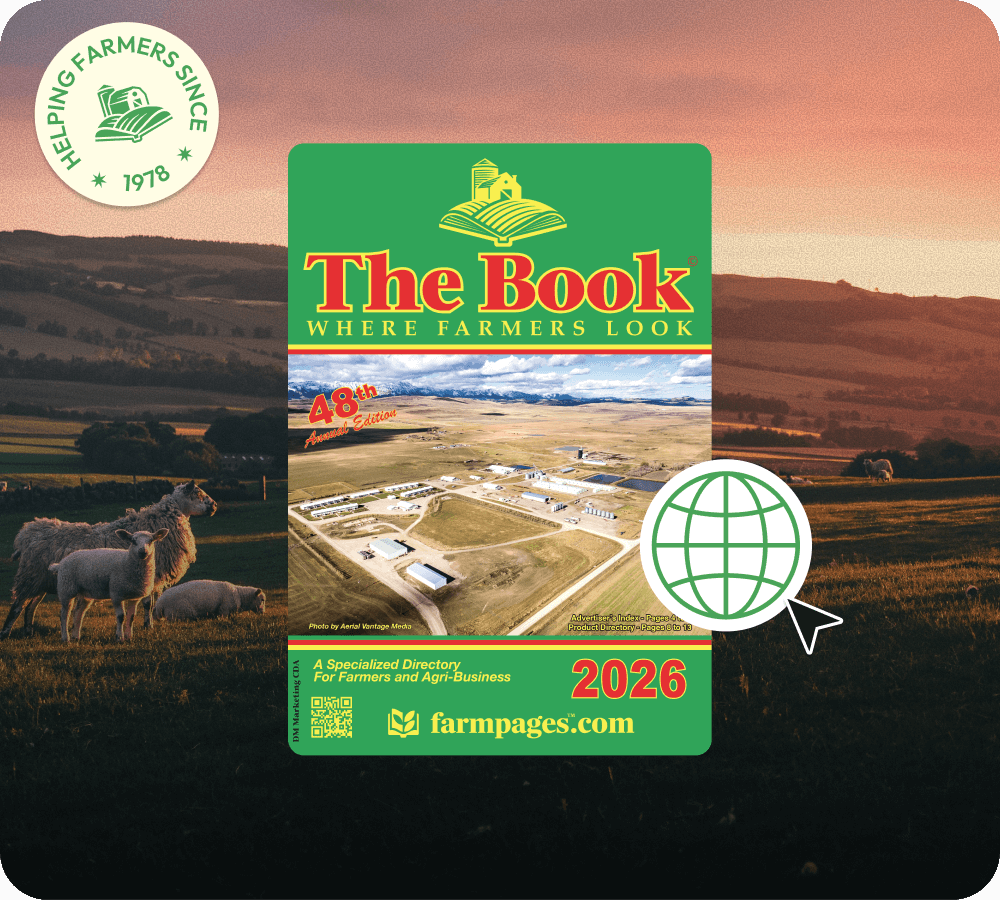
At the center of the platform is a searchable directory designed around the way producers actually shop. Farmers looking for farm equipment can browse suppliers by category, business or keyword, compare options and locate companies serving their region. The online experience complements the annual print catalogue, giving users another way to find vendors when a part fails, an equipment upgrade is being planned, or a new supplier is needed before the next season.

FarmPages currently organizes agricultural businesses across a broad range of categories including Buildings & Accessories; Crop Nutrition and Defence; Grain Systems; Harvesting & Hay Systems; Livestock Equipment & Pasture Management; Manure & Waste Management; Parts, Service & Repairs; Power Products & Tractors; Tech, Precision Farming & Monitoring; Seeding, Tillage & Field Equipment; Transportation; Dairy; Safety Equipment; Scales; and additional specialized products and services. This category structure helps producers move from a general need to a focused list of relevant suppliers without having to search through unrelated consumer results.

That focus matters in agriculture, where purchasing decisions are often time-sensitive and highly specialized. A producer searching for a combine component, grain handling system, livestock feeder, tillage tool or tractor-related service may need more than a generic search result. FarmPages is built to surface companies that specifically serve the agricultural market, including manufacturers, dealers, parts suppliers, service providers and other agribusinesses.

The platform also extends the reach of FarmPages beyond a traditional directory. Featured business profiles can include company descriptions, product and service details, locations, phone information and links to supplier websites. Special offers and the digital edition of The Book provide additional ways for farmers to discover products, while businesses can use the platform to reach an audience already looking for agricultural solutions.

According to FarmPages, The Book reaches more than 150,000 farmers across North America and is updated and distributed annually. Its current circulation spans major Canadian agricultural markets as well as farming regions in the northern United States. The long-running publication has built its identity around a simple idea: when farmers are preparing to buy, repair, expand or compare, they should have a dependable place to see who supplies what.

The digital directory carries that idea forward for a generation of producers who may move between print and online research. A farmer can begin with a category, narrow the search by supplier or keyword, and then contact a business directly. For suppliers, that creates visibility at a point when the user’s intent is commercial and specific rather than casual.

Agriculture continues to become more complex as farms adopt new machinery, automation, data-driven tools and specialized inputs. At the same time, dependable access to parts, repairs and regional suppliers remains essential. FarmPages combines those traditional and emerging needs in one directory, covering established categories such as grain handling and equipment repair alongside newer areas such as precision farming, monitoring and agricultural technology.

Farmers can access the latest catalogue online and search FarmPages by category, business or keyword. Agricultural companies interested in reaching the FarmPages audience can also explore advertising and featured listing opportunities through the website.

About FarmPages / The Book — Where Farmers Look

FarmPages is the online agricultural directory for The Book — Where Farmers Look, a specialized resource connecting farmers with agricultural equipment, supplies and services across Canada and the United States. Founded in 1978, The Book has grown from a Manitoba farm buyer’s guide into a North American agricultural reference reaching more than 150,000 farmers. The directory helps users search by category, business or keyword across equipment, parts, grain systems, crop production, livestock, buildings, technology and other agricultural services.

Media / Business Contact

Organization

FarmPages / The Book — Where Farmers Look

Address

PO. Box 99, Richer, Manitoba, R0E 1S0

Contact Info:
Name: George
Email: Send Email
Organization: FarmPages
Address: PO. Box 99, Richer, Manitoba, R0E 1S0
Phone: 204-416-9970
Website: https://farmpages.com/

Release ID: 89203767

If you encounter any issues, discrepancies, or concerns regarding the content provided in this press release that require attention or if there is a need for a press release takedown, we kindly request that you notify us without delay at [email protected] (it is important to note that this email is the authorized channel for such matters, sending multiple emails to multiple addresses does not necessarily help expedite your request). Our responsive team will be available round-the-clock to address your concerns within 8 hours and take necessary actions to rectify any identified issues or guide you through the removal process. Ensuring accurate and reliable information is fundamental to our mission.

More News
Why Democrats are pivoting to thirst traps
Oct 26, 2026
Why Democrats are pivoting to thirst traps

“It is a very real dynamic that you could have all these videos about Jon Ossoff, and it's not seen as detracting away from his overall message or his seriousness as a politician,” The 19th’s Grace Panetta said on Vox’s Today, Explained podcast. | Elijah Nouvelage/Getty Images Democrats have been emphasizing lots of issues in the runup to the 2026 midterms: The Iran war. The state of the economy and healthcare. Corruption. And…hotness. Specifically, their candidates: The internet is awash in clips of Michigan candidate Abdul El-Sayed pumping iron and podcasters proclaiming that “America deserves a hot president” in a video interspersed with photos of Georgia Sen. Jon Ossoff. Having a good-looking candidate is by no means a new tactic — famously, it may have helped John F. Kennedy win election over Richard Nixon — but the online left is adapting that strategy for the internet and fandom age.  Grace Panetta, a politics reporter for The 19th, wrote about how “thirst edits” of Ossoff in particular are proliferating online. Panetta says the organic origins of a lot of these videos are of particular interest to Democratic operatives, who see it as a way to gain back ground they lost on the internet after the 2024 election.  Panetta spoke with Today, Explained co-host Sean Rameswaram about who’s thirsting over Democratic politicians in the first place, how 2026’s hot candidates are different from those of yore, and whether it’s actually giving them a boost.  Below is an excerpt of their conversation, edited for length and clarity. There’s much more in the full podcast, so listen to Today, Explained wherever you get your podcasts, including Apple Podcasts, Pandora, and Spotify. Where are these edits coming from? Regular online creators. And it’s important to note at the outset that these are not paid partnerships. The campaign is not paying these influencers to make edits about how they think their candidate’s really attractive.  That’s partly why I wanted to dig into it, because it’s organic. These are just online creators wanting to draw visibility and attention to a candidate that they really like. Jon Ossoff is currently running for reelection in these midterms. How do we know for sure that he isn’t somehow behind the campaign? I spoke to several creators who make these videos and they said that they’re doing it for the love of the game and they’re just supporters. His campaign did not give me a quote or a statement for this story. So it’s fair to assume that he’s not directly involved and he doesn’t repost these videos.  But as people pointed out to me, his campaign knows that they have an attractive, compelling candidate. And they’ve previously been vaunted for their digital strategy this cycle of putting out very high-quality livestreams of his rallies. There’s a lot of material for an enterprising TikToker who wants to make these edits or clips. They have a lot to work with.  His campaign, as one person put it, is definitely playing into that, but not directly engaging. It’s a fine line to walk. Is it just an Ossoff thing or is this going on with other candidates? I do recall that Abdul El-Sayed hits the gym. Famously so. Yes, he hits the gym. I just watched so many videos for this story. I also came across a fair number of Gavin Newsom edits. There are people who think he gives sort of a Patrick Bateman, American Psycho vibe. There are also official Democratic accounts, including the TikTok account for the DNC, the headquarters account, which was formerly Kamala HQ, who have been posting edits of Ossoff and also Abdul El-Sayed, who kind of leans into this gym-bro persona.  The headquarters account posted a side-by-side of Ossoff and Abdul El-Sayed with the caption, “There are 69 days until election day.” Nice. Yes. There are also lots of edits of Mamdani, and former President Barack Obama. Obama nostalgia content goes hard on the internet. So you’re seeing these more official side Democratic campaign accounts leaning into it and playing up their candidates. Having an attractive candidate is nothing new. You mentioned Obama. JFK was famously dashing. What feels different about what you’re seeing now on social media? I think this is really a culmination of a lot of different things happening right now in politics and specifically within the Democratic Party.  After their loss in 2024, there was a lot of conversation about the gerontocracy, how we’re governed by a lot of really old people, for the most part, in this century. And also about Democrats’ digital strategy and the aftermath of 2024.  One thing that a lot of people in that digital space have been talking about is how Republicans and the Trump campaign really capitalized on getting that organic engagement on platforms like TikTok and Instagram, where a lot of Americans are now going to get at least some of their news, and also engaging with and encouraging the creation of this kind of organic content on platforms and from creators that are not always expressly political or official-side.  “A candidate’s messaging strategy is only as good as the content and only if it meets people where they are and actually speaks to a real need people have.” As one Democrat I talked to put it, she thinks it’s a way for Democrats to win back the internet and to really create a contrast with the Republicans. And she said to have fun on the internet because Republicans are having fun on the internet and it appears to be working for them, or at least it was in 2024. Is there something about this being something on the left that makes it sort of tricky? This is, broadly speaking, objectification, right? It is a fine line between thirst and objectification. And there is also a gendered element to it that it is mostly men that these types of videos are being made about.  Now, granted, a lot of people make sort of hype edits or positive content about AOC because she’s a very popular female politician on the left, but it’s true that women candidates are held to higher standards in terms of how they present themselves and how their supporters portray them.  It is a very real dynamic that you could have all these videos about Jon Ossoff, and it’s not seen as detracting away from his overall message or his seriousness as a politician. Is there a drawback of focusing on looks? Does it make the Democratic Party or these candidates seem superficial or not that serious? President Trump has been the defining figure in our politics for 10 years now. And he is famously very, very image focused and image obsessed. We live in a very image-obsessed society, and I think there’s kind of a bipartisan acknowledgement of that.  And looks matter to people in all kinds of ways. They do matter in politics, they do matter to voters. Whether you like that that’s the case or not, it is the reality. And I think the way that a lot of people on the left see this is, people want to look at attractive people. People take attractive people more seriously and are more willing to listen to them. So we should play into that and play that up.  That’s also been the case on the right. President Trump famously loves people out of “central casting.” There’s been this whole movement on the right about making conservatism sexy again. And especially at the beginning of the second Trump term, you had all these influencers talking about how the second Trump term was going to usher in this great age of hotness, which is of course very based on sort of stereotypical male-centered Eurocentric beauty standards.  I think the genie’s out of the bottle on this one in terms of the fact that our politics and society is very image-obsessed. And I think the left, being locked out of power, realizes they have to play on those terms and they have fun doing it. You could look at it as giving “Kamala is brat,” which famously did not work. Is it working in any tangible way for Ossoff, for Abdul El-Sayed, or anyone else? I think a lot of the time in politics, the success of a message is really dependent on the broader political situation. I think a part of the reason that the Kamala’s brat thing didn’t work is people were like, “Okay, that’s great, but my gas is too expensive and prices are too high and I’m not happy with how things have gone under the Biden administration, so I don’t really care.” I don’t know that specific digital strategy makes or breaks a campaign or candidate, but it feeds into a bunch of larger factors.  Something that a lot of people I spoke to said they liked about Jon Ossoff is how he is incredibly serious in Senate hearings. He doesn’t grandstand. He really holds Trump administration officials’ feet to the fire. He’s been very focused in his role in the Senate and on the campaign trail about calling out corruption. He’s a very, very gifted speaker and orator. So I think a candidate’s messaging strategy is only as good as the content and only if it meets people where they are and actually speaks to a real need people have. And I think people are really unhappy with the second Trump term and politicians being super old and out of touch, and it’s a perfect storm of factors that makes it work for him.

YOUR NEWS, OUR NETWORK.

Do you have Great News you want to tell the world?

Be it updates about your business or your community, you can make sure that it’s heard by submitting your story to our network reaching hundreds of news sites across 6 verticals.

Expert Features

The Expert Features reports on the issues and the world’s everyday news. Handled by experts in different niches, you will find different subjects and perspectives.