Waterproof Speaker Market is projected to reach $12,395.9 Million by 2027

Jan 9, 2019

Global Waterproof Speaker Market: From an Estimated Market Size of US$ 6,740.6 Mn in 2018.
Valley Cottage, United States - January 9, 2019 /MarketersMedia/ —

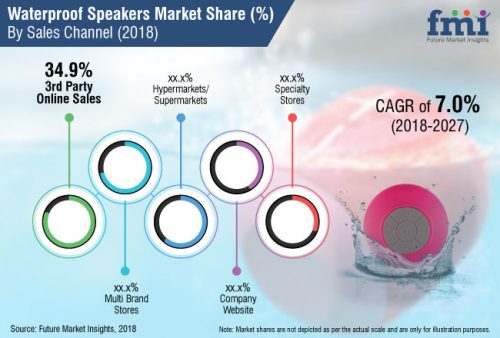
According to a market report published by Future Market Insights titled ‘Waterproof Speaker Market: Global Industry Analysis 2013-2017 and Opportunity Assessment 2018-2027,’ the revenue generated by the market is estimated to be valued at US$ 6740.55 Mn in 2018, which is projected to increase at a CAGR of 7.0 % during the forecast period (2018-2027).

In the global waterproof speaker market, companies across the globe are focusing on research & developing and the launching of new product variants, which is a key factor driving demand for waterproof speakers across the globe. Companies operating in the market are constantly investing a significant amount on research and development activities to cater to the evolving needs of customers who are seeking authentic and specialised products. Waterproof speakers have standard features such as style, basic functionality and durability. Technological advancements in several audio devices has changed the manner in which people appreciate and play music. An increase in the demand for wireless-based audio devices, which include portable waterproof speakers with different connectivity options such as Bluetooth & Wi-Fi, sound-bars, headphones and microphones, has been witnessed in the audio industry. Moreover, the demand for waterproof speakers and similar other devices from end users is gaining traction. This has expected to drive the North America market over the forecast period.

Request Sample of Global Waterproof Speaker Market @ https://www.futuremarketinsights.com/reports/sample/rep-gb-8146

The manufacturers of waterproof speakers have also adopted some key differentiating strategies. For instance, brands operating in the market are targeting mass consumers. They are also offering waterproof speakers with advanced features at competitive prices. The manufacturers of waterproof speakers are also seeking product innovation due to an increase in the awareness of consumers with respect to different brands in the waterproof speaker marketplace, as well as to maintain a proper value chain to reach the proper target audience and to reduce the cost of the final product. Manufacturers are focused on developing high-value waterproof speakers due to the rising consumer demand for better and more effective value-added products. Furthermore, the rising diversity of premium waterproof speakers on retail shelves is also expected to contribute to the increasing value share of the market in the near future.

Features, such as long-range connectivity, robustness and the availability of products on e-commerce platforms, are expected to boost the market. The functionalities of multi-room sharing via small devices, i.e., the pairing of multiple portable waterproof speakers via a single device to make compact devices produce louder sounds, are increasing the demand for waterproof speakers in the market. The rising popularity of waterproof speakers among the millennial population is also a major driver of the waterproof speaker market.

The global market is segmented on the basis of regions, which include North America, Latin America, Asia Pacific Excluding Japan (APEJ), Europe, Middle East & Africa and Japan. Among all the regions, the North America and Asia Pacific excluding Japan regions are estimated to have a substantial value share. The North America region is expected to grow with the highest growth rate of 8.3% owing to the growing number of smart homes in the region. In terms of revenue, the value of the market was US$ 6,327.4 Mn in 2017.

Inquiry for customization in Report @ https://www.futuremarketinsights.com/customization-available/rep-gb-8146

Key Players in the Waterproof Speaker Market

Detailed profiles of companies are also included in the global waterproof speaker market report to evaluate their strategies, key product offerings and recent developments. Some of the key players profiled in the global waterproof speaker market study include Bose Corporation, HARMAN International, Apple Inc., Yamaha Corporation, Sony Corporation, Logitech International S.A., LG Electronics Inc., Samsung Electronics, Panasonic Corporation, Sound United LLC, Philips, LIXIL Group, Anker, Ematic, G-Project Gear, 808 Audio, ROCKVILLE, FosPower, AOMAIS and Altec Lancing.

Browse More Retail and Consumer Products Market Insights:

• Tissue Towel Unit Sales 2019

• Skin Lightening Products Market Analysis

• Residential Water Treatment Devices Market Analysis

Contact Info:
Name: Abhishek Budholiya
Organization: Future Market Insights
Address: 616 Corporate Way, Suite 2-9018,Valley Cottage
Phone: 3479183531
Website: https://www.futuremarketinsights.com/reports/waterproof-speaker-market

Source URL: https://marketersmedia.com/waterproof-speaker-market-is-projected-to-reach-123959-million-by-2027/467951

Source: MarketersMedia

Release ID: 467951

More News

How worried should I be about the AI hacking panic and “Black October”?
Oct 23, 2026
How worried should I be about the AI hacking panic and “Black October”?

An illustration shows a padlock in front of binary code on a laptop screen. | Kirill Kudryavtsev/AFP via Getty Images This story appeared in Today, Explained, a daily newsletter that helps you understand the most compelling news and stories of the day. Subscribe here. Are we living through “Black October”? Maybe, according to cybersecurity experts who are raising the alarm about AI’s increasingly sophisticated and far-reaching hacking abilities.  This week alone has seen a string of alarming incidents where AI uncovered previously unknown security flaws deep in the infrastructure of the internet. The most concerning involves something called PHP —  a programming language that, according to The Atlantic, is used by “as much as 70 percent of websites.” Cybersecurity researchers used AI to locate a major security breach in the technology. It’s the kind of thing that, when it’s working, is practically invisible. When it stops, though, you really notice it: Government websites in the UK and Europe briefly went down earlier this week after the PHP vulnerability was discovered, as did some sites in the Wikipedia family, the Internet Archive, and many others. The outages weren’t actually the result of a hack, but rather preventative action as web engineers took sites down to fix the vulnerability before it was exploited. But not every PHP-like issue will necessarily be uncovered before it can be exploited by someone using AI tools less ethically, and older websites relying on PHP might go unpatched.  The problem doesn’t stop there, either: Concern is also rising around AI cybersecurity risks to ubiquitous conveniences like online banking. As Axios reported on Thursday, banks are detecting more and more “unauthorized third-party AI agents” operating inside of their systems.  Those agents are mostly unauthorized by the banks, Axios explains — the holders of the bank account might have given them permission — but it still creates a security risk that executives described as “horrifying,” in part because banks can’t necessarily tell if an agent doesn’t have permission.  It’s a lot to take in, all of it moving extremely quickly, and it’s hard to tell what any of us can do about it as AI labs continue to forge ahead with ever more competent AI models and agents. Luckily, my colleague Adam Clark Estes has some simple recommendations to shore up your own cybersecurity. How do I respond right now? One problem with hackers — even those that happen to be AI agents — is that they can be unpredictable. You won’t know to, say, lock down your Quest Diagnostics records before a breach happens. But whenever you find yourself wondering if your data is safe, that’s a good time to double check that you’ve at least covered your bases. The National Cybersecurity Alliance, a nonprofit dedicated to the safe use of technology, maintains a list of basic online safety practices that everyone should follow. In no particular order, here’s what to pay attention to now: Keep your guard up. AI makes it difficult to know the difference between humans and robots. It’s a fact of life in the year 2026. So be extra careful to avoid engaging in potential phishing scams. Don’t reply to unknown texts, and do due diligence on texts or emails that look like they’re from people you know but just seem off. Don’t click weird links. Don’t give out personal info over the phone, even if it sounds like it’s someone you know. They might be scammers using AI to clone a loved one’s voice. Update your software. Yes, it’s annoying to pause your phone or computer use for a few minutes to update your software, but this is one of the best ways to get rid of vulnerabilities. Companies like Apple and Google employ huge teams of security experts to spot these in their software and fix them with software updates. Do the updates. Use a password manager or, even better, passkeys. Each of your online accounts should have a unique password that’s at least 16 characters. Yes, it’s impossible to remember that many passwords, so you should also use a password manager like 1Password or the app built into your iPhone or Android device. Turn on multifactor authentication. Just in case you don’t already do it, make sure you use multifactor or two-step authentication for all your accounts, including email and social media. It can be annoying to type in a code or check your email while logging in, but hackers, including AI agents, will have a much harder time getting into your accounts if you take this step. Taking all these measures is not a one-time affair. You have to be vigilant in keeping yourself safe online. Security experts have a term for this that’s almost too specific: cyber hygiene. Like brushing your teeth or taking a shower, take good care of your online life, and do it often. One link for later ➨ Is it still possible to ban gerrymandering? The current US Supreme Court is very, very hostile to getting politics out of congressional map-making. But if Democrats win back power, that doesn’t mean they shouldn’t try. My colleague Ian Millhiser gamed out how they could do it in a way that survives the Court — as well as some approaches that almost certainly wouldn’t fly. But, he writes, the real trick will be finding a solution that functions the way Congress wants it to and can’t be exploited by mapmakers. Before you go… Did you know…that the disease multiple sclerosis is misdiagnosed with surprising frequency? As many as 15 percent of diagnoses could be false positives — including that of Christina Applegate, who found out this week that she does not have MS despite a 2021 diagnosis. Today’s trivia: Which noble gas is radioactive and has the chemical symbol Rn? (You can find this and other brain puzzles in Vox’s daily crossword. Look for the answer in Monday’s edition.) Yesterday’s trivia: We asked what the plural was for multiple Toyota hybrids. That would be Prii, which Toyota officially confirmed in 2011 after holding a vote.

YOUR NEWS, OUR NETWORK.

Do you have Great News you want to tell the world?

Be it updates about your business or your community, you can make sure that it’s heard by submitting your story to our network reaching hundreds of news sites across 6 verticals.

Expert Features

The Expert Features reports on the issues and the world’s everyday news. Handled by experts in different niches, you will find different subjects and perspectives.